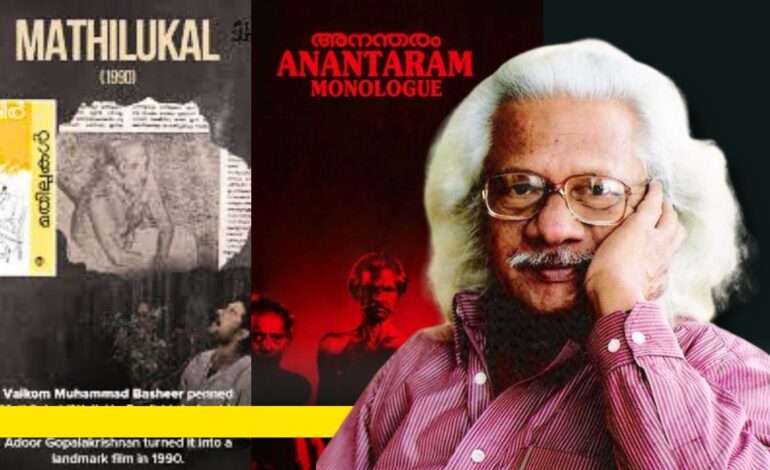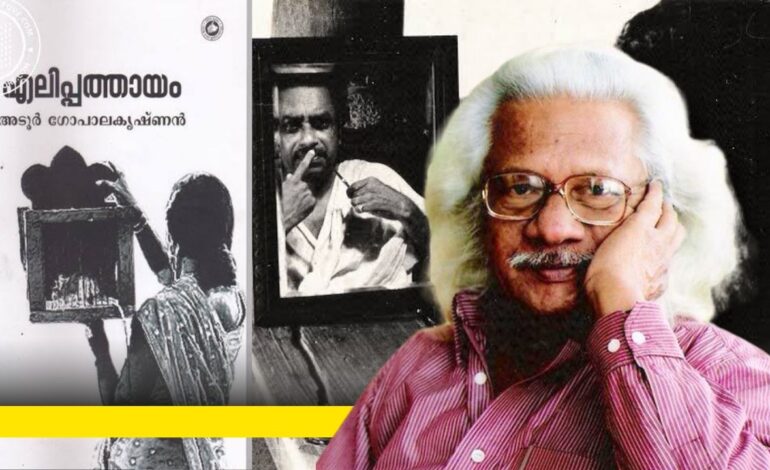
In this second installment of Professor V Vijayakumar’s essay on Adoor Gopalakrishnan, the author turns to the filmmaker’s gaze on Kerala’s entangled histories. Through Elippathayam and Mukhamukham, Adoor confronts the ghosts of feudalism and the failures of political movements, using silence, passivity and metaphor to question the futures promised—and abandoned—by social change.
The term Elipathayam evokes immediate imagery of an empty rice storage area. Rats scurry through it. It is a picture of pathetic degradation. The word elipathayam connotes decay and decay. Adoor translates the title of his film into English as “Rat Trap”. Rats appear as characters in the film. There are also scenes of trapping and drowning them in water. However, at its core, the film narrates the story of human lives ensnared in a metaphorical trap, with some managing to escape by absconding and at the mercy of others. Unnikunj cannot escape. Unnikunj, the central character, finds himself deeply ensnared in this metaphorical trap, immobilized and inert. He is stuck in a state of inaction, unable to stand, move, or engage in any meaningful work. He who looks at a cow eating coconut sapling and does not get up from his armchair and points out that it is a cow is a form of inertia. The same thing is told in an alternative way by the image of the man who halts his journey to attend a wedding because he is too hesitant to tread water. All good moments are alien to him. Unnikunj represents the feudalistic societal structure, a system characterized by stagnant social classes that hinder progress and emancipation. This system should be portrayed negatively, illustrating its ineffectiveness and lack of encouragement for motion. Now, its tooth has also fallen out. The great features of the system of power cannot be brought out. It has reached the decadent states of illusory pride and indolence.

Nevertheless, these films offer insights that extend beyond depicting the decadence of feudal remnants. The release of Elipathayam in Kerala coincided with a historic moment when the success of anti-landlord struggles was affirmed. The film was not an attempt to revisit Kerala’s past and show the inertia of feudalism. It is noteworthy that the brutality of feudalism in its larger form cannot be found in this narrative and focuses only on some of its remnants. The political and cultural values of feudalism persisted in Kerala, even as it pretended to be liberated from the landlord system. Land reform did not result in the subalterns who worked the land inheriting it. Feudalistic values endured, restricting practices like love marriages, non-caste unions, non-ritual marriages, and even second marriages. Love marriage is unthinkable for those who consider second marriage as a matter of pride. Unnikunj feels resentful of Kesu uncle who comes with a marriage proposal for his sister, a second knot. He says that Kesuvammavan is insulting his family. Later, he is shocked to find a love letter from the younger sister’s textbook. The displaced value system did not move away, it remained there. Although Unnikunj’s house is presented as an isolated area, an apology for the past, we see that the later history of Kerala proves that it is not so. From the isolated roots, it spreads throughout the Kerala society. The film, in its nuanced portrayal, subtly uncovers the persistence of feudal values in the state’s cultural fabric. Initially concealed and surreptitious, these values gradually surfaced. Adoor’s work delves into concerns about whether Kerala might regress to past feudal value system. The film portrays these resurfacing values as superstitions emerging from the shadows, manifesting as irrationality, embodying detrimental religiosity, perpetuating the outcasts of human gods, indirectly reviving the caste system, and manifesting as laziness and inactivity.
Unnikunj’s state of inaction served as an alternative narrative depicting the inertia that had gripped Kerala society. The liberation from the landlord system did not act as a powerful catalyst for new social life, new relations of production or a new value system. As the initial momentum waned, remnants of feudalism began to reassert themselves and permeate various aspects of social life. The one who does not feel the need to stop the cow from eating the coconut saplings, the one who does not even try to get up from the chair to do so, the one who is afraid and hesitant to face the thieves who come to steal the coconuts at night, the one who shows signs of sterility…Unnikunj’s passivity and inertness can be found in other forms in the social fabric of Kerala life during this period. Unnikunj’s neglect to prevent the cow from eating the coconut saplings, on a surface level, symbolizes a disregard for agricultural practices. On a broader perspective, it indicates the decline of Kerala’s agricultural production system. The scene in which Kariva mapilla shows Rajamma the paddy sheaves and says that everything is chaff also illustrates this breakdown. “Don’t try to farm with workers anymore. First, there are no farm workers to be found, and if somehow they do come, it’s with laws and norms.” These words from Kariya Mapila, the steward of the Naduvazhi, reflect not only the decline of the agricultural sector but also the entrenched attitudes that later came to characterize Kerala society. The stewards of the state were transforming into a class driven by modern, nouveau-riche and middle-class aspirations. Among them, disdain for the agitations of the working class grew, while the workers themselves lost their reverence for the dignity of labor. Manual labor came to be regarded as demeaning, and laziness and inertia spread as ways to avoid labor. The gap between Kariya Mapila’s words and these trends was minimal.

By the 1970s, Kerala presented a grim picture: the primary and secondary production sectors were not just stagnating but suffering significant recession and collapse. Meanwhile, the service sector had yet to visibly emerge. The struggle against Kerala’s feudal system was undermined by the undemocratic rebellion of 1959, diluting all the outcomes of anti-feudal movements. Consequently, the ideals of these struggles permeated society in a distorted form, influencing people’s mindsets. These historical undercurrents seem to have profoundly shaped the subconscious of Adoor, the filmmaker. His films resonate deeply with Kerala’s historical trajectory, reflecting its societal transformations and struggles.
The film opens with a series of shots depicting feudal symbols: a hanging lamp, a Chinese vase, a Sapramancha kattil (a traditional seat), a nalukettu (a traditional Kerala house) and so on. These scenes are punctuated by Unnikunju’s cry, “Did a rat bite me?”. As the narrative shifts to him chasing a rat and inspecting the bite mark, Sridevi prepares a rat trap, tying it with a piece of coconut, with Rajamma helping her while observing with some curiosity. The question arises: Is Sridevi preparing the trap for the rat Unnikunju is afraid of, or is it for Unnikunju himself? This duality suggests a larger metaphor: Are Rajamma and Sridevi trapped in a situation as well? As the plot unfolds, Unnikunj’s world begins to unravel. His routines are disrupted—he no longer receives coffee in the morning, the water for bathing is not prepared, and he chews stones in meals, he does not get cumin water to drink with meals. His authority is questioned by his eldest sibling, who demands her share. The silent brother is asked to speak up. The descent into chaos is further emphasized when a passerby questions Unnikunju, “Pffa, light from your torch on my face,” underscoring the collapse of his once-powerful world. The progression from Unnikunju running to catch the mouse to the final scene of him being caught and thrown into the pond mirrors his descent into helplessness. The act of drowning the rats in the trap is echoed in the final scenes, where Unnikunju himself becomes the trapped figure. These scenes critique the inaction that has gripped Kerala’s collective consciousness. Does Adoor view his protagonist with compassion? This question invites reflection on whether we should approach the inertia that has taken root in the minds of the Kerala people with the same compassion. Adoor, in his film, illuminates crucial moments in Kerala’s history, using Unnikunju’s story to convey these themes. The precision and dispassion with which Adoor addresses this issue suggest that, like a historian, he is both empathetic and objective in his portrayal of Kerala’s societal decline.
Adoor’s fourth film offers an excellent treatment of the Kerala Society, its movements. There were massive uproars and protests surrounding Mukhamukham, (Face to Face) with allegations that the film was promoting anti-communism. P. Govind Pillai criticized Adoor for presenting significant errors and anti-historical elements. Yet, there were also opposing views, with some abroad interpreting the film as pro-communist. Others saw it as the story of one person’s failure. Despite these objections, we must view Adoor’s cinematic concept as a profound narrative that investigates the fate of the movements in recent Kerala history. This was one of the director’s great endeavors. Adoor was chronicling different chapters of Kerala’s history through his films. He examined the lethargy and inertia that had taken hold of Kerala society, with a focus on what happened to the once-vibrant movements of the past. This inquiry into the fate of our great movements was central to Adoor’s project, and it should be treated with the utmost seriousness. This exploration could only have been done by focusing on the communist movement in Kerala, which Adoor accomplished through Mukhamukham. In the character of Sridharan, Adoor depicted the life of movements that had become estranged from the people—the one who run away, the one who always sleeps, the one who drinks until he faints. Through this, Adoor illustrated how the communist movement had distanced itself from the masses. This is the direct lesson of the film. To ignore this and offer alternative interpretations is to dismiss the responsible effort that Adoor made at a crucial moment in Kerala’s history. The lessons of Mukhamukham were not part of hostile criticism, but rather an urgent reflection of decline. In times of societal decline, who are our real enemies? They are those who refuse to acknowledge the decline. Recognizing that we are in a state of decline is the first step toward addressing it. Adoor’s fourth film succeeds in this task, offering a powerful commentary on the state of Kerala’s movements and the inertia that had set in.

The ‘liberation struggle’ in Kerala created a divide in its recent history, distinguishing it into pre-1959 and post-1959 periods. This struggle tainted the political sphere by introducing caste and religious influences. Post-struggle, the Left in Kerala, once focused on liberation, began to suppress its aspirations. Not only the communist movement but all social and political movements that once aimed at uniting Kerala had declined. Leadership in renaissance movements, inspired by figures like Narayana Guru and V.T., was taken over by elite groups from the 1959 anti – democratic agitation. Under their dominance, renaissance movements degenerated into caste and religious-based entities, losing their democratic and transformative values. The anti-democratic agitation itself overturned the democratic atmosphere that had begun to shape Malayali public life, introducing communal tendencies. Political parties and pressure groups, led by caste and religious forces, took control of key areas like education and culture. In 1959, following agitation from the communal forces, the communists were ousted from power in 1967 with their support. This rapid regression of the progressive movement in less than a decade highlights its decline. Adoor Gopalakrishnan’s failure to address the Congress movement’s decline, caste atrocities, and the degeneration of progressive movements in his films raises questions about his artistic choices. It seems that the decline of once-hopeful movements might be a central concern for creative intellectuals. In portraying Kerala’s history, the communist movement should be central, given its pivotal role in shaping the state’s trajectory.
Adoor refrained from directly chronicling the decaying era’s history. Instead, he employed symbolism. Comrade Sreedharan in Mukhamukham embodied the communist movement itself. Sreedharan, who aligns with and defends the working class, represents the movement grounded in solidarity. When Sreedharan retreats, he mirrors the withdrawal of that movement from its base, a retreating force. His persistent sleep signifies the movement’s drift into stupor, indifferent to public suffering. His visible agony mirrors the affliction of the movement’s deteriorating ideology. His drunken stupor, his surrender to intoxicating delusion, reflects a movement chasing hollow gratifications -fragile and susceptible to annihilation. The alienation of Kerala’s leftist ideology stems from its infatuation with violence. Violence is what drove Sreedharan underground.
Adoor repeatedly illustrated passivity through metaphor across his films. Recall Unnikunju’s lethargy in Elipathayam – he slumbers undisturbed even as burglars loot and crops vanish. Even the auditory stir of harvest doesn’t rouse him. Not even the vibrant rhythm of toil stirs him. Kariyamapilla remarks to Rajamma: “Does Unnikunju not wake? I thought such noise might rouse him.” Rajamma replies, “Kochattan has his moment, whatever happens, he’ll rise only then.” Yet, Sreedharan’s somnolence differs – it is unbroken, persistent even in motion. This unyielding Kumbhakarna-like slumber serves as a fitting symbol of the movement’s debilitating decline.

Sreedharan’s alcohol addiction drew severe disapproval. A companion remarked that he might have excused Adoor had he omitted those scenes. Through this perpetually intoxicated comrade, Adoor projected a movement entrapped in deceptive euphoria. Adoor’s creative force, guided by Marxist critique of spiritual dogma; creative hearts are moving through the Marxist methodology that captured them sometimes even unconsciously, found resonance in Marx’s assertion that religion is the people’s opium – promising illusion in place of remedy. The religious devotee, like the addict, seeks fleeting escape rather than enduring transformation. By rendering Sreedharan an inebriate, Adoor portrayed a movement seeking mirage-like reprieves. This interpretation reveals broader insights. The religious ideal demands strict adherence to immutable truth – a doctrine that resists renovation. Yet, an unchanging condition is one of paralysis. Thus, religiosity aligns with stagnation. To embrace sacred values is to accept dormancy.

In Mukhamukham, Adoor delivered a stark lesson: a movement consumed by illusions degenerates into a rigid state, unable to evolve. From this work, we must extract the daring vision of a master anguished by Kerala’s growing inertia. By the film’s conclusion, Sreedharan is eliminated. Who remains? The movement survives in Damodaran’s leadership, contractor Mathukutty, Sudhakaran’s expulsion, and Sreeni’s despair over his alcoholic father. These figures carried forward the legacy. They shaped the contours of post-Sreedharan Kerala. What unfolded thereafter?
Part Three: Lives Within Walls: The Personal and the Political follows tomorrow.
To read the other blogposts in the ‘Adoor- The Maestro’, click here.