


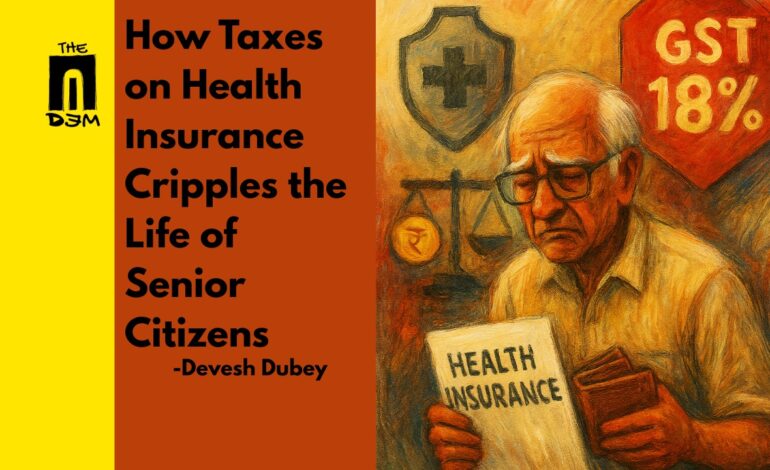
India’s elderly are walking a financial tightrope—battling age, illness, and indifference. At a stage where healthcare is a lifeline, the state slaps an 18% GST on health insurance, treating a survival need like a luxury.
The injustice cuts deeper when constitutional promises of welfare and dignity are rendered hollow. As policymakers dither and costs soar, seniors are forced to choose between treatment and affordability. Confronting the realities in this article, Devesh Dubey calls out the contradiction, demands urgent reform, and insists that eldercare be treated not as charity or commerce, but as a right grounded in justice and policy.
Senior citizens face mounting health risks and rising medical expenses, often while living on fixed pensions or dwindling savings. Yet the Indian tax system imposes an 18% GST on health insurance premiums, the same rate levied on luxury goods and entertainment. This aggravates the significant financial burden on healthcare for senior citizens. This often blocks access to essential healthcare altogether, further eroding their quality of life.
Such taxation is financially regressive and misaligned with the broader goals of public welfare and social equity. It affects those who are least equipped to absorb additional costs, especially at a time in life when consistent access to healthcare is most critical. The issue now calls for urgent policy correction.
This is no longer a policy oversight, it is a failure demanding immediate redress.
A Tax on Health Insurance for the Elderly
India’s elderly population, many of whom rely on fixed pensions or limited savings, already face challenges in accessing affordable healthcare. The imposition of an 18% GST on health insurance premiums further compounds this burden.
Health insurance for a 65-year-old individual is not a discretionary expense; it is a necessary financial safeguard. Yet current tax laws continue to treat it as a non-essential service, taxed at par with frills, not necessities.
This raises questions not only about policy alignment but also about ethical considerations.
Constitutional and Policy Frameworks
The Right to Health has been interpreted by the Supreme Court as part of Article 21 of the Constitution. Additionally, Articles 41 and 47 under the Directive Principles of State Policy call upon the State to ensure public health and welfare for the elderly.
Against this backdrop, taxing senior citizens’ health insurance at 18% defies both constitutional intent and policy commitments.
The GST Council has previously revised tax rates across various sectors. It has reduced GST on sanitary products, mobility aids, and even on items such as fast food. However, the tax on health insurance for the elderly remains unchanged, despite its social relevance and necessity.

A Delayed Policy Response
The issue has echoed across platforms, with advocacy groups and policy bodies urging the Finance Ministry and GST Council to act. Parliamentary panels have weighed in, and policy recommendations have been submitted.
Notably, in July 2024, Union Minister Nitin Gadkari formally requested the withdrawal of the 18% GST on life and health insurance premiums for senior citizens in a letter to Finance Minister Nirmala Sitharaman. More than a year later, the silence from the Centre remains deafening.
As time passes, more elderly citizens are left with difficult choices, some forgoing insurance altogether, while others compromise on necessary medical treatment due to affordability concerns.
Recommendations
To align with constitutional and ethical obligations, the following steps are recommended:
- Reduce GST on senior citizen health insurance premiums from 18% to a lower range of 0–5%.
- Classify senior health insurance plans as essential health services.
- Provide subsidized or GST-exempt insurance options for low-income elderly individuals.
An earlier recommendation by a Group of Ministers (GoM) proposed limiting GST relief to insurance policies with annual coverage of up to ₹5 lakh. Though well-intentioned, this cap no longer reflects today’s healthcare economics.
Soaring costs of hospitalisation, chronic care, and post-acute treatment render ₹5 lakh grossly insufficient for most middle-class seniors—especially those with chronic or complex conditions.
To ensure meaningful reform, this coverage cap should be revised to at least ₹8 lakh per year. Addressing inflation-adjusted healthcare needs is essential for making any GST relief both effective and equitable.
These proposals are modest and grounded in practical and legal rationale.
A Matter of Rights
This is more than a fiscal reform. It is a chance for the government to reaffirm its commitment to equity, justice, and care values that define a healthy democracy.
The Centre must stop treating eldercare as a budgetary afterthought and start recognizing it as a constitutional imperative.
The time to act is not tomorrow. The time is now.









Mr.Gadkari too sent his request letter to FM, an year ago…but no improvement in our Government stand…