
The ‘Precedented’ Killing of Journalists in Gaza

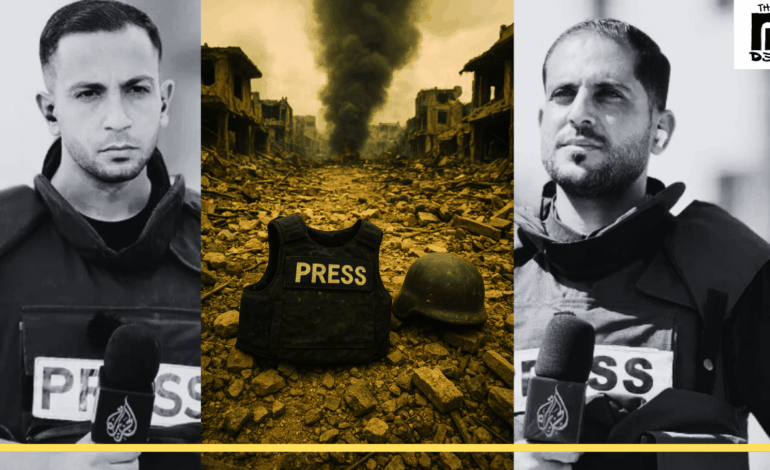
Anas Al-Sharif became the face of the war in Gaza for millions. Then Israel killed him.
“The truth has died and the coverage has ended,” Palestinian journalist Wadi Abu al-Saud said, recalling the drone attack on a tent located outside the main gate of Gaza City’s al-Shifa Hospital, which killed Anas Al-Sharif alongside Al Jazeera correspondent Mohammed Qreiqeh, camera operators Ibrahim Zaher, Mohammed Noufal, and Moamen Aliwa, and freelance reporter Mohammed al-Khaldi.
Anas Jamal Mahmoud Al-Sharif was born on December 3, 1996, in the Jabalia refugee camp, a densely populated and impoverished area in the northern Gaza Strip. His parents were refugees, displaced from the city of Al-Majdal—known today as the Israeli city of Ashkelon—during the 1948 Palestinian expulsion. He grew up in the alleys and streets of Jabalia, amidst the political and economic realities of the Israeli occupation and blockade. He graduated from Al-Aqsa University in Gaza with a bachelor’s degree in mass communication, where he specialized in radio and television. His professional journey began with volunteer work at the Al-Shamal Media Network before he joined Al Jazeera Arabic, where he rose to become one of the most prominent and recognizable correspondents covering northern Gaza. His story is a powerful counter-narrative to the dehumanizing rhetoric often applied to Gazans; he was a product of his homeland’s institutions, a young man who sought to build a professional life and give voice to his community against a backdrop of continuous conflict.

Since the conflict began on October 7, 2023, Al-Sharif became one of the most visible faces reporting from north Gaza. Despite repeated Israeli orders and direct threats to his life, he and his family refused to leave. He covered Gaza through airstrikes, massacres, and displacement, often working under extreme danger and chronic shortages of basic supplies. He was also part of a Reuters photography team that was awarded the prestigious Pulitzer Prize for Breaking News Photography. The Pulitzer board commended their work for its “raw and urgent” documentation of the Gaza war.
According to the Committee to Protect Journalists (CPJ), Al-Sharif had received multiple phone calls from Israeli military officers in November 2023, instructing him to cease coverage and leave northern Gaza. Less than three weeks after he was called by the Israeli army, his family home in the Jabalia refugee camp was bombed, killing his 90-year-old father, Jamal al-Sharif. Al-Sharif had been doing nonstop coverage and had not been home in 60 days.
While brutal killing of Anas and his colleagues is a shock to many, analysis from Brown University’s Watson Institute for International and Public Affairs cites that the war in Gaza has, in less than two years, killed more journalists than the U.S. Civil War, World War I, World War II, the Korean War, the Vietnam War (including related conflicts in Cambodia and Laos), the wars in Yugoslavia, and the post-9/11 war in Afghanistan combined.
What was shocking to keen observers was the urgency from the IDF to claim credit for this massacre. IDF international spokesman Lt. Colonel Nadav Shoshani, straining verisimilitude, claimed that intelligence obtained prior to the strike proved that “Sharif was an active Hamas military wing operative at the time of his elimination.” This is a dangerous pattern similar to several hospital bombings at the start of this genocidal campaign, which were initially denied by Israel, later branding even maternity wards as ‘Hamas Command and Control Centres’ and ultimately boasting about leveling them to the ground.

Northern Gaza bore a huge brunt of the carnage in Gaza, with intense, gapless bomb attacks and a total aid blockade, much before the entire strip was left to starve. Al-Sharif was the loudest voice from that part, and reports now say only a total of 30 journalists are left in Northern Gaza. This attempt to censor the news can be read alongside the recent Israeli security cabinet decision to occupy all of Gaza City, which will give the occupation total control of the narrative amidst major international pressure, including the commitments made by several Western countries to recognize the State of Palestine.