
In Which Arundhati Does Not Give Us Those Ones

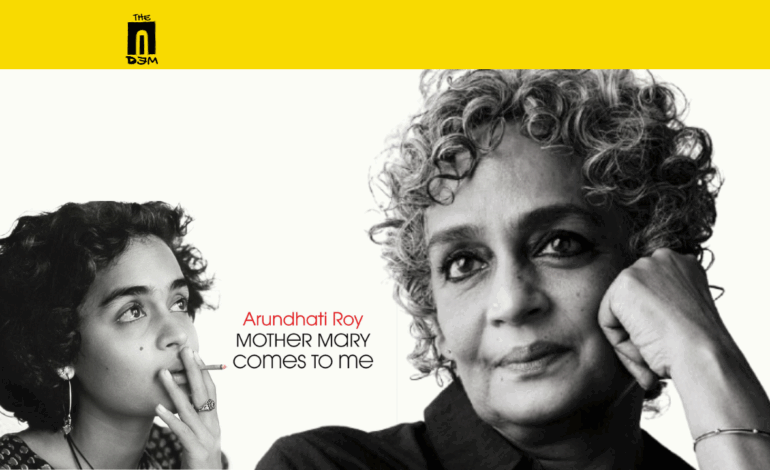
Thursday the 28th of August is when I needed a Mother Mary–like visitation. Big things had come crashing down on my head and I needed an Estha-Rahel-Arundhati-esque rescue. The new book has a bewitching cover. Young Arundhati Roy, a spliff in hand, her dark eyes mocking the world – eff you too, I dare you. The back cover, Arundhati now, tempered, her eyes still asking all of us to enter that infernal world of hers. When was the last time her book launch caused that strange stirring in the pit of the stomach? The Doctor and the Saint came close, the Afzal Guru essay was a punch in the gut. But not since the blue Plymouth drove down the dusty road in Ayemenem in The God of Small Things has there been this kind of palpable, collective, worldwide — or at least countrywide — anticipatory gasp.
I needed to disappear into the new book. The Amazon online delivery wasn’t giving me the required redemption: Your order has been dispatched. It will be delivered by the 5th of September. I would be dead by then. An entire day went by. It was the 29th morning. I was at the veterinary hospital with a sick dog. I needed the book NOW. It was calling out to me in a strange feral way. I called the bookshop close by.
“Do you have the book?”
“Yes we do,” came the prompt reply.
I sent the taxi waiting outside the clinic to get a copy while Golu and I waited for the results of his blood test. The book arrived while we were in the fancy clinic lobby. Golu sniffed the package conspiratorially and, seeing that it wasn’t edible, lay at my feet, drifting into an afternoon, post-vaccine stupor.

“Perhaps what I am about to write is a betrayal of my younger self by the person I have become. If so, it’s no small sin. But I’m in no position to be the judge of that.” Witchcraft and wizardry. Arundhati Roy’s scalpel-like gorging out of flesh is what I, an ardent fan — and you, perhaps — go to her pages for.
My heart was racing at double-triple speed as Arundhati tells the story of Mary Roy running out of a bad marriage with Arundhati aged 3 and her brother LKC aged four and a half. Running from Assam to Calcutta to Ooty, to stay “as interlopers” in one half of her grandfather’s cottage until they were booted out of there as well.
The Mary Roy who was a famous feminist also leaps out from the pages, twenty feet tall, as a demonic, savage non-mother – perpetually throwing Arundhati and her brother out. Throwing plates and cups and saucers and making Arundhati and LKC run, run, run till they disappeared from her life and each other’s lives for a decade.
The mother-daughter feminist duo in a vice-like grip is taut and tense — an unputdownable, searing story that makes your throat dry; you forget to swallow.
“I feigned sleep the night she came and woke my brother up and took him – little-boy sleepwalking – to her room. I followed as quietly as I could and watched through the keyhole as she beat him until the thick wooden ruler broke. ‘No son of mine comes home with a report that says “average student.”’ She raged at him without raising her voice above a whisper…The whispering made the whole thing even more terrifying. My brother didn’t react…In the morning, she hugged me and said, ‘You have a brilliant report.’ I was filled with shame…On the occasions when I am toasted or applauded, I always feel that someone else, someone quiet, is being beaten in the other room. If you pause to think about it, it’s true, someone is.”

We cross over quickly to Arundhati the fugitive, who dissolves her pain in the anonymity of New Delhi of the 1970s. She “follows her groin” and takes up with an Adonis-like man, her architecture college senior she fondly calls Jesus Christ – JC. But anything that begins to feel safe is something she eventually needs to run from. And we run with her into Arundhati’s life as a film writer and producer and companion to the filmmaker Pradip.
But after this section reaches roughly the mid-point of the book, past the deliverance of that fabulously fun satirical film some of us know as In Which Annie Gives Them Those Ones, something happens to the storytelling. It starts to feel a little bit like travelling through what we all mostly know – a re-stitching of The God of Small Things, the Booker, The Algebra of Infinite Justice, the Seditious Heart, the writings on India’s nuclear deal, the Narmada dam, Kashmir, Dantewada. The mother-daughter twist in the gut, the small girl who has to grow up very quickly, gets lost — and ARUNDHATI THE FAMOUS WRITER starts to take over.

What was so bewitching about Arundhati’s writing in The God of Small Things, for a fan like me, was how she found a sub-language that was as much about her as it was about each of us. It was universal and particular. It was intimate and scalding. It told the West and the white people to fuck off in a way her predecessors writing in English – Amitav Ghosh, Vikram Seth, Salman Rushdie, all Westward-seeking, still proceeding – didn’t do. While Amitav Ghosh was still describing idlis as Indian pancakes, Arundhati firmly and plainly made her writing for us, sans explainers. It was for us Easterners to tell the West, you need to sit here and see things our way.
From the second half of the book, however, I felt like I was losing that Arundhati to a new, westward-facing avatar. This is Arundhati telling the West about Kashmir and Modi and the Narmada dam. The information filling in the chapters chronologically, keeping pace with her life, was too basic. The Kashmir chapter was almost completely devoid of an emotional register, except as long, overarching, over-the-top emotional outpourings.
“I was troubled by even the most casual conversations I had with people in Kashmir…I could see cold anger and resentment being bottled up by people like money is banked in a capitalist economy.”
There are broad strokes but no in-line sketching of details, of descriptions, of stories to make you feel what people in Kashmir have bottled up. What we get instead is cold, far away, and too sketchy to, in turn, make us the readers feel alongside.
Plus, for the first time ever in Arundhati’s writing, I was upset to see a big factual error. It’s in the chapter on Phoolan Devi, that she calls “The Great Indian Rape Trick.” In this chapter she tells us how she had a violent reaction to the film Bandit Queen for its voyeuristic rape scenes and mostly for the lack of agency the filmmaker gave Phoolan Devi, on whom the film is based. The error is that she describes Phoolan Devi as Dalit, when in fact she was from the Other Backward Class group, or OBC caste.
This is significant because Arundhati met Phoolan Devi and talks about caste throughout the book. A slip like this made me feel suddenly like I’d stepped from a big, wild, wonderful jungle into quicksand. The intimate, angry, politically savvy and gutsy Arundhati disappears into another kind of Arundhati. The world-facing, politically correct Arundhati who is constantly telling instead of showing us what is what.
She takes us through the 1984 anti-Sikh riots while telling us that at the time, she wasn’t wearing her political hat, she wasn’t involved with the blood and gore unfolding on the streets of Delhi. Which is fine, but then why take us, the readers, through it, in that case? Similarly, when she encounters people from the Dalit caste in her childhood, the outward-facing, self-conscious Arundhati feels the need to step into the scene and tell the reader she didn’t know what caste was what at the time. Which is also perfectly fine, but begs the question — why wrap the scene with these qualifiers? Why does Arundhati need to tell the world, “when I grew up, this was happening in the country and world,” unless it segues naturally into her story?
And then, the book returns to Mary. Her mother was sick and dying. And the storytelling is back to its brutal, bruising, vulnerable beauty.

“We were all worn to the bone because we had to be at her beck and call, attending to her endless requests – put on the fan, put it off, draw the curtains, open them, take off my socks, put them back, change my diaper, change it again…One night I was woken up and summoned to her room. She was lying in bed with her eyes open. She barely acknowledged me. She didn’t need anything, she just wanted me to stand around. I felt I was on the verge of a breakdown myself. Suddenly she said in an unnaturally loud voice, ‘Tell those Parayas to come in here and clean me…’ Without realising what I was doing, I picked up the chair near her bed and smashed it down…It was the first and only time in all my life with my mother that I had reacted spontaneously.”
I could have finished the book in four or five hours flat if I didn’t need to intersperse it with belly rubs for a recovering dog. Even if I did find myself a little less mesmerised in the middle, the sum of it all was to make my other troubles evaporate. It may not have given me “those ones” as The God of Small Things did. But it is still searingly, unflinchingly, boldly Arundhati. You cannot escape its vice-like grip.