


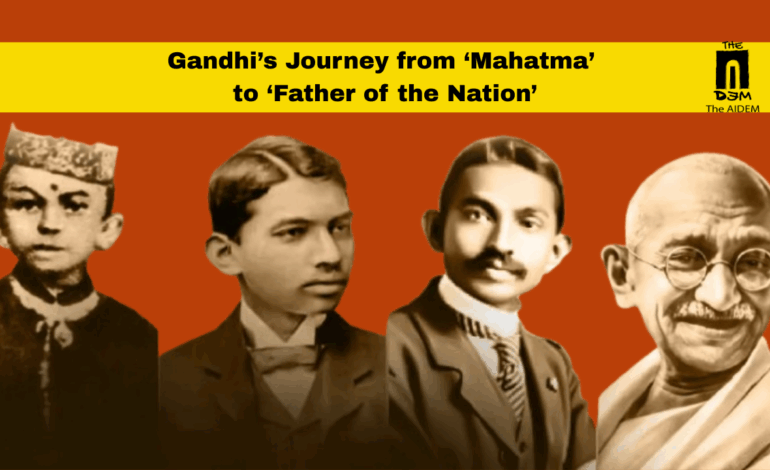
Every Gandhi Jayanti, the world recalls his creed of truth and non-violence. Yet, beyond these familiar ideals lies a Gandhi often overlooked—the thinker who envisioned self-reliant villages, sustainable living, and development rooted in moral responsibility. He spun the charkha not just as resistance but as a blueprint for economic justice. He walked miles not only for freedom but to insist that progress must serve the poorest first. In revisiting his life, we uncover a man who challenged modernity’s excesses and offered a vision startlingly relevant to our climate crisis and fractured societies. This article series traces that deeper Gandhi – how a barrister became Mahatma, how a guide became Bapu, and ultimately, how he came to be remembered as the Father of the Nation.
In 2025, as India commemorates the 156th anniversary of Mohandas Karamchand Gandhi’s birth, we honor the man affectionately known as the ‘Father of the Nation’. The phrase is not a statutory conferment but a moral inscription—an affective honor engraved in the memories of millions whose lives his politics and ethics reshaped. Gandhi’s journey from being hailed as Mahatma to being cherished as Bapu and finally remembered as ‘Rashtrapita’, meaning ‘Father of the Nation’, reveals as much about the evolution of his public persona as it does about India’s emergence from colonial subjecthood to sovereign polity.

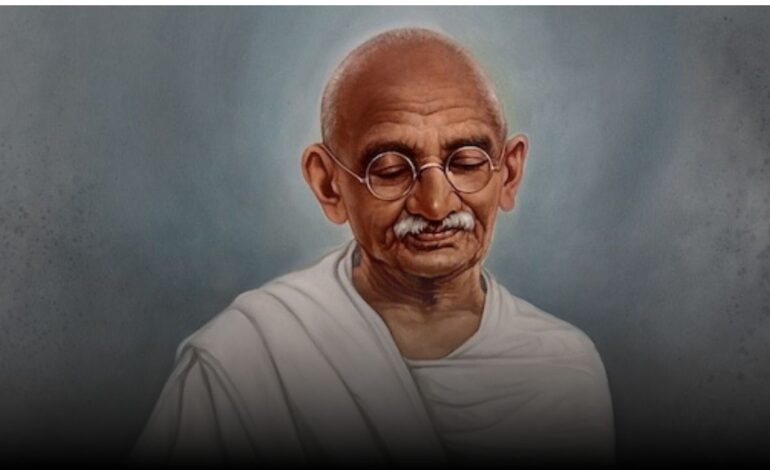
When Gandhi returned to India on January 9, 1915, after his work in South Africa, he wasn’t yet the figure we know today. He took the advice of his mentor, Gopal Krishna Gokhale, to travel across the country, riding in third-class train carriages to witness firsthand the struggles of its people. That itinerary exposed him to India’s material suffering and provided the experiential basis for a moral narrative that would remould his public identity. Before long, Mohandas Karamchand Gandhi transcended the private sphere of a law practitioner and activist. He became Mahatma, Bapu, and finally, the Father of the Nation. Each of these titles had a different origin and resonance, together revealing the layered ways in which India, and the world, perceived him.
The first major title Gandhi received was Mahatma, or “Great Soul,” popularized by poet-philosopher Rabindranath Tagore, though its earliest use remains debated. Tagore, who himself would later be called Gurudev, began publicly referring to Gandhi as Mahatma in his writings after Gandhi’s return to India. Historian Ramachandra Guha notes that while the exact first usage is contested, “Tagore’s authority and Gandhi’s growing stature ensured that the title Mahatma stuck.”
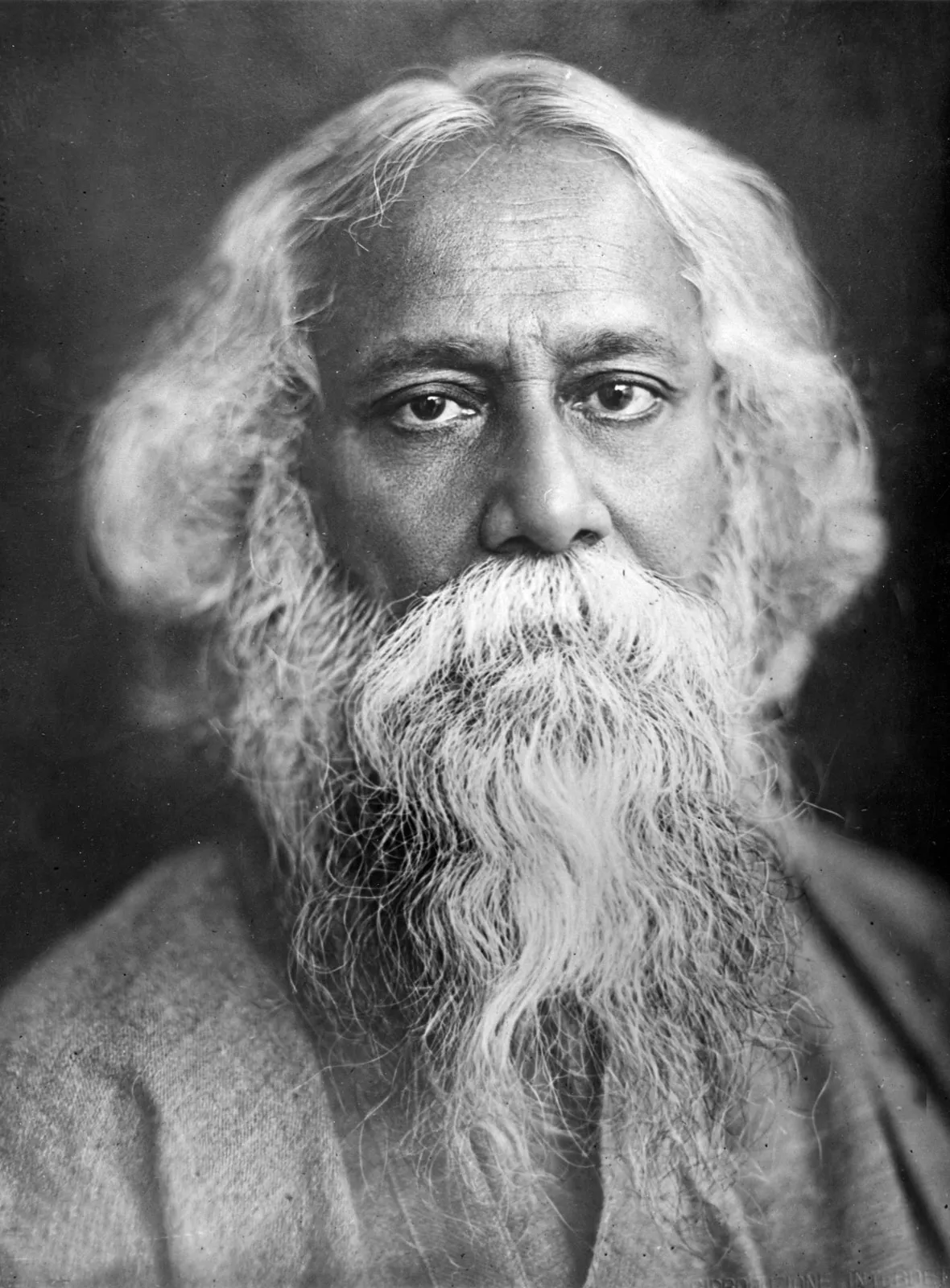
Gandhi never felt at ease with the title. In 1920, he wrote in Young India, “I do not feel I deserve the great title of Mahatma. I am but a humble seeker.” Nevertheless, the nation and the world saw him not just as a politician but as a moral teacher, and Mahatma became his most enduring spiritual title.
If Mahatma was spiritual, Bapu was personal. In many Indian languages, Bapu simply means “father.” Gandhi’s close associates and followers began using it in the 1920s, and it eventually became his most common form of address.
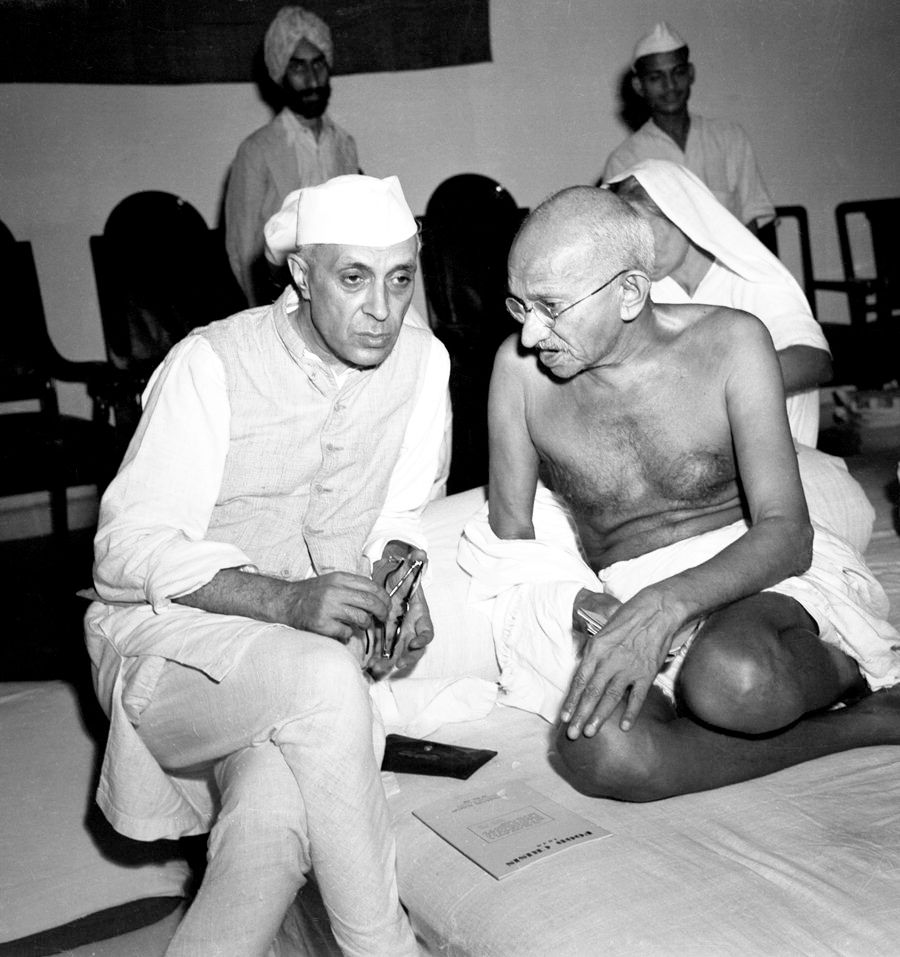
The correspondence between Gandhi and Jawaharlal Nehru offers a clear example of this shift. In the early 1920s, Nehru addressed Gandhi as “Sir” in his letters. But by the mid-1930s, his salutations changed to “My dear Bapuji” or simply “Bapu.”
Nehru’s letters revealed a deep, affectionate bond. In a 1930 jail letter during the Civil Disobedience Movement, Nehru confided, “Bapu, we all feel that you are leading us as only a father can lead his children… your suffering is ours, and your courage gives us strength.” This demonstrates how Gandhi was seen not only as a leader but as a father figure, someone whose simplicity and sacrifice provided both guidance and strength to millions of ordinary Indians.
The transition from Bapu to Father of the Nation was a gradual process marked by a few pivotal public moments.
The first widely noted use came on July 6, 1944, when Subhas Chandra Bose, speaking on Azad Hind Radio in Rangoon, addressed Gandhi as “Mahatmaji, Father of our Nation,” seeking his blessings for India’s freedom struggle. His words fused moral and paternal images, bridging political divides and showing how deeply Gandhi’s role had become ingrained in the national psyche.
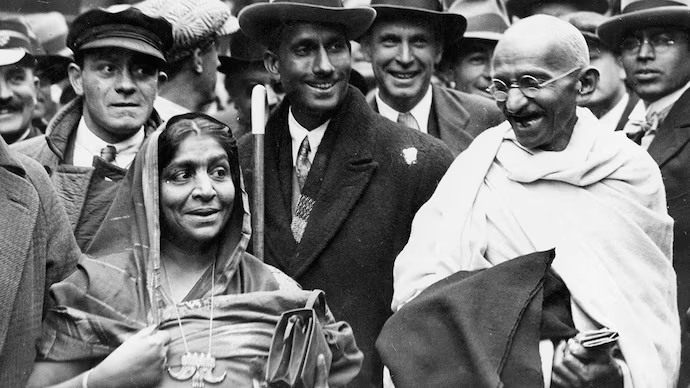
The next milestone came in March 1947, when Sarojini Naidu, a poet and Gandhi’s close associate, introduced him at the Asian Relations Conference in New Delhi as the “Father of the Nation.” By giving a formal voice to what millions already believed, Naidu’s words resonated on an international stage.
The title became irrevocably etched in the nation’s memory on January 30, 1948, the day Gandhi was assassinated. That evening, Prime Minister Jawaharlal Nehru addressed the nation on the radio with the now-immortal words: “The light has gone out of our lives and there is darkness everywhere. Our beloved leader, Bapu, as we called him, the Father of the Nation, is no more.”
Yet despite this reverence, the Indian government has never officially conferred the title “Father of the Nation.” In 2012, a Class 6 student, Aishwarya Parashar, asked the government if Gandhi had ever been officially declared the Father of the Nation. After a search, the National Archives replied that no such official record existed. In 2020, the Ministry of Culture provided a more definitive response, stating that “no law or ordinance has ever been passed in this regard.”
The legal explanation lies in Article 18(1) of the Indian Constitution, which prohibits the state from conferring titles except for military and academic distinctions. And yet, outside the realm of law, Gandhi’s fatherhood of the nation has never been in doubt. The Supreme Court of India itself observed in a 2020 hearing that “Mahatma Gandhi is the Father of the Nation and people hold him in high esteem, beyond any formal recognition.”
Gandhi’s journey from “Mahatma” to “Bapu” to “Father of the Nation” was not scripted by legal proclamation but by the moral consensus of a people. He earned his title not by decree but by the lived experiences of those who followed him. The man who once wrote, “I do not feel I deserve the great title of Mahatma,” ended up being remembered as both the Great Soul and the Father who gave a nation its freedom.







Oh Gosh. We never thought of this.