

‘Electoral Democracy’s Survival Dependent on Civil Society Movements’
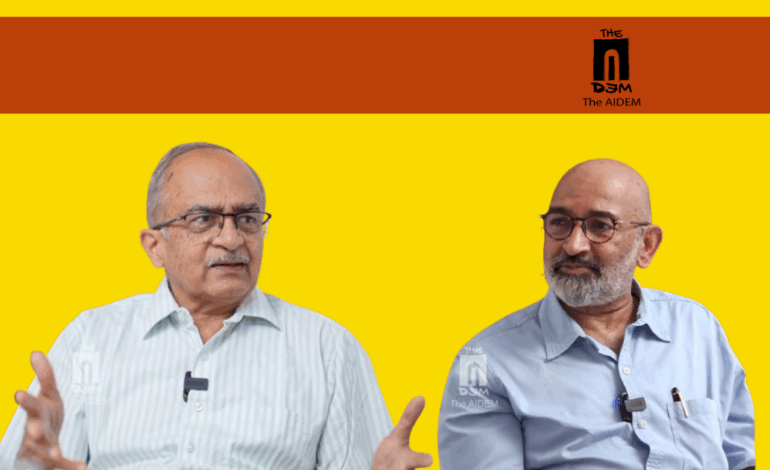
Prashant Bhushan in conversation with Venkitesh Ramakrishnan , Managing Editor , The AIDEM
Venkitesh Ramakrishnan :
Hello and welcome to The AIDEM Interactions once again. We have with us today the one and only Prashant Bhushan. Prashant, as I was mentioning earlier( before recording this interview) , we had published one of your speeches about a year and a half ago — just around the time of the 2024 elections. At that time, there seemed to be a rejuvenation of the democratic spirit in the country. There was a systematic fight against the authoritarian tendencies at the Centre. But now, as we near the end of 2025, where do you think those hopes stand? How do you view the situation today?
Prashant Bhushan:
That rejuvenation before the 2024 elections did result in the BJP losing its majority in Parliament. However, despite losing their majority, their power and ability to act unchecked remain virtually undiminished because their two supporting parties continue to back them unconditionally. As a result, the BJP has doubled down on state repression, curbing free speech, and suppressing movements—such as those currently unfolding in Ladakh.
Unfortunately, while there is widespread discontent in the country and public opinion, in my view, has turned against the BJP, we still don’t see any concrete, ground-level mass movement against the regime or for reclaiming democratic values. It’s a difficult situation, though we are beginning to see some signs of youth-led mobilizations, such as those protesting against paper leaks and other irregularities, as well as movements like the Vote Chori campaign.
I believe that two major national movements are urgently needed today. First, a movement to reclaim democracy, especially considering the Election Commission’s complete capture by the BJP and its dishonest, non-transparent conduct, which puts the entire electoral system in peril. Second, a nationwide movement on unemployment, which is already a grave issue and will worsen with the advent of artificial intelligence. The potential for both these movements exists.
VR:
What we lack are the leaders to spearhead them. And that, I think, is the biggest question right now.
Coming to the specific issue of the Vote Chori campaign you mentioned — I’ve been speaking to people across the country, especially in North Indian states. Bihar has already seen significant developments, and the process seems to have started in Uttar Pradesh, Haryana, Delhi, and elsewhere. But one point that both BJP leaders and independent observers often raise is that, unless the opposition has people on the ground — booth-level agents who can verify whose votes have been deleted or which fictitious names have been added — it’s impossible to counter this manipulation. How do you see this challenge, especially given your experience with earlier mass movements?
I grew up in the 1970s and vividly remember the movement between 1975 and 1977. There was no social media or television then, yet people communicated and built an extraordinary mass movement. So what is lacking within the opposition, according to you?
PB:
Unfortunately, Electoral politics in India has become heavily dominated by money. Very few parties have genuine volunteers anymore; most rely on paid workers. Since the BJP now controls the bulk of political funding, opposition parties are struggling even to pay their booth-level agents. Without such people on the ground, it’s impossible to conduct effective verification — especially since the Election Commission refuses to be transparent or follow its own rules and guidelines.
The manipulation of voter lists — adding bogus voters and deleting genuine ones — can only be prevented through vigilance. And this vigilance cannot depend solely on political parties. We need a civil society movement. The real stakeholders in democracy are the citizens whose votes are being tampered with. It’s their rights that are being stolen.
VR:
Rahul Gandhi has recently alleged that all of this voter manipulation is being done through a centralized server system. That adds an even greater dimension of danger because if it’s being done at a centralized level, how can people possibly track it on the ground?
PB:
Yes, and even in the case Rahul Gandhi highlighted, it was discovered purely by accident when a voter personally realized that their name had been deleted. The use of centralized digital systems by the Election Commission makes this problem much worse.
Today, the Election Commission’s entire system is digitized and centralized. They can easily issue instructions — for example, to add five lakh fictitious names or delete five lakh genuine voters — across constituencies. The rules clearly require every application for addition or deletion of a voter to be made public on the website. But the Commission isn’t doing that.
So, when new voter lists are suddenly published, citizens find that lakhs have been deleted or replaced. Moreover, the Commission has prohibited independent analysts from using computers to track and compare these additions or deletions. All this makes it possible to manipulate data from a central system, and the Election Commission has effectively become a total stooge of the BJP.
The only way to resist this is through a strong, vigilant civil society movement that insists on transparency and accountability.
VR:
You have dealt with several Election Commissions over the years — both as a lawyer and an activist. How would you rate the current Election Commission compared to its predecessors?
PB:
This is undoubtedly the worst Election Commission we’ve ever had. The institution has been steadily deteriorating through the Modi years. Until then, the Commission maintained a fair degree of independence.
But under the Modi government, there’s been a deliberate and systematic effort to subvert the autonomy of all constitutional institutions — the Election Commission being foremost among them. The judiciary, the media, the Comptroller and Auditor General (CAG), universities — every pillar of democracy has been compromised. The government has perfected a policy of controlling these institutions by appointing loyalists to key positions.
Today, vice-chancellors are appointed through RSS recommendations. The CAG and Election Commissioners are government nominees who act as stooges. Even in the judiciary, the government blocks the appointment of independent judges by simply not approving names recommended by the collegium. This is how institutional independence is being destroyed.
VR:
In this context, let me refer to what economist and social activist Parakala Prabhakar recently suggested. He argues that since all the institutions and pillars of governance have been compromised, the opposition should consider boycotting Parliament and resigning en masse. How do you view such a proposal?
PB:
Well, it is certainly worth considering, but whether that should be done or not, I feel, should depend upon the extent to which we find that the purity of the electoral process has been subverted. We already know that money power today reigns supreme in elections, and money is concentrated with the BJP. All instruments of propaganda are also with the BJP.
However, despite this, I find that public opinion is against them. That is largely because they have not yet completely managed to control social media or alternate media platforms. They do have mechanisms to influence them, but they haven’t succeeded to a large extent. So, by and large, social media, YouTube, etc., are still relatively free—and public opinion remains critical of them.
Now, despite all this, the outcome of elections will depend on the integrity of the electoral roll and whether people are actually allowed to vote. For example, in one of the by-elections in Uttar Pradesh, it was found—and established—that Muslims were simply not allowed to leave their houses and vote. There was a kind of police guard placed around Muslim villages to prevent voting.
If the opposition succeeds in preventing such large-scale tampering with the electoral roll and the prevention of people from voting, I feel that even in these conditions, the BJP is likely to lose. Of course, we don’t know to what extent EVMs might be manipulated in the future, though currently there is no major evidence of such manipulation.
So, I believe that the time to boycott elections would come only when we clearly see large-scale manipulation of electoral rolls and widespread prevention of voting. I don’t think right now is the time for that.
VR:
You’ve been talking about civil society movements. But if you look at the way many of these movements have been tackled by the government recently—the suppression of students protesting against exam paper leaks in eastern UP and Bihar, or what has happened to someone like Sonam Wangchuk—it seems that civil society is being crushed. Wangchuk, who is globally celebrated for his work in sustainable development, was branded “anti-national.” Given all this, how can civil society movements even hope to stand up to the might of the government?
PB:
Branding people as anti-national, or calling students “paper jihadists,” as BJP governments have tried to do, is not going to help them much anymore. Public opinion has understood that these are diversionary tactics.
But yes, the brutal suppression—through lathi charges, curfews (as in Ladakh), and arrests of leaders like Sonam Wangchuk—has two effects. It results in the immediate suppression of movements, but it also fuels anger against the government. That anger can boil over at any time, as we’ve seen in Nepal, Bangladesh, and even Sri Lanka. The government is playing with fire because such anger cannot remain suppressed indefinitely.
If you look at Ladakh, it was a peaceful movement. Sonam Wangchuk was fasting peacefully and merely asking for the BJP to fulfill its promises—statehood and Sixth Schedule rights. But when the police used tear gas and lathis on peaceful demonstrators, some protestors began throwing stones. Then bullets were fired, people were injured, and that led to arson.
Fact-checking sites like Alt News suggest there may have been foul play in the arson—that it wasn’t entirely spontaneous, but triggered by vested interests. That’s possible, though I’m not ruling out that angered demonstrators themselves may have reacted violently after such brutal treatment. When you use tear gas, lathis, and bullets on peaceful protestors—killing and injuring many—the anger is bound to explode.
VR:
But Sonam Wangchuk immediately condemned the recent violence, saying it would set their movement back. Yet, he was arrested on the grounds that his being free posed a threat to peace. In fact, his detention itself could become a threat to peace. Certainly, his release would have helped restore calm.
Given all this, what is the way forward? We have a lot of conceptual ideas before us, but uncertainty still prevails. We don’t know whether there will be a centralized mechanism, and with the Election Commission functioning as it is, there are doubts about how vote rigging can be prevented and whether free and fair elections can actually take place.
Moreover, it remains unclear how a proper civil society movement can be built, given the many challenges. On top of that, Rahul Gandhi’s latest press conference has been described by the BJP as something that could “instigate a Nepal-like situation.” The BJP seems to be firing on all cylinders, while the opposition continues to appear disunited. They still have not come together on a common agenda. And as you rightly pointed out, the civil society too is yet to come up with a clear and cohesive agenda of its own. So, where do we go from here? What’s the way forward?
PB:
I think the answer to these questions lies less in political parties and more within civil society. Over the years, political parties—even those that once seemed good—have degenerated. Their workers have been reduced to being paid employees. Unfortunately, that’s the nature of power politics and electoral politics in this country—it has come to depend largely on money.
Now, therefore, is the time for a robust, rejuvenated civil society to rise and start movements, particularly on two crucial issues: unemployment and the integrity of our electoral process. These are ripe for major nationwide civil society movements. They must be taken up seriously, for they are deeply emotive issues that affect millions.
VR:
You were part of a powerful civil society movement during the last days of the UPA-II government, particularly during the Nirbhaya case and the India Against Corruption (IAC) movement led by Anna Hazare. At that time, civil society movements and their leaders enjoyed great credibility. Do you think we have credible leadership today?
Especially considering that those involved in that earlier movement have taken different paths—you and Yogendra Yadav are working independently, Arvind Kejriwal is seen as being consumed by power, and Anna Hazare has largely gone silent, with his credibility being questioned. Don’t we now need an entirely new and alternative leadership to emerge?
PB:
Yes, certainly. The way the India Against Corruption movement evolved—culminating in the formation of the Aam Aadmi Party and its eventual degeneration into a political party as corrupt as others—undeniably set back civil society enthusiasm and activism for several years.
However, I believe the time has now come for civil society activism to re-emerge. New leadership will emerge too. Sonam Wangchuk, for instance, is an outstanding leader in Ladakh. Similarly, I’m sure other young, capable leaders will rise elsewhere. There are many good, sincere young people across the country.
As I said, the way the India Against Corruption movement ended did dampen the spirit of activism for a while, but it has now been about twelve years since then. The time is ripe for civil society to step out of the shadows and once again take center stage.
VR:
Let me conclude with one last question—about the credibility of our political leadership. When I interact with people on the ground, across various states including the Hindi heartland, this question always arises. People talk about the need for a popular movement on issues like unemployment, but they also point out that mainstream opposition parties seem to move merely from election to election, without any sustained political engagement with the people.
There are countless issues—rape cases, developmental imbalances, unemployment—but none of these seem to become long-term political issues for the opposition. Why is that? How can we overcome this limitation?
PB:
Unfortunately, that is indeed a problem with the nature of our current electoral politics—it moves from one election to another. Political parties prioritize every election rather than building the party from its grassroots foundations. Over time, most political parties have been weakened.
That said, there are still a few good leaders left in various parties. I would include Rahul Gandhi among them—he is, I feel, a good political leader. But individual leaders alone cannot ensure that political parties remain true to their founding objectives.
We need deep democratic reforms in this country. For instance, we must do away with the first-past-the-post system at two levels and introduce proportional representation to check money power in elections. We must effectively implement limits on election expenses, impose caps on political party spending, and ensure state funding of elections.
Equally important are internal reforms within political parties, including genuine inner-party democracy.
I remember when the Aam Aadmi Party was coming to power, I had a conversation with Arvind Kejriwal. I told him that although he had promised internal democracy within the party, he seemed to be moving away from it. He didn’t respond. Some of my friends later said, “Political parties can’t really have that kind of internal democracy—there has to be one central leader.”
That, unfortunately, is the prevailing perception. People think parties must revolve around a single face or leader.
VR:
Yes, many keen political observers share that view. Still, when people ask me why opposition leaders remain so narrowly focused on elections rather than long-term issues, I struggle to answer.
Let me ask you a history based question: you have observed Indian politics for a long time. If we look back, say to the 1975–77 period, even then—during the Janata era—there seemed to be some system of addressing people’s issues. When do you think the current state of rupture began? When did political parties lose that connection with people’s movements?
PB:
I think it has happened gradually, over many years. There’s no single point when we can say the rupture took place. Step by step, politics turned into a game of publicity, image projection, and face recognition. That’s why every election now revolves around one leader’s image. People recognize that leader’s face—and that’s how they vote.
To address this, we need deep-rooted ( comprehensive ) reforms in our entire democratic and electoral system.
VR:
Social media also plays a major role in this degeneration—but that’s a separate discussion altogether.
From what you’ve said, Prashant, your view is that this degradation has happened gradually, but the process of repairing it must happen urgently.
PB:
Yes, absolutely. It has to happen fast—and it must come from civil society, not merely from political parties.
VR:
Thank you very much, Prashant. We’ll continue to engage with these important issues in future interactions.
PB:
Thank you very much.
The audiovisual recording of this interview can be seen here: