What began as an ostensibly noble effort to celebrate the supreme sacrifice of the Sahibzadas — Guru Gobind Singh’s younger sons — has, under the BJP-Sangh Parivar’s stewardship, become a symptom of political doublespeak befitting a fractured national narrative.
On the surface, the Narendra Modi led National Democratic Alliance ( NDA ) Government of India insists that Veer Bal Diwas is a day to honour courage, conviction and righteousness — a unifying inspiration for the youth nation-wide. Prime Minister Narendra Modi has repeatedly framed it as a tribute to unshakeable faith that inspires future generations.
Yet this ostensible celebration of Sikh history is sharply at odds with Sikh institutions and historians who argue the name itself dilutes the gravity and specificity of the martyrdom. Sikh scholars, the Akal Takht and some MPs say the day should be Sahibzade Shahadat Diwas — highlighting martyrdom, not just bravery.
Herein lies the first contradiction: the BJP claims historical respect while dismissing the Sikh community’s own lexicon and ethical reasoning about their martyrs’ sacrifice.
Across Punjab, political actors have called out what they see as political manipulation of religious sentiment. A Shiromani Akali Dal (SAD) leader has openly accused the BJP of flat-out lying about whose idea “Veer Bal Diwas” was, preparing legal action against party spokespeople for misrepresentation.
Meanwhile, the BJP in Punjab defends the decision as a global acknowledgement of courage and martyrdom — evoking grand patriotism even while downplaying Sikh community objections.
This pattern is not limited to this observance alone. When Uttar Pradesh’s Chief Minister Yogi Adityanath presided over Veer Bal Diwas programmes in his state, the rhetoric shifted swiftly from commemoration to nationalist ideology: framing Sikh sacrifices as symbols of unity only if subsumed under a broader Hindu-majoritarian conception of Bharat. The event culminated in grand claims of unwavering nationhood and spiritual symbols meant to align with a Hindutva-inflected narrative of “sacrifice and renunciation shaping history”.
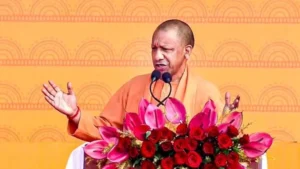
What is striking is that the Uttar Pradesh government’s messaging selectively appropriates the language of inclusion—invoking the Sikh langar tradition and the rhetoric of social harmony—while deliberately evading the substantive political debate around the name itself. This instrumental use of pluralist idioms functions less as genuine recognition and more as rhetorical cover.
The contradiction becomes clearer when set against the BJP’s broader ideological project in the state: the same government that borrows the symbolism of communal equality has actively promoted sites such as the Rashtra Prerna Sthal in Lucknow, a memorial complex that elevates RSS-linked figures like Atal Bihari Vajpayee and Syama Prasad Mookerjee, whose political legacies are deeply contested within secular and constitutional traditions. Far from an aberration, this dissonance reflects a consistent BJP strategy in Uttar Pradesh—deploying the vocabulary of harmony to mask a deeper programme of ideological consolidation and historical re-inscription aligned with Hindutva.
This is a familiar pattern of doublespeak: the same actors will speak about pluralism and unity in one breath, and in the next insist on a government-preferred nomenclature that refuses to accommodate dissenting religious interpretations. The effect is a confusion of patriotism with state messaging, irrespective of the nuanced religious and historical contexts in which these symbols actually originated.
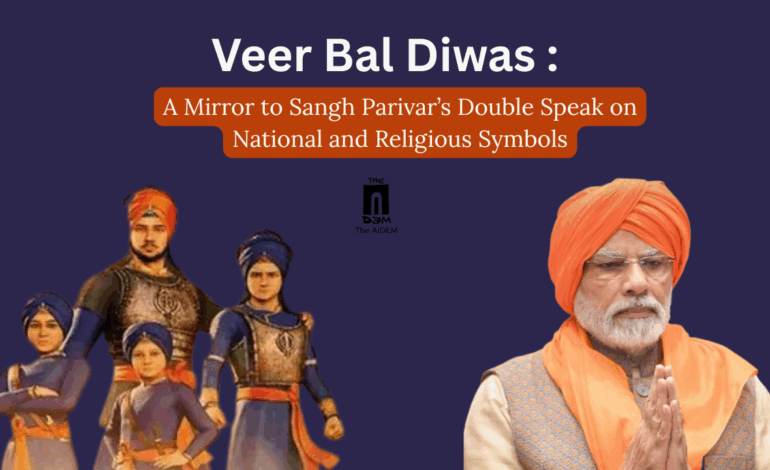
In the Punjab context, Aam Aadmi Party ( AAP) leaders have even accused the BJP of disrespecting Sikh symbols by issuing cartoons of Guru Sahiban and the Sahibzadas — a depiction forbidden in Sikh tradition — even as the same party taxes political capital by honouring them at official events.
This is not unique to Sikh symbolism. Often in Uttar Pradesh, the demolition of the Babri Masjid remains a sacred talking point for Sangh Parivar affiliates as an assertion of Hindu identity — a narrative that glosses over the contested and painful history of that event for many Indian citizens and minorities.
In both cases, what emerges is a political grammar of symbols — one in which observances like Veer Bal Diwas are not just days of remembrance, but arenas of ideological negotiation. The BJP’s insistence on a particular framing — even when it contradicts local religious bodies or historical accuracy — reveals a broader project: aligning diverse identities under a centrally curated conception of Bharatiyata.
If nothing else, this episode demonstrates how politics infuses even the most heartfelt commemorations with strategic double meanings, turning sacrifices into slogans and devotions into data points in an electoral calculus — a trademark of the doublespeak that critics from across the ideological spectrum now readily identify.
Also Read – analysis from Punjab Today News on this topic here: