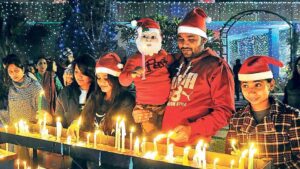
On Christmas morning, as church bells rang across many parts of India and candles were lit in sanctuaries, an unease travelled with the hymns. It was not loud everywhere, not always violent, but it was present enough to alter the texture of the day. The festival that celebrates birth, hope and peace unfolded in 2025 under a shadow—one cast by interruptions, intimidation, and a growing sense that faith itself had become something to be policed.
Across the country, Christmas was observed—but cautiously. Churches remained open, prayers were said, and choirs sang. Yet, layered over the ritual was a new awareness: that celebration itself now carried risk, that visibility invited scrutiny, and that silence might be safer than song.
Mumbai: Silence as Indictment
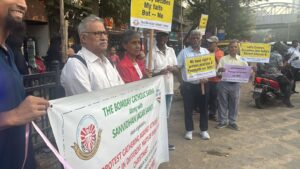
In Mumbai, the reckoning came a day later. On the evening of December 26, in Goregaon West, a resolute group gathered on the street, not to sing carols but to stand in silence. Organised by the Bombay Catholic Sabha along with constitutional rights collectives, the protest was deliberately restrained. There were no slogans, no amplified speeches—only placards invoking the Constitution and the quiet insistence that worship is not a provocation.
Among those present were civil-liberties voices whose presence broadened the meaning of the protest. Teesta Setalvad stood alongside parishioners and local residents, joined by veteran journalist and minority-rights advocate John Dayal and Jesuit priest-activist Cedric Prakash. Their participation signalled that the issue was not simply about Christian grievance, but about the shrinking guarantees of citizenship itself.
The silence was intentional. Participants later described it as a moral choice: to shout would invite caricature; to stand quietly would force attention. Silence, here, was not withdrawal—it was accusation.
But Mumbai was responding, not originating. What unfolded there was shaped by what Christians elsewhere had experienced on Christmas Day itself.
Nalbari: Intimidation Without Spectacle
In Nalbari, a small district town in western Assam, Christmas arrived with unease rather than festivity. On December 25, Christmas decorations at a Christian educational institution were vandalised, with installations pulled down and hostile slogans reportedly raised. The incident was neither large nor prolonged, yet its impact was immediate and profound.
For local Christians—few in number and accustomed to low-profile observance—the message was clear: even restrained celebration offered no insulation. Decorations had been confined to institutional premises, not public processions. Their destruction suggested that visibility itself had become the trigger.
Christmas services went ahead, but quietly. Some families chose to remain indoors. Community elders sought police assurances, while rights groups flagged the episode as emblematic of a newer pattern—pressure without overt violence, intimidation that leaves no dramatic footage but achieves its purpose by instilling caution.
Raipur: When Celebration Becomes Contestable
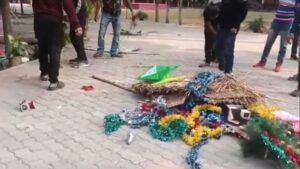
In Raipur, the disruption was more public and symbolic. Christmas displays in commercial and public spaces—Santa Claus figures, festive installations—were attacked and damaged. Videos circulated quickly, showing smashed decorations and raised slogans, transforming what might once have been dismissed as vandalism into a broader statement.
What unsettled observers was not only the damage but the target. These were not churches or prayer halls but cultural symbols of Christmas, stripped of religious messaging. Their destruction suggested a widening zone of contestation: that even secular expressions associated with the festival were now objectionable.
For many Christians, the implication was chilling. If even Santa Claus could be framed as provocation, what space remained for public celebration? The question lingered long after the debris was cleared.

Bareilly: Worship as Confrontation
In Bareilly, the disruption unfolded at the threshold of worship itself. As Christmas prayers concluded, groups gathered outside churches chanting religious slogans, effectively transforming the exit from midnight mass into a moment of confrontation.
No physical violence followed, and that fact would later be cited as evidence of restraint. Yet for those present—particularly elderly worshippers and women—the experience was deeply unsettling. The purpose, many felt, was not escalation but assertion: a reminder of who controlled the street outside the sanctuary.
Here, intimidation functioned through proximity rather than force. The message was delivered without blows, but it landed nonetheless.
A mob of people chanting Hanuman Chalisa infront of a church in Bareilly
A Pattern, Not a Coincidence
None of these incidents, taken alone, altered the national order. Together, they revealed something more enduring: a pattern of low-intensity, festival-centred intimidation, calibrated to avoid mass outrage while steadily narrowing the space for minority expression.
What made Christmas 2025 different was not simply the number of incidents, but their timing and tone. Disruptions arrived not at the margins of the festival but at its heart—on December 25, in public view. For many Christians, the signal felt unmistakable: celebration was being tolerated, not accepted; allowed, but watched.
Across the country, Christmas masses went ahead—often under police presence. Clergy spoke carefully, invoking peace without naming fear. Congregations sang Silent Night with an altered awareness of the word silent.
Political reactions followed swiftly. Statements were issued, condemnations voiced, assurances offered. Yet for those who stood in silence on a Mumbai pavement, the concern ran deeper than episodic vandalism. What troubled them was normalisation—the quiet acceptance of disruption as routine, the gradual lowering of expectations around what minorities may safely do in public.
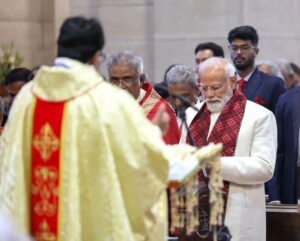
In The AIDEM’s lens, what unfolded this Christmas was not merely a law-and-order issue or a clash of sentiments. It was a democratic moment revealing strain: the narrowing of civic space, the fragility of pluralism, and the subtle recalibration of whose faith can occupy public life without justification.
Christmas 2025 did not erupt into nationwide violence. That fact will be cited as reassurance. But it also did not pass as an unremarkable celebration. Between prayer and protest, between the church pew and the city street, a question lingered through the season:
In a republic founded on freedom of conscience, why must faith keep proving its right to exist?
That question—more than the smashed decorations, the slogans, or the silences—is what made this Christmas different.