

Young, Unskilled, Unemployed: How India’s Demographic Advantage Is Slipping Away

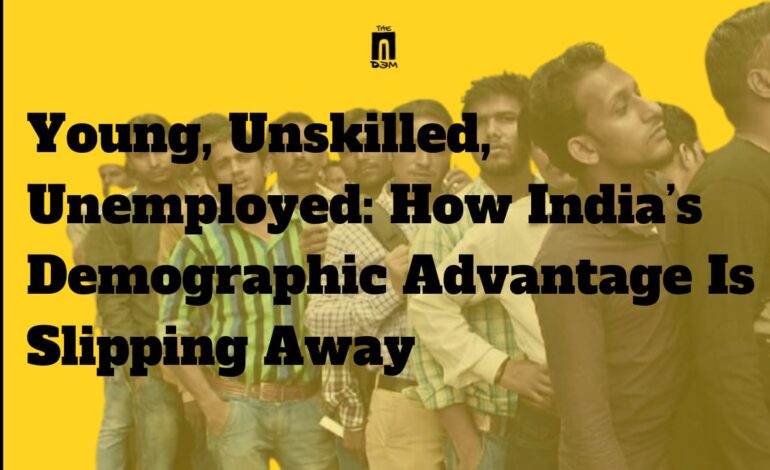
India today enjoys a rare demographic advantage. It has the youngest population among all major economies in the world. The country’s median age — the age at which half the population is younger — currently stands at 28.8 years.
This advantage, however, is not permanent. India’s median age was just 21.1 years in 2000. It rose to 27.0 years in 2020 and is projected to climb sharply to 47.7 years by 2100.
In comparison, China’s median age is already 40.1 years, while Japan — the world’s oldest society — stands at 49.8 years.
At a time when most global economies are ageing rapidly, India’s youthful labour force offers a once-in-a-generation opportunity to accelerate economic growth and sustain long-term momentum.
But this dividend can only be realised if the youth are made productive through quality education, relevant skills, and meaningful employment.

PMKVY Under the Scanner: Big Promises, Poor Outcomes
Recognising this potential, the Modi government launched the ambitious Pradhan Mantri Kaushal Vikas Yojana (PMKVY) in 2015.
Conceived as a flagship skill-development initiative, the scheme aimed to provide short-term, industry-relevant training to school dropouts, unemployed youth, and vulnerable sections of society.
Had it been implemented effectively, PMKVY could have transformed India’s workforce and strengthened the foundations of economic growth.
Instead, a recent report by the Comptroller and Auditor General of India, tabled in Parliament, paints a disturbing picture.
The report questions the scheme’s ability to generate real employment and bridge the skill gap. It highlights weak governance, poor monitoring, and even instances of corruption and nepotism.
Among the most glaring findings are serious lapses in beneficiary verification, financial disbursement, and tracking of job outcomes. In several cases, the same photograph was used on multiple registration forms.
Over 94 per cent of beneficiary records had invalid or missing bank details, with some accounts absurdly listed as “11111111”.
Payouts for more than 34 lakh certified candidates were pending, while only 18.44 per cent received successful Direct Benefit Transfers (DBT).
CAG teams also found training centres closed on the ground even as records falsely showed training in progress.
Equally troubling was the violation of eligibility norms. Candidates were enrolled despite failing to meet age, education, and experience criteria.
In some cases, individuals lacking basic educational qualifications were trained for technically demanding roles, raising serious concerns about quality and credibility.

Jobs, Not Just Schemes: The Real Test Ahead
The report further found a glaring mismatch between training and actual industry needs. Skills were imparted in sectors where demand was negligible, resulting in poor placement outcomes. Overall, only 41 per cent of certified candidates managed to secure jobs.
Unutilised funds running into hundreds of crores point to poor planning and weak coordination between the Centre, states, and implementing agencies.
What was designed as a powerful tool for youth empowerment has instead become a case study in administrative failure.
This should serve as a wake-up call for the government. A well-conceived scheme aimed at harnessing India’s youth advantage has been squandered due to lax supervision and ineffective execution.So far, there has been little clarity on action against defaulters or meaningful reforms to fix systemic flaws. The answer, however, lies not in abandoning the scheme but in overhauling it to make it practical, transparent, and outcome-driven.
As the Economic Survey 2024 notes, India must create at least 7.85 million non-farm jobs annually until 2030.
Many experts argue that the real requirement is closer to 10 million formal sector jobs every year. While official data claims that unemployment is declining, the assertion finds few believers on the ground.
With lakhs of young Indians entering the job market every year, the stakes could not be higher. The government must either create jobs directly or enable the private sector to do so, while also encouraging entrepreneurship.Failure to do so risks turning India’s demographic dividend into a demographic burden — fuelling frustration, social unrest, and long-term economic instability.
This article was also published on Punjab Today News and can be read here.