

Breathless Republic: The Lancet Counts the Dead, Gita Gopinath Counts the Losses


India is being slowly asphyxiated in plain sight. Air that is four to ten times more polluted than the safe standard as deemed by global health science has become the daily reality from the National Capital Region (NCR) to tier‑3 towns, yet the accountable political systems behave as if this is an unfortunate inconvenience, not a national emergency. The numbers now assembled by some of the world’s most respected scientific and economic institutions leave no room for doubt: this is a republic gasping itself to death, and almost nobody in power is meaningfully answering for it.
A slow‑motion health emergency
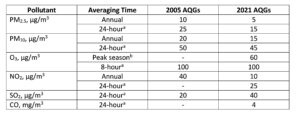
The latest mortality estimates associated with The Lancet show India bearing one of the heaviest air‑pollution burdens on the planet. Long‑term exposure to Fine Particulate Matter (specifically PM2.5) at levels the World Health Organization guidelines deem unfit for health is now linked to roughly 1.5 to 1.7 million premature deaths every year in the country, close to one in six deaths nationwide. The 2024 Lancet Countdown on Health and Climate Change concludes that in 2022 alone, more than 1.7 million Indian deaths were attributable to PM2.5 pollution, with a large share tied directly to the burning of fossil fuels.
This is not an abstract risk. It manifests in the everyday through a heart attack in a middle‑aged office‑goer in Ghaziabad, the chronic cough that never leaves a schoolchild in Delhi, the lung disease that shadows a factory worker in Mullanpur. Yet, even as these figures circulate in medical journals and global reports, official responses in India continue to hide behind the language of “no conclusive national data”, treating peer‑reviewed epidemiology as a nuisance to be managed rather than a call to act.
Horton’s indictment: a democracy that looks away
 Richard Horton, editor-in-chief of The Lancet
The Lancet has been warning about Indian air pollution for years. A 2024 Lancet Planetary Health study on annual PM2.5 exposure in India showed that the mortality burden of extremely high pollution is even greater than previously thought, and that there is effectively no safe threshold: even at already elevated levels, more pollution means more death. On this scientific foundation, editor‑in‑chief Richard Horton has now issued what amounts to a moral charge sheet.
His recent comments, captured in Indian headlines as “India is dying of dirty air, and no one is held to account”, do something unusual: they connect impersonal numbers to the behaviour of a constitutional democracy. Horton points to the Lancet Countdown’s estimate of over 1.7 million PM2.5‑linked deaths in 2022, and to the finding that fossil‑fuel pollution alone is implicated in hundreds of thousands of those deaths. He underlines that the same assessment estimates economic losses from these premature deaths at about 339 billion US dollars, roughly 9.5 percent of India’s GDP that year.
When Horton says India is “dying of dirty air” and that “no one is held to account”, he is asking why a country that can bring down governments over onion prices cannot find a single minister, regulator or chief minister who has paid the political price for millions of predictable, preventable deaths. This is a crucial question as to the functioning of Indian democracy itself.
Gita Gopinath’s warning: growth on borrowed breath

Gita Gopinath, Deputy managing director of the International Monetary Fund
Drawing explicitly on Lancet Countdown figures, she highlighted that more than 1.7 million deaths in 2022 were linked to PM2.5 in India and noted the same staggering estimate of losses equivalent to around 9.5 percent of GDP from premature mortality due to outdoor air pollution. She described this burden as a “hidden tax” on households and firms, paid not in income‑tax offices but through hospital bills, missed work days and stunted productivity.
Gopinath also pointed to World Bank assessments that environmental degradation, driven largely by air pollution, knocks off several percentage points of India’s GDP annually. The message is clear and relentless: health losses and economic losses are two faces of the same crisis. India’s growth narrative, celebrated in Davos sessions and investor pitches, is quite literally being built on borrowed breath.
A world map of pollution that is a map of India
City‑level data show how comprehensively India dominates global pollution tables. The World Air Quality Report 2024 and associated summaries find that India is among the five most polluted countries, with an average annual PM2.5 concentration of about 50.6 micrograms per cubic metre, nearly ten times the WHO guideline of 5 micrograms.
Within that national average lies an even starker story. According to these rankings, six of the ten most polluted cities in the world and 13 of the top 20 are in India, including Byrnihat, Delhi, Mullanpur, Loni, Faridabad, Greater Noida and Noida. An AQI‑based analysis for 2024 reports that 94 of the 100 most polluted cities globally are now Indian.
What is new is not that Delhi is among the worst. It is that smaller towns and industrial nodes once imagined as “cleaner” escapes are fast becoming indistinguishable from the metros. Annual PM2.5 concentrations in many tier‑2 and tier‑3 cities now fall in the 30–60 microgram range, four to five times higher than the WHO’s “healthy” benchmark. The AQLI’s India fact sheet translates this into something incredibly alarming: in parts of northern India, life expectancy is being cut by several years solely because of particulate pollution.
Collapsed public transport, captive to private exhaust
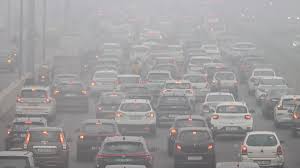
The air‑pollution story cannot be separated from how India moves. Over the past two decades, the country’s cities have quietly shifted from public to private transport, not because people prefer traffic jams and EMIs, but because public systems have been allowed to wither. Analyses of urban mobility show falling bus ridership and rising dependence on two‑wheelers and cars across dozens of cities, with Delhi’s share of trips by bus declining as private‑vehicle share climbs.
This collapse has a direct translation into foul air. Research by organisations such as the Centre for Science and Environment finds that in Delhi, vehicle exhaust is now the single largest local contributor to PM2.5 in many seasons, with emission inventories attributing a substantial fraction, often in the 20 to 40 percent range, of fine particulate pollution and the dominant share of nitrogen oxides to road transport. The Commission for Air Quality Management has told the Supreme Court in formal submissions that vehicular emissions are the biggest source of air pollution in Delhi‑NCR, warning that ad hoc measures will not suffice without structural changes in transport.
Outside the showcase metros, conditions are harsher and choices fewer. Reviews of National Clean Air Programme cities record threadbare bus services, minimal formal mass transit and heavy reliance on two‑wheelers, informal shared autos and small cars in tier‑2 and tier‑3 towns. As these settlements sprawl without sidewalks or safe cycling routes, their PM2.5 levels climb into the 100–150 microgram band, multiple times to the WHO guideline, propelled by traffic, industry, construction and dust.
A state that starves buses while subsidising fuel and roads is not neutral; it is actively choosing more exhaust in the air its citizens breathe.
Policy on paper, poison in the air
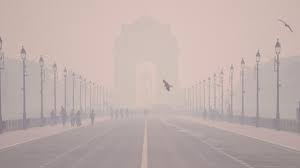
Faced with this landscape, the Indian state points to the National Clean Air Programme, winter emergency frameworks like the Graded Response Action Plan (GRAP) and headline claims of 20 to 25 percent reductions in particulate levels in some cities since 2019. But for residents of Delhi‑NCR, Ghaziabad, Noida, Lucknow, Patna, Varanasi and dozens of smaller towns, the lived reality is unchanged with winters where PM2.5 levels remain five to ten times WHO norms for days on end, with schools shut while offices and malls hum along, and AQI maps that glow red and purple as if on permanent high alert.
When international studies quantify deaths and economic losses, ministries respond by parsing methodology, insisting that Indian death certificates do not list “air pollution” and implying that the problem is one of perception rather than policy. Blame is nudged toward farmers, small builders and weather patterns, while the fundamentals, coal approvals, vehicle policy, urban sprawl and the starving of public transport remain politically untouched.
In this light, Horton’s assertion that “no one is held to account” and Gopinath’s description of pollution as a growth‑sapping “hidden tax” are not rhetorical flourishes. They are precise descriptions of a system that functions with mass, measurable harm as long as it remains slow, unequal and easy to deny.
What accountability would look like
If India accepts that poisoned air is a national emergency, accountability begins with the government treating it like one. That means acknowledging publicly that millions of premature deaths and huge economic losses are intolerable, and putting clean air on the same footing as food security, national security and disaster response.
From there, every major decision on energy, transport, urban planning and industry must be tested against a single standard: will this make the air cleaner, fast, and for everyone, or not? Anything that fails that test should simply not go ahead. The message from the top must be unambiguous: this is an emergency, and the state will be judged by whether Indians can finally breathe without fear.









This is a signicant piece. Gita Gopinaths endorsement of the pollution crisis in India is more credible and more significant than her breathless endorsement of the Govts claims on the economy