


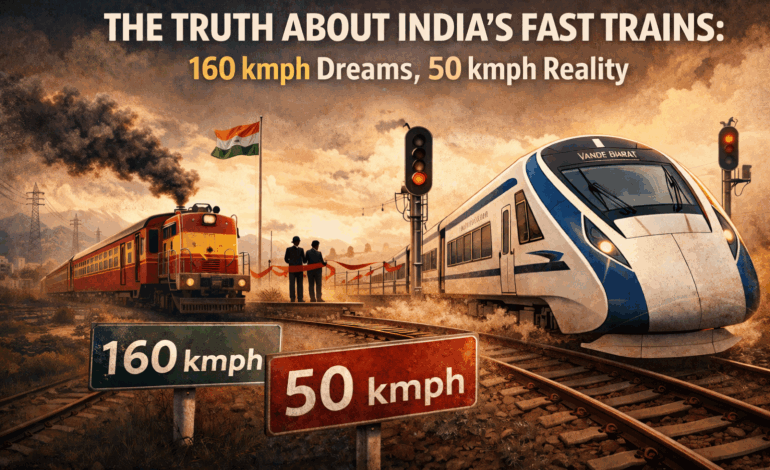
For a decade, governments have sold Indians a vision of semi high-speed rail, from Rajdhani nostalgia to Vande Bharat spectacle. Yet the average Indian train still crawls at 40–65 kmph, flagship routes take almost as long today as they did in the 1970s, and ordinary passengers are losing days of their lives to a railway system that prefers inauguration optics over structural reform. This is the story of how India’s fastest claims outpaced the tracks beneath them.
On paper, India has entered the age of “semi high-speed” rail. The Vande Bharat Express is designed to run at 160 kmph and has been tested at up to 180 kmph, and ministers routinely cite these numbers as evidence that India has finally arrived on the global fast-train map. The government’s messaging is seamless: sleek trainsets, social media reels of ribbons being cut, hashtags about a “new India.” Yet the everyday arithmetic of Indian Railways tells a very different story. Most long-distance trains live in a world of 40–65 kmph. The much-advertised Vande Bharat services rarely sustain even 80 kmph as a system-wide average. And the Delhi–Howrah Rajdhani, launched in 1969 as a vanguard of a modernising republic, still takes roughly the same time between the two cities today as it did in the early 1970s.
This gap between promise and performance is not a technical accident. It is a political choice, a story of what gets built for the camera, what gets postponed and who the railway is actually being redesigned for.
The illusion of speed: 160 in speeches, 40 on the ground
The first fracture in the “fast India” story appears in the railway system’s own documents. The National Rail Plan acknowledges that the average speed of passenger services hovers around 50.6 kmph, while freight trains manage only about 25 kmph. But system-wide averages only sit that low if a very large number of services are operating well beneath them. When one looks beyond premium brand names into the duller world of “slow and fast passenger” trains, the trains that tens of millions of workers, students and migrants depend on, the picture turns stark. Government schedules list long-distance passenger and MEMU/DEMU services that average barely 28–35 kmph across hundreds of kilometres.
These are not quaint hill railways or tourist curiosities. Take the 15027/15028 Maurya Express, an officially designated Express train of the North Eastern Railway zone, running between Sambalpur Junction and Gorakhpur Junction. It covers approximately 1,164–1,176 km and takes over 31 hours to complete the journey, at an average speed of just about 35–37 kmph. The irony is almost too sharp to miss: the Maurya Express runs on modern LHB rakes with a maximum permissible speed of 110 kmph. The coaches are physically capable of more than three times the speed at which this “Express” actually operates. A train designed for 110 kmph crawls at 37 kmph in practice, and the government still calls it an Express.
The Maurya Express is not an outlier. The Howrah–Rajgir Fast Passenger, officially a “fast passenger” service, covers roughly 658 km at an average of only about 28 kmph. The Tatanagar–Itwari Passenger runs close to 887 km at around 35 kmph. Services such as the Asansol–Varanasi MEMU and Guntur–Kacheguda DEMU also hover in the 31–35 kmph band. In other words, the bulk of trains that carry ordinary Indians across the core network are moving at bus-like speeds, even as the national conversation about railways revolves around 160 and 200 kmph.
Rajdhani: yesterday’s future, today’s ceiling
At the premium end of the network, the arithmetic is less brutal but no less telling. When the Howrah–New Delhi Rajdhani began operations on 1 March 1969, it was the fastest thing India had seen on rails: roughly 1,450 km in about 17 hours and 20 minutes, at an average speed comfortably ahead of anything else on the timetable. It was the railway’s own advertisement for what modernity looked like.
Today, the same train, running as 12301/12302, covers essentially the same distance in about 17 hours 15 minutes, with an average speed in the mid-80s kmph. Archival timetables and contemporary charts make for an unsettling read. The journey time that once symbolised the future has, in effect, become the ceiling. In five decades, through electrification, computerised signalling, new locomotives and successive political campaigns for “fast rail,” the Rajdhani has shaved perhaps five minutes off a 17-hour journey. That is not progress. That is stagnation dressed in nostalgia.
While political rhetoric escalated from “fast” to “semi high-speed” to “bullet train future,” the flagship timings barely moved. The most celebrated premium train in the country remains, in terms of journey time, a 1969 product. If the Rajdhani itself, operated with every advantage the system can offer, has not meaningfully accelerated in 55 years, it raises a pointed question about what is happening to the thousands of slow trains beneath it.
Vande Bharat: high-speed in headlines, not on tracks
The Vande Bharat Express was supposed to break that ceiling. Engineered for 160 kmph and tested at 180 kmph, it has been marketed as the face of a new, aspirational rail era. Yet an RTI reply accessed by NDTV reveals that the Vande Bharat’s actual average speed has not risen with its political profile. It has fallen. From about 84.5 kmph in 2020–21, it dropped to about 76.3 kmph in 2023–24. Route-wise figures make the picture sharper: several Vande Bharat services, including those on hilly or congested routes, clock only around 60–65 kmph on average, putting them in roughly the same speed band as the ordinary express trains they were meant to replace.
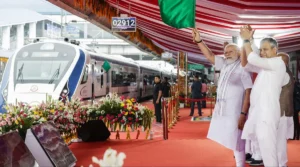
The engineering gap is staggering. A trainset designed for 160 kmph routinely operates at less than half that speed. Railway officials explain this by pointing to track conditions, signal systems, mixed-traffic congestion and “infrastructural work” that has not yet been completed. That is precisely the point. Governments chose to buy and inaugurate the fast trains before the system underneath them was ready to let them run fast. The result is a showcase coach imprisoned by a 1970s-era operating environment.
What a 10 kmph gain would actually mean
In this context, the obsession with maximum headline speeds looks not just misleading but actively evasive. For the vast majority of passengers travelling on ordinary services, the relevant question is not what a trial-run trainset can touch on a cleared track. The relevant question is whether their train arrives before they have spent an entire night on the floor of a sleeper coach.
The arithmetic is simple and its implications are serious. Take the Maurya Express: it covers approximately 1,164 km at about 37 kmph, taking over 31 hours. Raise the average speed to even 47 kmph, a ten-point increment that most functional rail systems would consider modest, and the same distance falls to about 25 hours, saving approximately six hours per journey. Scale that across millions of passengers on thousands of slow trains, and the time returned to citizens every day runs into crores of person-hours annually.
For the very longest routes, journeys of 2,000–2,500 km that currently consume 40–60 hours, the stakes are even higher. If system-wide average speeds for mainstream express trains were genuinely pushed into the 80–100 kmph band through a sustained and planned effort rather than a PR campaign, such routes could be shortened by 24–48 hours. That is an entire working day, or two, given back to people who currently spend it watching landscape drift past at 37 kmph.
These are not abstract calculations. They determine whether a migrant worker from Gorakhpur or Sambalpur loses three days of wages in travel time every time he commutes between home and work. They determine whether a student from a small town can realistically travel for a family emergency without disappearing from college for a week. In a country where railways remain the default long-distance mode for hundreds of millions of people who cannot afford to fly, every 10 kmph of sustained average speed is a concrete political question: how much of people’s lives does the state believe it can afford to waste?
Optics instead of surgery
The engineering knowledge to fix this is not in short supply. CAG reviews and Ministry planning documents have for years acknowledged that average operating speeds remain “much lower” than what upgraded rolling stock, modern locomotives and electrified tracks should allow. The reasons are structural: thousands of permanent speed restrictions on ageing tracks that were never renewed, congested junctions and yards that create cascading delays, no effective separation of freight and passenger traffic on most of the network, and timetables designed around political logic rather than operating efficiency.
A serious programme to address these constraints, incremental, technical and unglamorous, would produce better outcomes for more passengers than any number of new branded trainsets. Removing permanent speed restrictions zone by zone, modernising block signalling across major routes, rebuilding bottleneck junctions and rationalising timetables to reflect what the track can actually sustain: none of this produces a viral video or a prime-time inauguration. All of it would quietly push system-wide averages upward in ways that millions of passengers would feel directly, every single journey.
Instead, policy has tilted towards optics. More brand names, more ribbon-cutting ceremonies, more emphasis on what a train can theoretically do in a controlled trial, while ordinary express trains branded “Superfast” crawl at 50 kmph and a train officially called an Express, the Maurya, takes 31 hours to cover a distance that a decent highway bus would attempt in 20. The word “express” itself has quietly become a form of administrative fiction on the Indian timetable.
The political choice inside the slow train
India does not lack the engineering capacity to run many more trains at meaningful speeds. It has already spent enormous sums on electrification, new coaches and selective track upgrades. What it lacks is a political appetite for the kind of system-wide redesign that would make faster speeds the norm for most trains, not just a handful of premium services used as election backdrops.
The choice to keep announcing 160 kmph while leaving 37 kmph trains running is not a failure of capacity. It is a reflection of priorities. As long as a gleaming Vande Bharat on a flagship corridor generates more political capital than five slow trains quietly made 15 kmph faster, the incentive structure will keep producing more launches and fewer improvements. The Maurya Express will keep taking 31 hours to cover 1,164 km. The Rajdhani will keep arriving at roughly the same time it did when Indira Gandhi was Prime Minister. And governments will keep telling Indians that their railway is racing towards the future, at 37 kmph.
*All speed, distance and journey time figures are cross-verified against Wikipedia (Maurya Express, Howrah–New Delhi Rajdhani), RailYatri, eRail.in, NDTV RTI report and the National Rail Plan document.









:
Dr. Dubey’s article highlights the stark gap between India’s fast-train promises and the slower ground reality. A sharp and timely reminder that ambition must be matched with real infrastructure progress.