


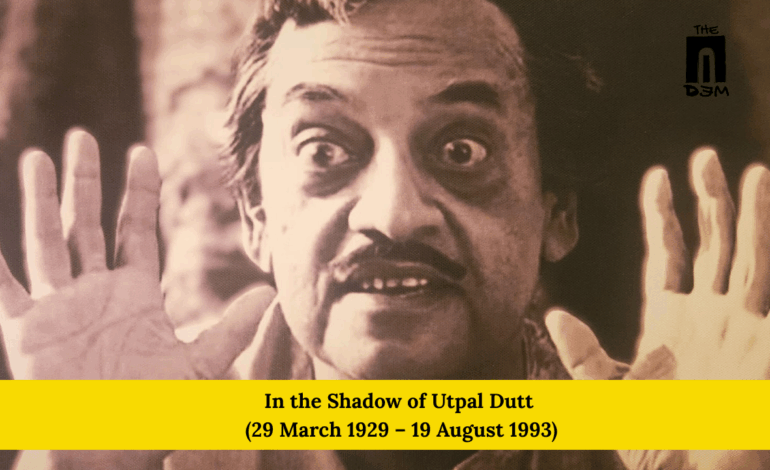
Had destiny permitted, Utpal Dutt would have stepped into his ninety-seventh year, and the thought alone fills me with a tender ache. To me, he was not merely an actor but a childhood icon whose artistry in films like Naram Garam, Rang Birangi, and the immortal Golmaal etched indelible laughter and wisdom into my growing years. My ardor for the cinema of yesteryears knows no bounds, and as a Lucknowite steeped in the cultural heritage of our nation, I found myself drawn irresistibly into the chronicles of this towering figure.
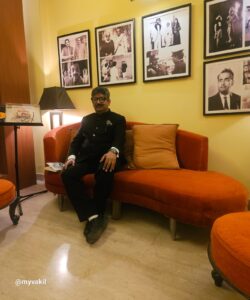
In our modern age, where the click of a mouse unveils worlds, I discovered not only archives of his genius but also a living connection to his illustrious family. The internet, with its virtues and vices, became my bridge to his daughter, Professor Bishnupriya Dutt of JNU; her husband, Debashish Paul, a stalwart in advertising and letters; and their radiant daughter, Ahvana Paul. To converse with Mrs. Bishnupriya Dutt over WhatsApp was, for me, nothing short of a fairy tale, and my visit to their Delhi residence last month was the fulfillment of a long-cherished dream.
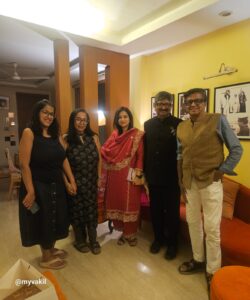
That evening unfolded like a tapestry of remembrance. We spoke of Utpal Dutt Ji’s theatre days, his vision steeped in Marxist thought, his conviction that the worker stood equal, and his disdain for the edifice of capitalism. His passion for theatre was no passing pursuit, it was his very breath. His Jatra performances drew audiences of no less than fifteen thousand souls, and his transition to cinema was itself theatrical: while embodying Othello, he was discovered by filmmaker Madhu Bose, who entrusted him with the lead in Michael Madhusudan (1950). From there, his journey spanned Bengali cinema, collaborations with Satyajit Ray, and a lifelong devotion to revolutionary theatre.
The family’s recollections revealed a man who was jailed for his art, whose play Kallol shook the establishment, and whose “People’s Little Theatre” brought drama to the very street corners of Bengal. His Jatra scripts, performed under open skies, became the voice of the people, echoing his communist ideals. Even his Bollywood roles, over a hundred in number, were but a means to sustain the Theatre, which was his lifelong passion. This particular video of his, on youtube avidly describes his passion for the theatre and what it actually meant to him
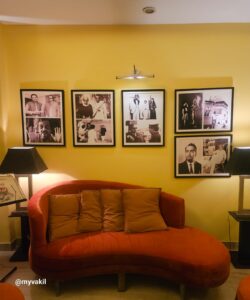
As we leafed through photographs unseen by the world, I felt the pulse of history. Here was the man who won the National Film Award for Bhuvan Shome, who claimed three Filmfare Awards for his comedic brilliance, and who was honored by the Bengal Film Journalists’ Association for Path O Prasad and Agantuk. His legacy was not confined to accolades; it was alive in the laughter, the protest, the poetry of his performances.
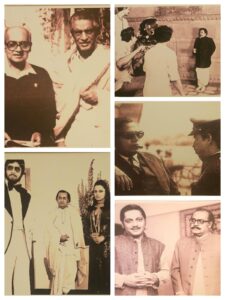
The evening was crowned with authentic Bengali fare- fish, prawns, and vegetables prepared with love. Around that table, nostalgia mingled with warmth, and as we parted, I carried with me not only memories but a newfound kinship. I had entered their home as a devotee of Utpal Dutt, and I departed as a friend of his family, bound forever by the spell of art, heritage, and remembrance.




Comment: “This piece thoughtfully revisits the turbulent phase of 1993, highlighting how individual voices like Advocate Syed Mohammad Haider Rizvi’s captured the deeper socio-political tensions of the time. It serves as a reminder that history is not just about events, but about the lived experiences and courage of those who documented them.”
It is the affection and reverence I hold for the noble Man he was, an immaculate embodiment of the cultural ethos for which our Nation has been celebrated across the world. My salutations extend to him and to his family, who continue to radiate and uphold those very cherished values.