

Vijay’s Third Force Moment: A Disruption Tamil Nadu Can No Longer Ignore

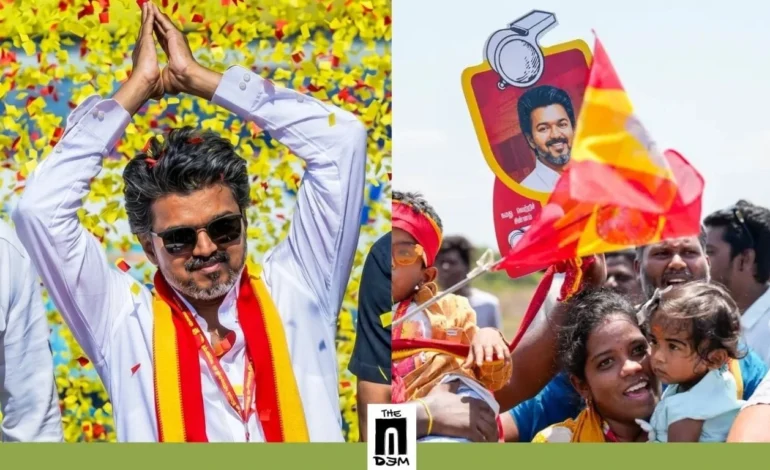
As the campaign for the TamilNadu’s Legislative Assembly elections came to a close on the evening of April 21, 2026 , there was little doubt that the polls this time had assumed an interesting—and unmistakably disruptive—twist with the advent of “Thalapathy” Vijay into the battlefield. Having ruled the roost in Tamil filmdom for almost three decades, he has not merely transitioned into a politician’s role; he has stepped into it with an assertiveness that signals intent rather than experimentation. The path may be a beaten one, taken by many South Indian superstars over the years with varying degrees of success, but Vijay’s entry refuses to sit comfortably within that predictable arc.
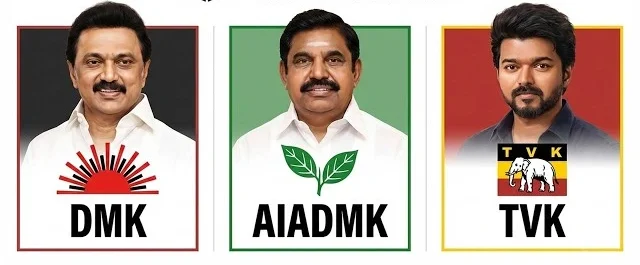
Belying widespread speculation and the confident predictions of analysts that he would either align with the BJP-AIADMK combine or operate in tacit collusion with the BJP, Vijay has instead chosen to occupy—and actively construct—the elusive third space. This is no minor tactical shift. It is a direct intervention in a political landscape where power has shuttled between two entrenched poles—the DMK and the AIADMK—for nearly six decades. By being the first to announce candidates for all 234 seats, Vijay did not merely silence rumours; he established momentum, signalling organisational readiness and political seriousness.
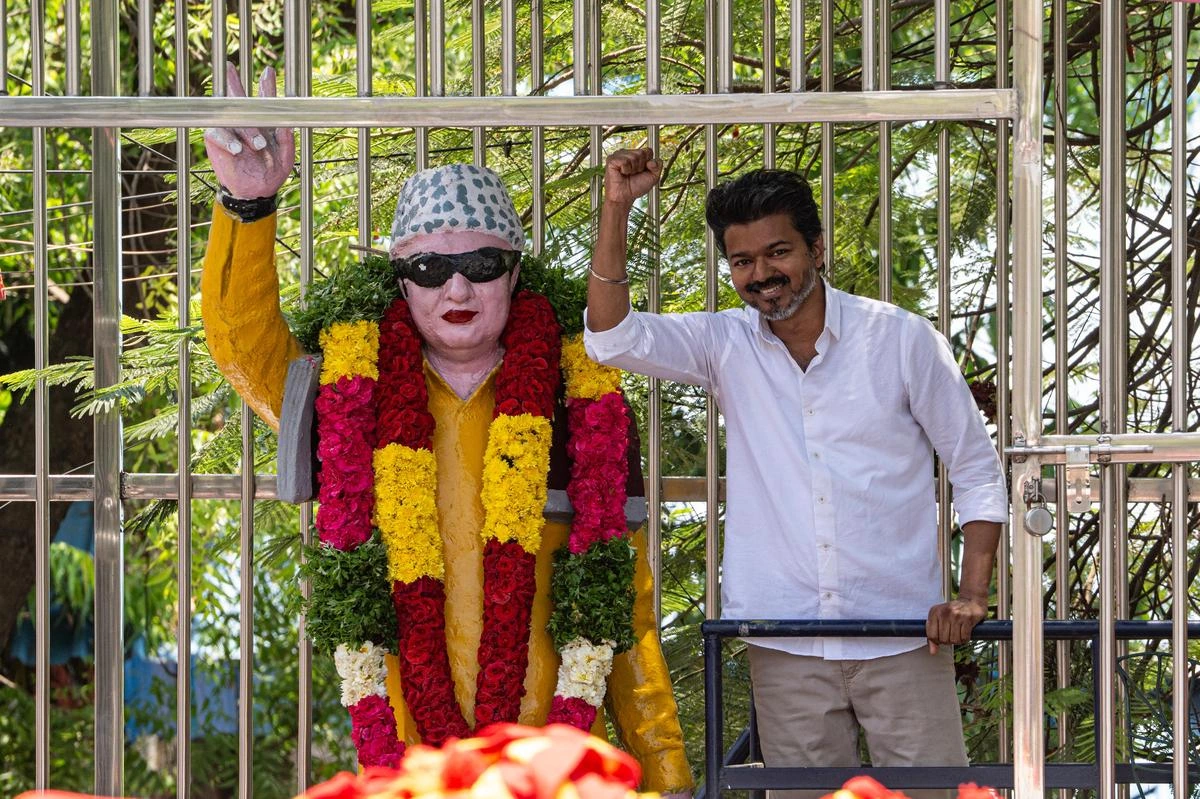
Yet, unlike earlier cinematic icons such as MGR or NTR, who rode bipolar contests to power, Vijay is attempting something far more structurally complex: the creation of viability within a triangular contest. This is not just an electoral gamble; it is a recalibration of political imagination in Tamil Nadu.
History offers both caution and possibility. Chiranjeevi’s Prajarajyam Party in undivided Andhra Pradesh once carved out a significant 17% vote share against the Congress and TDP juggernauts, only to dissolve into the Congress within two years—a short-lived but instructive experiment in third-force politics. At the other end of the spectrum stands the Aam Aadmi Party in Delhi, which not only emerged as a third force but went on to displace established players, eventually obliterating the Congress space altogether. Meanwhile, Pawan Kalyan’s Janasena chose the safer route of alliances, securing proximity to power without fundamentally altering the political order.
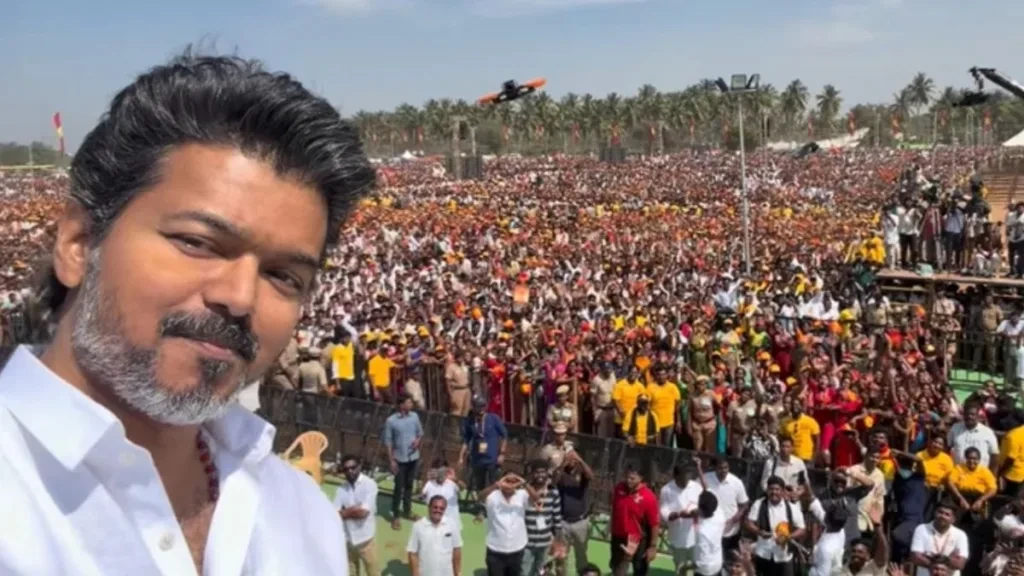
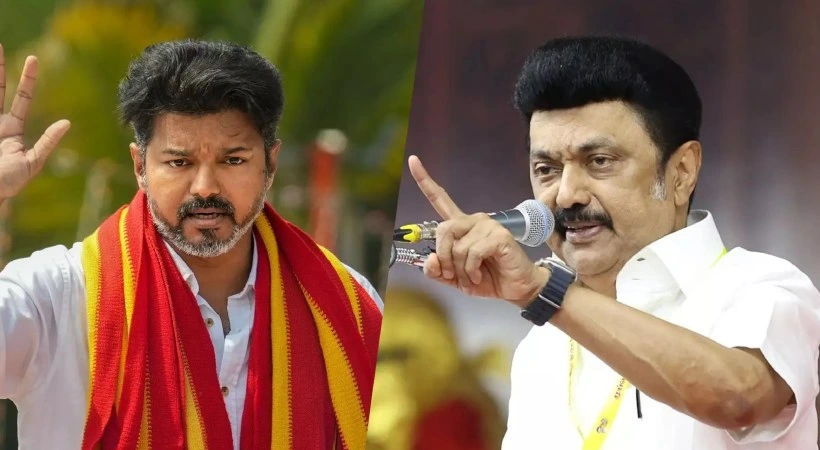
It is in contrast to these trajectories that Vijay’s approach stands out. His rhetoric has been consistently calibrated to project himself not as an adjunct, but as the primary alternative to the ruling DMK. By framing the contest as one between Stalin “sir” and Vijay, he has deliberately erased the BJP-AIADMK axis from the central narrative. This is not accidental. It is a strategic repositioning that seeks to recast Tamil Nadu politics as a contest between two regional forces, rooted in the state’s linguistic, cultural, and ideological specificity. In doing so, Vijay is also tapping into a deeply embedded resistance among Tamil people to the hegemonic impulses of the Union government—an instinct shaped by decades of Dravidian political consciousness and opposition to Hindi imposition.
The Groundswell Behind Vijay
Across India and the world, electoral politics periodically witnesses a yearning for disruption—a search for something that feels like change, regardless of whether it ultimately delivers. From Barack Obama’s “hope and change” campaign in the United States to political churns in Nepal, Sri Lanka, Delhi under Kejriwal, or even the social justice mobilisations of Lalu Prasad Yadav and Mayawati in the 1990s, this impulse has repeatedly reshaped political outcomes. Vijay’s campaign is consciously attempting to harness precisely this moment.
The enthusiasm visible in his rallies, particularly among the youth, reflects not just fandom but a projection of possibility. Significantly, Vijay has turned one of his biggest criticisms—his political inexperience—into a narrative asset. By invoking his own rise in Kollywood from obscurity, he suggests a parallel trajectory in politics, framing himself as proof that entrenched hierarchies can be disrupted.
His political messaging has also sought to balance critique with continuity. While he has been vociferous in attacking the DMK on corruption and nepotism, he has simultaneously embraced the welfare-oriented framework that defines Tamil Nadu’s developmental model. Schemes like the “Annapoorani super-six,” emphasis on women’s safety, and focus on youth signal an attempt to align with the Dravidian legacy while claiming to renew it.
Crucially, Vijay’s unequivocal anti-BJP stance—and his refusal to yield to central pressures, including CBI interventions and obstacles to his ₹400-crore film project Jananayagan—has added a layer of political credibility. In a national context where the BJP dominates across 21 states and aggressively weakens opposition forces, Vijay’s decision to stand independently is not just bold; it is structurally significant. It also places the DMK in an awkward historical position, given its own past alliances with the BJP, including its participation in the NDA during the 2002 Gujarat pogrom. Meanwhile, the AIADMK’s continued alignment with the BJP further sharpens Vijay’s attempt to occupy a distinct political space.
Fault Lines and Fragilities
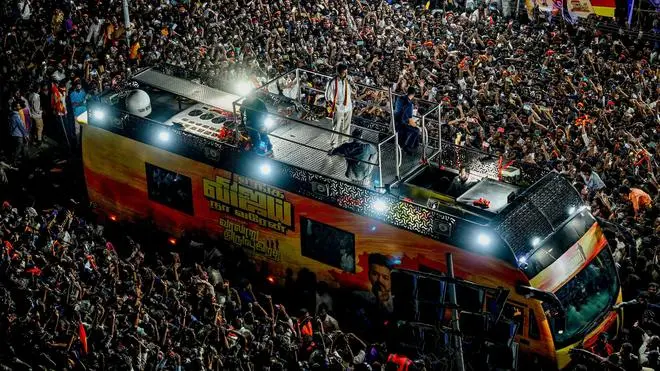
Yet, this emergence is not without shadows. The Karur stampede during Vijay’s 2025 roadshow, which claimed 41 lives, remains a moral and political scar that cannot be erased. It raises uncomfortable questions about mobilisation, responsibility, and the risks of mass political spectacle.
Equally significant is the performance of the incumbent DMK government under M K Stalin. With strong welfare delivery and double-digit growth rates, the government has managed to balance development with social justice in ways that are rare in the Indian context. This complicates the anti-incumbency narrative that Vijay might hope to ride.
There are also deeper ideological ambiguities. Vijay’s attempt to place the Bhagavad Gita alongside the Constitution in his guiding principles, while simultaneously invoking Ambedkar and Periyar, has drawn criticism. In a state where Periyar’s rationalist philosophy forms the bedrock of political identity, such positioning raises questions. Is this a lack of ideological clarity, or a calculated attempt to broaden appeal by softening ideological edges? The answer remains uncertain—and politically consequential.
A Political Jolt with Uncertain Outcomes
Whoever emerges as the next Chief Minister on May 4, one conclusion is unavoidable: Vijay’s entry has already altered the terrain. The question is not whether there has been disruption, but what form that disruption will ultimately take.
Will Tamil Nadu settle into a durable three-cornered contest? Will this moment evolve into a new bipolarity between the DMK and Vijay’s TVK, pushing the NDA to the margins? Or will Vijay’s experiment mirror earlier third-force attempts that flared brightly but briefly?
For now, the odds may lean toward a future where a younger Udhayanidhi Stalin faces an ascendant Vijay in a reconfigured political duel. But what is undeniable is this: Vijay is no longer a peripheral entrant testing waters. He is attempting to redraw the map—and Tamil Nadu politics, for the first time in decades, is being compelled to respond.








“A compelling and timely analysis of Tamil Nadu’s evolving political dynamics. G. Naveen thoughtfully captures how Vijay’s emergence as a third force could reshape the landscape. Insightful and definitely a conversation-starter.”