


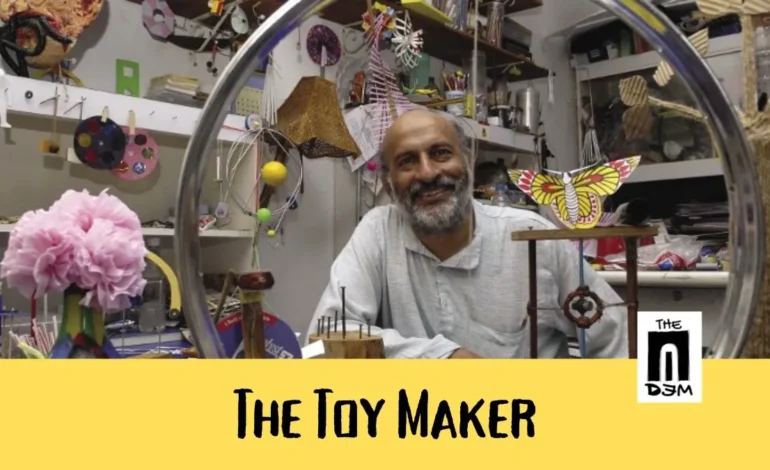
Arvind Gupta gave up a career at India’s premier automobile company to make science toys out of matchsticks and bicycle tubes in rural Madhya Pradesh. He has since uploaded eighty-six hundred science experiments to YouTube, broadcast a hundred and twenty-five television episodes on Doordarshan, and put five thousand books online for free. His argument is simple: a child who builds a rocket from a balloon understands rocket science. A child who memorises equations does not.
For roughly a thousand years, it was the custom in China to bind the feet of young girls. Small feet were considered beautiful; the deformity was considered desirable. The toes were folded under and bound tightly, the arches broken, the growth of the foot suppressed over years of painful constriction. Hundreds of millions of women were permanently crippled by a practise whose logic—that the foot should be made to conform to an ideal rather than allowed to develop as nature intended—was so thoroughly embedded in the culture that it was barely noticed as cruelty until the practise was abolished in the early twentieth century.
The school system that independent India inherited—and that Indian governments have, with modifications, is built around a similar inversion: it begins not with the child but with an ideal of what the child should know, forces the child’s mind into that shape through memorisation, examination, and punishment; it measures its success by whether the resulting performance matches the predetermined template. A child who sits quietly when the teacher is absent, as Gupta once observed, has been successfully trained. Whether the child understands anything has become a secondary question.
The alternative tradition in Indian educational thought is old and distinguished. J. Krishnamurti argued that genuine education cultivated a scientific mind—not the accumulation of scientific facts but the habit of approaching everything with curiosity and rigour—and that freedom and order, properly understood, were not opposites but complements, both arising naturally from a learning environment that trusted the student. Gandhi went further: he proposed that the hands were as important as the head, that a child who could only read and write had been only partially educated, that the goal of schooling was not to produce a credential but to produce a whole human being capable of sustaining a democratic society. He called his model Nai Talim—new education—and it was practised at Sevagram, near Wardha, before independence arrived, but the government chose a different path.
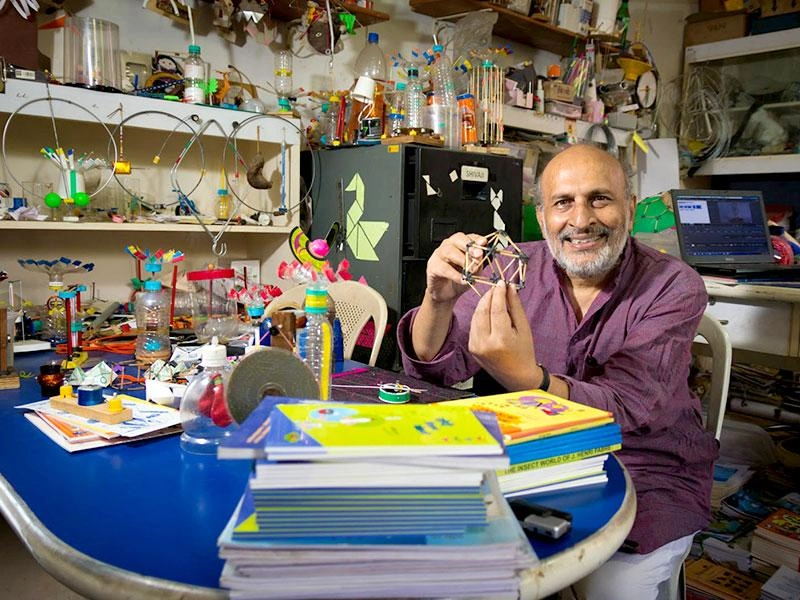
Arvind Gupta has spent his career attempting to smuggle the spirit of Nai Talim back into Indian classrooms through the most improbable of vehicles: a matchstick, a bicycle inner tube, a drinking straw, an empty Tetra Pack carton, a battery and more. He is not a romantic about tradition or a critic of modern science. He is, rather, a practical man who has reached a practical conclusion: that the fear of science—the sense that it belongs to a world of expensive equipment and advanced degrees—is the single largest barrier between Indian children and scientific understanding, and that the most effective way to remove that barrier is to show them that the principles of physics and chemistry and mathematics are already present in the things they throw away every morning.
THE BOY FROM BAREILLY
Gupta was born in Bareilly, in Uttar Pradesh, the fourth son of parents who had not received much formal education but understood its value with the clarity that comes from not having had it. His mother, determined that her children would have what she had not, sold her jewellery to enrol them in Bareilly’s best private school. Gupta was an excellent student and went on to study electrical engineering at the Indian Institute of Technology in Kanpur.
The IIT Kanpur of the early nineteen-seventies was not insulated from the turbulence of the times. Around the world, students were in the streets: against the Vietnam War in the United States, against established hierarchies in Europe, and in India, against a system that seemed to be producing inequality as efficiently as it produced engineers. Jayaprakash Narayan—the Gandhian who had become the moral conscience of Indian public life—was calling on educated young people to go to the villages, to take their skills to the places that needed them most rather than to the institutions that would pay the most for them. Gupta heard the call but did not immediately answer it. He graduated, joined Telco—the Tata Motors company, then India’s premier industrial employer—and spent two years doing work that did not suit him.
The decisive intervention came from a lecture at IIT Kanpur, delivered before his graduation, by a scientist named Anil Sadgopal. Sadgopal had a master’s degree from the Indian Agricultural Research Institute and a doctorate in molecular biology from the University of California. He had joined the Tata Institute of Fundamental Research as a faculty member in 1968, left it in 1971, and gone to Hoshangabad district in Madhya Pradesh to found a voluntary organisation called Kishore Bharati, which worked on agriculture, health, and education. In 1972, he launched the Hoshangabad Science Teaching Programme—a project to teach science to students in grades five through eight at government schools, using hands-on methods rather than textbooks and memorisation. The lecture struck Gupta as the most honest account of Indian education he had heard. He filed it away.
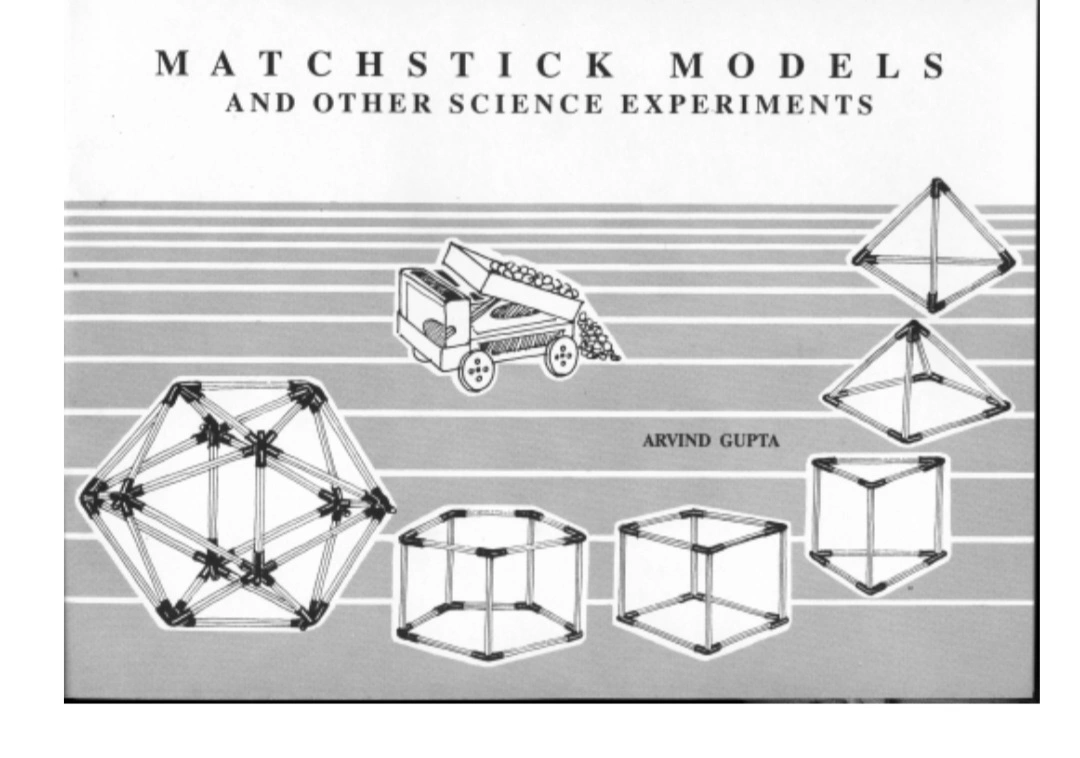
After two years at Telco, he took a year’s leave and went to Hoshangabad. There, surrounded by children in government schools who had no laboratory equipment, no science kits, no budget for materials of any kind, he began making things. He took bicycle inner tubes and matchsticks and showed children how to build geometric structures—frameworks for understanding molecular chemistry, architectural principles, the properties of shapes. The experiments were not demonstrations; they were constructions. The children were not watching; they were doing. When the year ended and he returned to Telco, he found he could not settle. He left the company, worked briefly in smaller organisations, and eventually received a fellowship from Professor Yash Pal, then Secretary of the Department of Science and Technology, to write a book.
‘Matchstick Models and Other Science Experiments’ appeared in 1978 and was translated into twelve languages within two years. It was followed by dozens more. The books were not textbooks. They were instruction manuals for making things out of trash.
THE MOTOR
The experiment that Gupta describes as his proudest achievement requires four components: a battery, two small magnets, some copper wire, and two safety pins. From these materials—the total cost is negligible and all of it can be found in any Indian household—he builds a working electric motor. The copper wire is wound into a coil and balanced on the safety pins, which act as axles and conductors. The magnets are placed on either side. When the circuit is completed, the coil rotates. (D C MOTOR – HINDI – 30 MB)
This is not a toy. It is a functional demonstration of electromagnetic induction, the principle that underlies every electric motor and generator in the world. The child who builds it has not read about electromagnetic induction; she has made it happen, with her hands, from components she assembled herself. “The day I built that little motor,” Gupta has said, “I was so happy that I kept waking up in the night to switch it on and off.” He was not describing a childhood memory. He was describing his reaction as an adult engineer.
The significance of this reaction is worth dwelling on. Gupta had studied electrical engineering at one of India’s finest technical universities. He understood electromagnetic theory. And yet the experience of making a motor from a battery and some wire produced in him a delight that years of formal study had not. The formal study had given him the equations; the experiment gave him the thing itself. He has spent his career arguing that Indian education has the order of these two wrong: it provides the equations first, in the hope that comprehension follows, when in fact comprehension must come first, through contact with the phenomenon, and the equations are the tool for describing what the child already knows.
The argument is not anti-intellectual. Gupta is deeply read—in science, in educational philosophy, in literature across multiple languages—and the resources he has made available on his website include not only science experiments but serious books on mathematics, ecology, economics, education and fiction. What he is against is the use of abstraction as a barrier rather than a gateway: the classroom in which a child is handed a formula for rocket propulsion before she has ever seen a rocket, let alone tried to build one. A child who watches the Mangalyaan spacecraft launch on television and then makes a balloon rocket in her backyard has crossed a threshold that no amount of memorisation can cross for her. She has understood, in her body, what thrust is. (BALLOON ROCKET – HINDI – 16MB .wmv)
In 1982, Anil Sadgopal founded Eklavya—a voluntary organisation in Bhopal that continued and expanded the Hoshangabad Science Teaching Programme. Gupta wrote science books for Eklavya and then moved to Delhi, where his former IIT Kanpur professor M.M. Chaudhary was by then deputy director of the National Council of Educational Research and Training. Chaudhary invited him to make science television programmes for children.

TARANG
Tarang, the word means ripples, ran for twenty-five years on Doordarshan, India’s national television network, producing a hundred and twenty-five episodes. Doordarshan has a reach that private channels do not, particularly in the Hindi-speaking heartland and in the rural districts of central and northern India. A show about science experiments made from household waste, broadcast by the state television network, could reach children in villages that had no laboratories, no science kits, no trained science teachers, and no prior encounter with the idea that science was something they might do rather than something that happened in other places to other kinds of people.
Each episode followed the same format: a simple question, a simple experiment, performed with materials found at home, explained in plain language. The materials were never exotic. Drinking straws, old newspapers, rubber bands, empty bottles, candle stubs—these were the instruments. The experiments ranged from demonstrations of basic physical principles to constructions of working models: pumps, motors, periscopes, musical instruments, weighing scales. The underlying message of every episode was the same: the world you live in is made of science, and you already have everything you need to explore it.
The Tata Trusts, which had supported Gupta’s television work, continued to fund the expansion of his activities after he moved to Pune in 2003, when his daughter finished school and left for medical college. The astrophysicist Jayant Narlikar, one of India’s most distinguished scientists, who had done his doctoral work at Cambridge under Fred Hoyle and co-developed the Narlikar-Hoyle theory of conformal gravity, had established the Inter-University Centre for Astronomy and Astrophysics in Pune in 1988 and invited Gupta to build a children’s science centre within it.
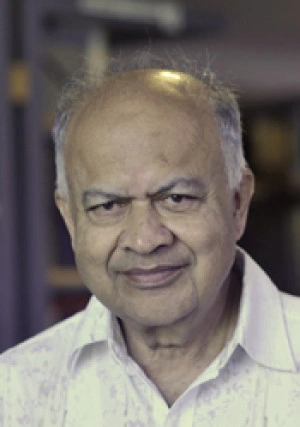
Narlikar’s invitation was significant in several ways. It placed Gupta in an institution of genuine scientific prestige, which gave his work a legitimacy that the educational establishment sometimes withheld. It also provided resources: the Tata Trusts contributed four million rupees to establish the centre, which set Gupta and his colleagues, including Vidula Mhaiskar, who holds a doctorate from Stanford, to the systematic work of documenting, cataloguing, and scaling up the approach he had been developing for thirty years.
The centre has produced fifteen hundred varieties of science toys made from waste materials. Plastic bottles alone have yielded a hundred and ten distinct experiments. Eighty-six hundred video demonstrations have been uploaded to YouTube, in English and in Indian languages; more than a hundred have been translated into Chinese, and more than three hundred into Spanish. The TED talk Gupta delivered, titled ‘Turning Trash into Toys for Learning,’ is among the most-watched in the organization’s archive. His website, arvindguptatoys.com, hosts more than five thousand books, available without charge, in dozens of languages, including more than a hundred in Tamil.
WHAT THE HANDS KNOW
Gandhi’s concept of education of the hand—the proposition that the capacity to make things is not a supplement to intellectual development but a precondition of it—is usually described as an expression of his political economy: a resistance to industrial capitalism, a defence of cottage industry, a vision of self-sufficient villages. These dimensions are real. However, the educational claim is separable from the economic one, and it rests on an observation that developmental psychologists have since confirmed in considerable empirical detail: children who learn through making understand what they have learnt in a different and more durable way than children who learn through being told.
The child who reads that a lever multiplies force understands it as a proposition. The child who uses a stick and a stone to move a heavy object understands it as a fact about the world, one that she discovered herself and that she will not forget. The difference between these two modes of understanding is not merely quantitative—the second child does not simply know more. She knows differently: she has experienced the phenomenon rather than received an account of it, and her subsequent engagement with related phenomena will be shaped by that experience.
Gupta’s particular contribution has been to extend this insight to children who are, in two important senses, at the greatest distance from formal science: children in rural India who are first-generation learners, whose parents have no scientific background, and who encounter formal education in a language they are still learning; and children in schools that have no laboratories, no science kits, and no budget for the equipment that science teachers in urban private schools take for granted. For both groups, the standard approach to science education—equations first, experiments (if any) later—is not merely ineffective. It is actively hostile, because it establishes, before the child has learnt anything, that science is for people who are unlike her.
The toy made from waste dissolves this hostility before it can form. A child who makes a working periscope from two mirrors and a cardboard tube has not been told that optics is accessible; she has discovered it. A child who builds a bridge from newspaper rolls and tests how much weight it can bear has not been instructed in structural engineering; she has practised it. The abstraction, if it comes later, arrives in a mind that already knows what the abstraction is describing.
Two practical consequences follow from this. First, the barrier between rural and urban science education—real, enormous, and growing as private schools equip themselves with increasingly sophisticated laboratories—becomes less absolute. A school in a village with no electricity can offer its students a genuine encounter with physical principles if it has someone who understands Gupta’s methods, because the materials his methods require are available everywhere. Second, the mathematics of science education improves. India has tens of thousands of government primary schools in which no functioning science experiment has ever been performed. Equipping them with commercial laboratory apparatus is beyond any realistic budget. Equipping them with Arvind Gupta’s instructions costs nothing.
THE QUESTION OF SCALE
India has, in the seventy-five years since independence, built an impressive infrastructure of elite technical education: the Indian Institutes of Technology, the Indian Institutes of Science, the National Institutes of Technology, and a dense network of engineering and medical colleges that produce graduates in numbers that have transformed the global technology industry. This investment has been real and its returns significant. But the beneficiaries of this system have been, overwhelmingly, students who arrived at the IIT entrance examination already equipped with the cultural and economic capital to navigate a system designed for people who were already somewhat like the people who designed it.
The students Gupta works for and works with, because his method requires working with rather than for, are the ones who fall away before the entrance examination is reached, often before they have finished primary school. They fall away not because they are incapable of scientific thinking but because the system encountered them as strangers and treated them accordingly: speaking to them in languages they did not yet know, testing them on things they had not had the opportunity to experience, and communicating, through every institutional arrangement, that the things the system valued were things that belonged to people from somewhere else.
Gupta does not claim that matchstick models will close this gap entirely. He is not a utopian. He makes a more modest and more defensible argument: that the first encounter with science should not frighten, should not exclude, and should not presuppose access to equipment or income that most Indian families do not have. If the first encounter is a delight and if the child discovers, through her own hands, that the world is full of phenomena she can investigate, the subsequent encounters may go better. They may not. The structural inequalities of Indian education are not dissolved by a battery and two safety pins, but they cannot be addressed at all if the child has already decided, in the first years of school, that science is not for her.
Gupta’s website receives millions of visits annually from every inhabited continent. His YouTube channel has been subtitled into languages whose speakers live in countries that do not appear in his biography. A schoolteacher in rural Kenya, a home-schooling parent in Brazil, a district science coordinator in a province of Indonesia—these are among his users, and they found him not through any institutional channel but through the discovery that what he offers works: that the experiments can be done, that the children enjoy them, and that something changes in a child who has successfully made a working motor from a battery and some wire and two small magnets.
What changes, precisely, is difficult to measure in the terms that educational systems use to measure things. It does not immediately appear in test scores or examination pass rates. It is closer to what the psychologist Mihaly Csikszentmihalyi called flow—the state of complete absorption in a task that is both challenging and manageable—and to what Krishnamurti meant by a scientific mind: not the possession of scientific knowledge but the habit of approaching the world with curiosity rather than fear. It is, in a phrase that Gandhi would have recognised, the beginning of education rather than its end.
THE BOUND FOOT AND THE OPEN HAND
The practise of foot binding in China did not end because the Chinese people concluded that small feet were not beautiful. It ended because a new generation of reformers—educated women, modernising officials—made the argument, with sufficient force and over sufficient time, that the cost of the ideal was greater than its value, and that the foot, left to grow as it wished, would serve the woman better than any ideal could. The argument was met with resistance. Habits of a thousand years do not dissolve easily, but they can dissolve, and they did.
The Indian school system’s habit of treating children as vessels to be filled rather than minds to be exercised is not a thousand-years old, but it is deeply embedded, and the interests that sustain it—the examination boards, the coaching industry, the universities that select on the basis of marks rather than demonstrated curiosity—are substantial. Gupta does not argue with these interests directly. He bypasses them, the way water bypasses an obstacle: not through force but through persistence, finding the channels that are open and moving through them.
The open channel, in his case, is the child’s hand. The hand is not examined. It is not ranked. It does not produce a percentile score that determines university admission. It can, however, make a motor from a battery, build a bridge from newspaper, construct a musical instrument from a rubber band and a cardboard box, and in doing so demonstrate, to the child and to anyone watching, that the mind attached to that hand is not empty, not slow, not unscientific, and not in need of binding. It is in need of materials, and instructions, and the company of someone who believes that what it produces is worth producing.
Arvind Gupta has spent his career being that someone. He is not famous in the way that Indian industrialists or politicians are famous. He does not run a large organisation, control a significant budget, or advise the government on policy. He makes things from trash and shows children how to do the same, and he has been doing this for fifty years, and the number of children who have been reached by his methods—directly, through television, through the internet, through the teachers he has trained and the books he has put online without charge—is beyond any precise accounting. The motor, when you switch it on, keeps turning.










“While The Toy Maker presents an interesting and thoughtful premise, the narrative at times feels a bit slow and overly reflective. The themes of creativity and social reality are compelling, but they could have been explored with more clarity and sharper storytelling. At certain points, the piece seems to lose its pace, which slightly weakens its overall impact. Still, it remains a meaningful read that raises important questions, even if it doesn’t fully deliver on its potential.”