


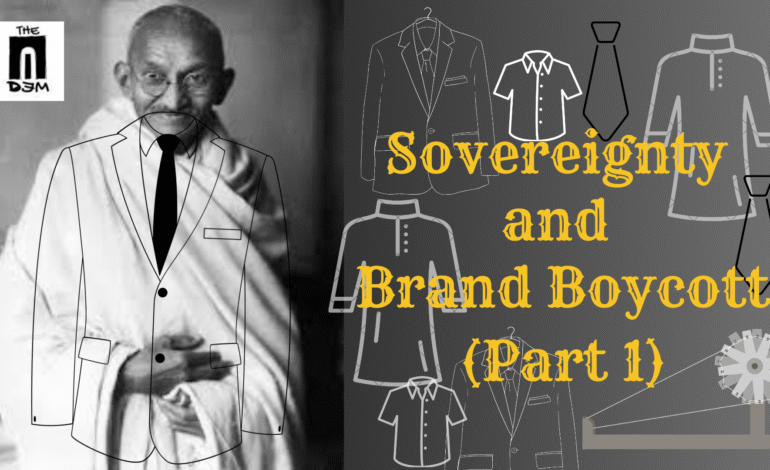
The politics and history hiding behind daily aesthetics are often the bearers of socio-economic and religious identity. Symbolic and social capital is etched onto human bodies through grooming, clothing, branded indulgences, the roll of the tongue while conversing, the crispness of the collar, the gait of walking etc, which are all ultimately discrete outfits signaling authority and power. The way in which we consume the world, the way markets micro-manage and serve the function of visibilising our socio-political identities is starkly evident. This series looks at how aesthetics have always been appropriated and transformed into symbols that are injected into everyday life through policy, rhetoric, propaganda, and deliberate ethical or moral statements and so on, and why one must always reflect on their daily habits to inspect the larger leviathan upholding and maintaining it.
(This article is divided into two parts. The following is Part 1)
Gandhi’s Journey of Ethics and Aesthetics
With the West Asia conflict pushing oil past $100 a barrel and dragging the rupee to record lows, India is facing a modern fight to protect its precious foreign exchange reserves. When Prime Minister Narendra Modi recently stood before the nation to deliver his urgent “seven appeals” asking citizens to skip foreign travel, postpone gold purchases and fiercely embrace swadeshi goods over foreign brands, it sent a clear signal to the world. Yet, this call for “economic patriotism” is not a new playbook. It is the revival of a century-old blueprint but executed more sincerely and sacrificially beyond just lip service.
Long before modern governance framed import reduction as a macroeconomic shield, a single man in a simple loincloth executed the most radical fashion boycott in human history. When Mahatma Gandhi shed his tailored London suits for a humble, hand-spun dhoti, he proved that a nation’s sovereignty is explicitly woven into what its citizens choose to wear. In the biting autumn of 1888, a young man of nineteen stood on the deck of a steamer as it navigated the murky waters of the Thames.
Mohandas Karamchand Gandhi did not arrive on the shores of England with the serene, sparse appearance that would one day define him. He arrived as a creature of profound anxiety, his heart fluttering with the dual burden of a mother’s vow and the crushing weight of colonial expectation. He was a student of the Empire, and in his trunks, he carried a collection of clothes that he believed would be his passport to civilization.
However, as the London fog seeped into his bones, Gandhi quickly realized that the fabrics of Kathiawar were a language the English did not speak. To the Victorian eye, he was an “Oriental” curiosity. To himself, he was a man in desperate need of a tailor. The journey of the Mahatma did not begin with a prayer or a protest. It began, curiously and somewhat comically, at the Army and Navy Stores on Victoria Street and the high-end boutiques of Bond Street.
To understand the radical nature of Gandhi’s later simplicity, one must first look back at the quiet, conventional world of Porbandar and Rajkot. Born in 1869 into a family of diwans, chief administrative officials to princely states, Gandhi’s early relationship with clothing was one of unthinking inheritance. In his Kathiawari childhood, attire was a marker of caste, regional pride, and the modest elite status of the Modh Bania community.
In his autobiography, Gandhi is uncharacteristically silent about his childhood clothes. This absence is telling. In the regional world of 19th-century India, a child’s dress was not a site of self-expression. It was a social uniform. One wore the turban of one’s caste and the tunic of one’s station. There was no “choice” to be made. Clothing functioned as a social skin, protecting the wearer’s status within the intricate hierarchy of the princely states.
Yet, this background provided the foundation for his later obsession with “correctness.” As a member of a family that served as the bridge between Indian subjects and princely rulers, Gandhi understood that appearance was a tool of diplomacy. When the opportunity to study law in London arose, he viewed the “gentleman’s costume” not as an ornament, but as a professional necessity. He was not just going to study the law. He was going to master the aesthetics of the lawmakers.
The London that greeted Gandhi was the beating heart of a global empire, a city that lived by rigid codes of conduct and even more rigid codes of dress. Settling into his studies at the Inner Temple, Gandhi felt a profound sense of “social awkwardness.” He was a vegetarian in a land of roast beef, a shy boy from a small town in a metropolis of towering confidence.
His solution was a radical attempt at assimilation. “I thought it was my duty to become an English gentleman,” he wrote. This was not a hobby. It was a full-time occupation. He spent hours in front of the mirror, parting his hair with meticulous care and agonizing over the knot of his tie.
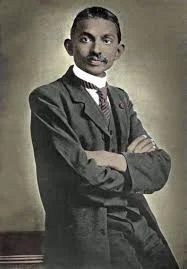
The transformation was expensive. At the Army and Navy Stores, strategically located near the seat of British power in Westminster, he purchased a “chimney-pot hat”, the iconic Victorian top hat, for nineteen shillings. But even this was not enough. To truly belong to the social world of the English Bar, he believed he needed the pinnacle of sartorial elegance. He ventured to Bond Street, where he spent ten pounds, a small fortune for a student, on an evening suit.
But the “gentleman” was more than just a suit. Gandhi enrolled in dancing classes to learn the grace of the ballroom. He took up the violin to master the music of the West. He hired a tutor for elocution to iron out the vowels of his native tongue. This was Gandhi’s most intense period of “self-fashioning.” He was attempting to build a shell so perfect that no Englishman could doubt his intellectual or social equality. The experiment lasted barely three months. The realization came not from a political awakening, but from a growing sense of spiritual and intellectual disharmony. As he practiced his violin and stumbled through his dance steps, a voice within began to whisper. “I was a student and ought to get on with my studies,” he reflected. “I should qualify myself to join the Inns of Court.”
He began to see the “chimney-pot hat” and the Bond Street suit for what they were: an elaborate camouflage. They offered entrance into rooms, but they did not offer peace. This early London phase was Gandhi’s first encounter with the “imbalance between appearance and purpose.” He began to simplify, though only slightly. He stopped the music and dance lessons, but he kept the suit. He had realized that the clothes did not make the man, yet he was still too fearful of the colonial gaze to discard them.
When he returned to India in 1891, called to the Bar at the Inner Temple, he was a fully-fledged “Black Act barrister.” He opened a practice in Bombay, appearing in court in his Western robes, stiff collar, and polished shoes. But the professional “shield” failed him in the moment of truth. In his first case, standing before a judge, his nerves shattered. “My heart sank, my head was reeling,” he recalled. The expensive English suit could not provide the inner strength required to speak. The “gentleman’s” costume was an empty vessel.
In 1893, Gandhi accepted a legal assignment in South Africa, still clinging to his Western professional identity. He arrived in Durban dressed as a high-status barrister, but the racial landscape of the Transvaal and Natal didn’t care about his Bond Street pedigree. The first major “sartorial skirmish” occurred in a Durban courtroom. Following the custom of Indian professionals of the time, Gandhi wore his Western suit but retained his Indian turban. To him, the turban was a sign of dignity and cultural rootedness. To the British magistrate, it was a breach of decorum, a refusal to fully submit to the visual order of the court. The magistrate ordered him to remove it.
Gandhi refused and walked out. This was a pivotal moment in the politics of his attire. He realized that the British did not just want him to be a lawyer. They wanted him to be a subject. The suit was allowed, but the turban was an act of defiance. He wrote to the press, defending his right to wear the headgear, and the “turban incident” became a cause célèbre. Yet, he was still conflicted. He “pocketed the insult” and continued to wear the Western suit for many years, believing that “professional status” was his only protection in a land that viewed Indians as “coolies.” He was a man caught between two worlds, using the enemy’s clothes to fight the enemy’s laws.
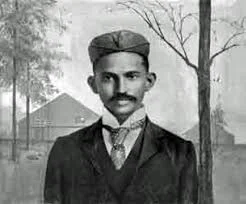
His true transformation began not in a courtroom, but in the trenches of human experience. Between 1899 and 1914, South Africa became Gandhi’s “laboratory.” During the Boer War, Gandhi organized the Indian Ambulance Corps. For the first time, he was not performing the role of a barrister. He was performing the role of a servant.
Clad in the functional, rugged gear of a medical corpsman, Gandhi felt the “dignity of physical work.” The heavy wool of the barrister’s suit was replaced by the lightness of service. He was sweating alongside indentured laborers, men who had never seen Bond Street and never would. He noticed that his expensive clothes “marked him out as a stranger among his own people.” The suit, which he had once seen as a bridge to the British, was actually a wall between him and India.
By 1910, the experiment moved to Tolstoy Farm. Here, Gandhi and his followers sought a life of total self-sufficiency. The Bond Street suits were not just discarded. They were rendered absurd. Life on the farm required building, carpentry, and gardening. Gandhi and his companions adopted “workingmen’s clothes”, inexpensive, durable trousers and shirts made of coarse blue cloth.
They also turned their attention to their feet. In the Transvaal heat, heavy leather shoes were a form of torture. Following the lead of his friend Herman Kallenbach, Gandhi learned the art of sandal-making. He found joy in the manual labor of cutting leather and stitching soles. By wearing sandals and work clothes, Gandhi was no longer trying to “fit in” with the masters. He was learning to “stand with” the oppressed. As Gandhi prepared to leave South Africa in 1914, the transformation was nearly complete. He had spent twenty years unlearning the lessons of his London youth. The “anxious effort” to be a gentleman had been replaced by a disciplined effort to be a human being.
He had learned a fundamental truth: clothing is never neutral. It can reinforce a hierarchy, or it can dismantle it. The Western suit had been an attempt to claim a status that the British would never truly grant him. By discarding it, he was reclaiming a power that the British could never take away.
When he finally set sail for India in 1915, he did not look like the man who had arrived in London in 1888. He was no longer a student of the Empire. He was a student of the soul. The “Tailor-Made Gentleman” was dead, and in his place was a man who had realized that freedom began with the courage to be ordinary.
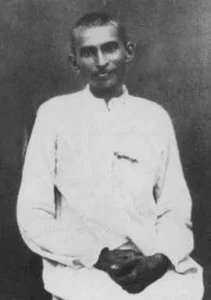
In January 1915, when the SS Arabia docked in Bombay, the man who stepped onto the pier was a curiosity to the waiting crowds. He was not the polished barrister who had left for London decades prior, nor was he yet the iconic ascetic of the Indian imagination. Mohandas Gandhi returned to his homeland as a man of “habit, not symbol.” He wore the simple garments he had grown accustomed to in South Africa, a plain tunic, a wrap, and the sandals he had stitched with his own hands.








A deeply reflective and intellectually rich article that reconnects Gandhi’s philosophy of clothing, swadeshi, and moral resistance with contemporary debates around sovereignty, consumerism, and political austerity. The piece thoughtfully examines how clothing was never just fabric for Gandhi, but a political language of self-reliance, dignity, and resistance against economic domination. The comparison with present-day appeals for austerity raises important questions about symbolism, authenticity, and the relationship between politics and public sacrifice. Insightful, timely, and highly relevant in today’s socio-political climate.
This article should be in school texts
I am sure Gandhi had rich friends and received gifts from them. But never let it known to the world.
Thank you
Very Beautifully crafted article. Thank you for this.
In London people hardly in this generation know about this great man from India. Sharing with others