

What We Lose When the Players We Love Grow Old

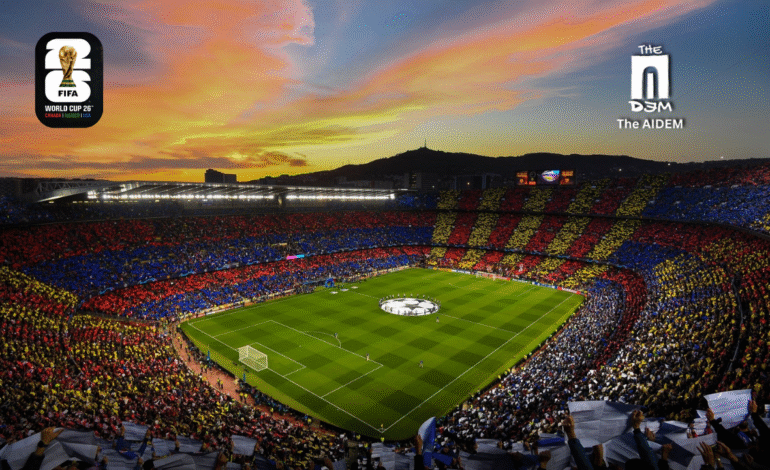
There is a particular kind of love that no one warns you about. A quiet, inherited kind; the kind that slips into you through the television screen, through your father’s voice rising an octave before a free kick, through the way the whole room holds its breath and, for one suspended moment, nothing else in the world matters at all.
That was how football found me. Through him.
My father was a player once. I know this the way I know most things about his youth: in fragments, in the past tense, in the way his eyes go somewhere else when he talks about it. He played, and he watched, and football was not a hobby for him but a language, a faith, a country he lived inside. He knew the names and the numbers and the histories. He could tell you about a match from decades ago the way other people tell you about their first love, with a precision that embarrasses you because you realise you have never remembered anything that clearly.
He had his gods before we had ours. Maradona, who played like he was settling a personal argument with gravity. Pelé, who exists in the memories of those who watched him the way myths exist: you’re never quite sure where the man ends and the legend begins, but it doesn’t matter because the feeling is real.
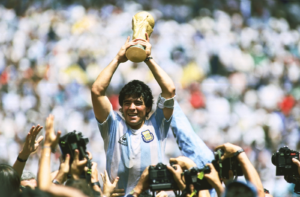
My father watched them with the particular devotion of a young man who had found something worthy of his whole heart. He watched Gulf Cup matches crowded around a screen with his friends, in that loud, argumentative, beautiful way young men watch football: everyone an expert, everyone wronged by the referee, everyone certain. Those rooms must have smelled of tea, cigarette smoke, and conviction.
And then, somewhere in the tenderness of a new marriage, he watched with her too, my mother, his new bride, who understood nothing about the game and everything about him; who sat beside him not for the football but for the shape of his joy; who asked questions that made him laugh; who probably still cannot explain the offside rule but could tell you exactly how his face looked when his team scored.
She watched for love. He never knew that was the most faithful kind of watching there is.
Then life did what life does to all of us. It accumulated. Work, responsibility, children, time, the slow sediment of adulthood settling over the passionate young man he used to be. He didn’t leave football. Football just… moved to a different room in his house. Still there, but quieter.
And then, somewhere in my childhood, he opened the door again. For us.
I was born in 1998. By the time I was old enough to understand what I was watching, Ronaldo—the one who moved like weather, like something that hadn’t yet learned that humans have limits—was already the reason to watch Real Madrid. And so Real Madrid became mine. Not chosen, exactly. More like recognised. Like the team had been waiting for me to arrive and claim it.
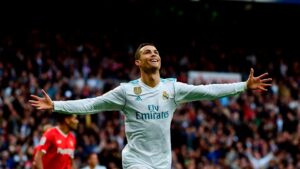
But it was Messi who broke something open.
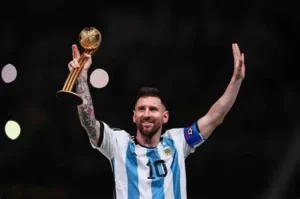
Watching Lionel Messi play football is not like watching a sport. It is like watching someone argue, very quietly and very politely, that the laws of physics were always just suggestions. He made me love Argentina the way you love a homeland you didn’t know you had. And so I carried two loves, club and country, the way some people carry two languages. Each one a different way of saying the same thing: this matters to me more than I can explain.
My father watched all of this with us, and for a while, we were fluent in the same tongue again. He’d point out a pass before it happened, explain a formation with his hands, say the name of an old player the way a poet says a word they’ve always loved the sound of. We were three generations of something: his old fire, our new fire, all of it burning in the same living room.
Then came 2022.
Qatar. December. The final.
I need you to understand what that month was for me. I need you to understand that the word anxious is not sufficient. Football had become, by then, entangled with everything—with identity, with joy, with the particular Argentine grief of a nation that had been waiting for Messi to be given what he had always deserved. And I had been waiting with them.
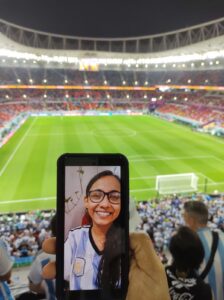
When Argentina played, I did not watch. I survived. I bargained with the television. I hid from the screen and then couldn’t stay away. I cried before goals, after goals, instead of goals. The penalty shootout against France was not sport. It was surgery performed without anaesthesia.
And they won.
They won.
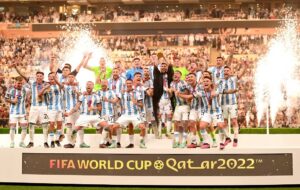
I want to tell you I remember exactly what I felt in that moment, but the truth is that I was so far outside myself that the joy arrived later, slowly, like a tide coming in. Relief before happiness. Release before celebration. Like something I had been clenching for years finally, finally unclenched.
It was in that madness, in that beautiful, exhausting, life-consuming madness, that I looked over at my father and noticed, for the first time, that he wasn’t there with me.
Not absent. He was in the room. He was watching. He even smiled when we scored. But the frequency was different. He had stopped tuning in to the same channel. He spoke about the old games, the old names, with more tenderness than he spoke about anything happening in front of us. He knew Mbappé was extraordinary—he even said so—but it was the way you compliment a stranger. Politely. From a distance.
He had lost the fire.
It startled me. Then it settled into something sadder than surprise: recognition. I had seen this happen with films too. My father, who once devoured cinema, now finds little he can love in what is new. He returns, always, to what he already knows. He is not indifferent; he is resolved. Fixed. Like a compass that has found its north and has no interest in being redirected.
I found it frustrating, in the way you find a person frustrating when you love them and cannot reach them. But I have come to understand it differently now.
Because I think I am beginning to understand it from the inside.
This World Cup, in 2026, I will watch. I want to be clear about that: I will always watch. Football is mine now, genuinely mine, not borrowed from a father or a boyfriend or a childhood phase. But something has shifted in me too, and I am still learning its shape.
The anxiety is gone. Or not gone—quieter. Replaced by something more like peace, which should feel like an upgrade but sometimes feels like loss. We won. My team won when it mattered most, with the player I loved most, in the final that felt like a whole life’s worth of waiting. I got what I wanted. And now I watch without my chest in my throat, and I don’t quite know yet whether that is healing or fading.
But that is not what frightens me.
What frightens me is Messi’s age. What frightens me is the mathematics of it, the inexorable, indifferent arithmetic of time applied to the bodies of the people we love to watch. Messi will play this World Cup as I have known him to play, and then, the curtain. And with it, something I cannot name will close.
The players who made me fall in love with this sport are playing their last tournaments. I know this. I watch Messi now, and I watch him differently than I used to, with a kind of reverence that is also a kind of grief, like watching a sunset you know is the last one before a long winter. Every moment with him on the pitch feels both ordinary and sacred, and I don’t know how to hold both of those things at once.
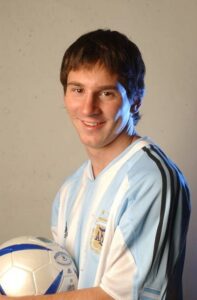
After he is gone, after all of them are gone—Ronaldo, Messi, the whole luminous generation that raised me—who will make me feel this way? I am told there will be others. There are always others. Mbappé is extraordinary; I know this the way my father knew Mbappé was extraordinary: politely, from a distance. The next generation will be brilliant and worthy, but they will not be mine.
And I find myself afraid—afraid in the way my father maybe never thought to be afraid because it crept up on him quietly—that I am standing at the edge of my own passion. That this World Cup is not just the last one with my favourite players. That it might be the last one in which football feels like it did at 3 a.m. in Qatar, with my heart outside my body.
Maybe it is age. Life has its own demands, its own competitions, its own scorelines I have to track. Maybe passion is finite, not in the heart but in the hours, in the attention, in the willingness to let something wreck you temporarily for the sake of beauty.
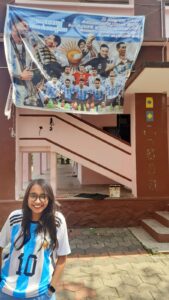
Maybe I am becoming my father.
And perhaps that is not the tragedy I fear it is.
Perhaps every generation gets a golden window, a stretch of years when football (or film, or music, or whatever it is that finds you) arrives at exactly the right moment and writes itself into you permanently. My father had his window. I had mine. His closed slowly, and he didn’t notice until it had. Mine, I can see closing. I am watching it close.
And there is grief in that, yes, but also something else. Something almost like gratitude.
Because I got to have it. I got to be the girl who could not breathe during a penalty shootout. I got to be the girl who cried for a footballer the way other people cry for poetry. I got to love something with my whole nervous system, with my whole self, irrationally and completely, the way we are rarely allowed to love anything past a certain age.
My father gave me that. Without meaning to, without ceremony, simply by loving something first and letting me watch.
So this World Cup, I will watch knowing it is the last time for certain things: the last time for these players, maybe the last time for this version of myself. I will try to memorise how it feels. Not the scoreline. The feeling.
The held breath before a free kick.
The whole room going still.
My father’s voice, somewhere in my memory, saying a name as though it’s the only word he knows.
The beautiful game does not owe us permanence. It only ever promised to be beautiful. And it kept that promise, every single time.
That has always been enough.








**“A thoughtful reflection on one of sport’s most universal emotions—the bittersweet realization that even our greatest heroes grow old. Beautifully written and deeply relatable.”**