

Waste, Responsibility and Decentralisation: A Gandhian Perspective on Solid Waste Management in Kerala (Part 2)

Applying Gandhian Principles to Waste Management
The source-level segregation of solid waste cannot move in a genuinely Gandhian direction if the segregation of biodegradable and non-biodegradable waste ends at the household or commercial level. It must continue systematically through every level of Gandhi’s “oceanic circle of villages.”
In other words, the processing of solid waste generated within each Local Self-Government (LSG) unit should, to the greatest extent possible, be carried out within that unit itself. The only exceptions should be cases that unavoidably require highly specialised, capital-intensive technologies, such as the treatment of hazardous biomedical waste. Otherwise, decentralised solid waste management—which is intended to prevent waste from accumulating in massive dumping sites and triggering public protests and ecological disasters will fail in practice.
Interestingly, in his critique of centralised production and unfettered markets, Gandhi acknowledged the occasional necessity of centralisation and the use of machines. This principle applies equally well to modern solid waste management. Disposal facilities for biomedical waste, e-waste, and specialised toxic waste streams (such as Kerala Enviro Infrastructure Ltd. (KEIL) in Kochi) are more efficiently developed at the state or regional level than by individual local bodies. Because the solid waste economy functions as a miniature reflection of the broader market economy, such limited centralisation can effectively complement a decentralised network of local units.
The Circular Economy and the Language of Responsibility
Reversing the failed paradigm of centralised waste management requires a transition towards a circular economy that emphasises waste reduction, material reuse, and recycling. However, such a transition will remain incomplete unless we fundamentally change the vocabulary we have traditionally used to describe solid waste management. This linguistic dimension has received remarkably little attention.
For example, the phrase “lack of availability of land” is frequently invoked by councillors, Urban Local Body (ULB) officials, and politicians to justify their inability to identify land or persuade ward members and councillors to accept local waste management facilities. Yet establishing such facilities is one of the fundamental administrative responsibilities of a ULB. When local bodies fail in this responsibility, that civic failure should not be concealed behind passive, market-sounding expressions such as “unavailability of land.”
Instead, we must collectively acknowledge our inability to develop local solutions within the ward. The bottle booths now found at many street corners provide one example of such local interventions. We need a vocabulary that emphasises accountability at every level, rather than a rights-based discourse that allows citizens or their representatives to offer superficial justifications. The solid waste ecosystem differs fundamentally from the logic of the market economy; it is governed primarily by shared public obligations rather than individual private rights.

Implementing a circular economy in waste management while simultaneously allowing a free-market economy to flourish in the production of goods and services is a difficult proposition for any developing region. It is therefore essential to make people aware that the language used in administration and public policy can itself either facilitate or obstruct a genuine transition to a circular economy.
Regional Realities and the Informal Sector
This linguistic and administrative challenge is further complicated by regional differences. A national framework such as India’s Solid Waste Management Rules (2016, and the subsequent amendments) provides an essential legal foundation, but each state requires strategies tailored to its own geographical and demographic conditions. Kerala’s realities differ significantly from those of Rajasthan or Himachal Pradesh. For example, Kerala’s coastal municipalities face acute challenges such as leachate management and marine pollution, while its exceptionally high population density severely limits the availability of land for waste management infrastructure.
Similarly, waste streams such as construction and demolition waste, as well as electronic waste, remain heavily dependent on informal networks of scrap dealers and waste pickers. Although these informal actors perform an invaluable socio-economic function by recovering and recycling materials, the environmental and occupational hazards associated with their work often remain inadequately addressed. A comprehensive decentralised waste management policy must therefore recognise and systematically integrate these informal systems into the formal waste management framework.

Conclusion
In short, Gandhiji’s conception of society grounded in individual responsibility, duty, decentralisation of power and wealth, and the pursuit of truth offers profound insights for achieving the goals of modern solid waste management. This is particularly significant because failures in waste management are ultimately philosophical failures as well: failures to perceive the world as an interconnected whole rather than as fragmented spheres organised around the maximisation of individual gain. A genuinely Gandhian perspective also requires us to extend our ethical concern to other forms of life and to the shared environment upon which all life depends.
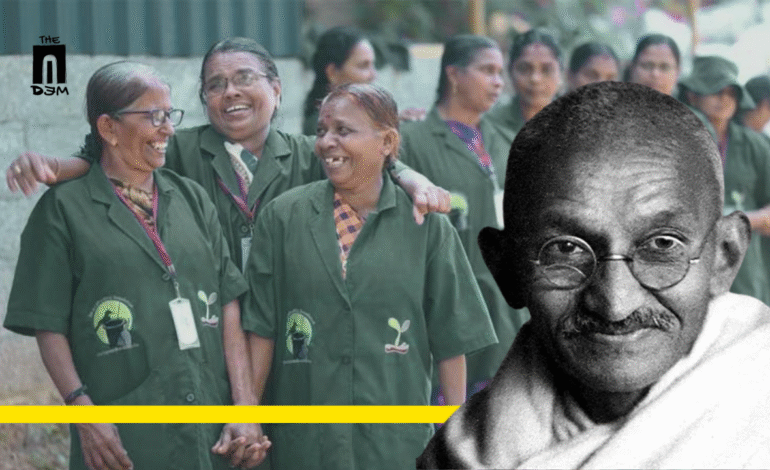
Kerala’s relatively successful experience over the past five years demonstrates that solid waste management cannot succeed unless the principle of decentralisation of power, wealth, and responsibility is upheld throughout the entire system from segregation at the household level, to localised collection by the Haritha Karma Sena, to processing at Resource Recovery Facilities (RRFs), and finally to the safe treatment and disposal of inert waste.
Furthermore, the state must assume responsibility in a manner that ensures that inert waste; the fraction that cannot be recycled further is not simply transported beyond Kerala’s borders for final disposal. Adopting such a self-sufficient approach will reinforce public awareness of our own immense local responsibility. Efficiency in the solid waste economy is maximised when responsibilities are fulfilled by individuals, households, and governance institutions at every level. Otherwise, an exploitative system driven by competition, externalised costs, and greed will prevail, allowing private agencies possessing capital and technical expertise to profit at the expense of ecology and public health.
The future of urban waste management lies neither in technology alone nor in market mechanisms alone. Both are essential tools, but neither can substitute for the social foundations of waste management. Effective systems emerge when citizens actively participate, local governments coordinate transparently, public institutions provide effective oversight, and private actors contribute where appropriate. Waste management succeeds not when waste is treated merely as a market commodity, but when it is recognised as a shared civic responsibility.
Read the Part 1 of the Article here









“A compelling continuation of the discussion on waste management. The article convincingly argues that sustainable solutions require not just better infrastructure but also active citizen participation, local governance, and a sense of shared responsibility. The Gandhian emphasis on decentralisation remains remarkably relevant in addressing today’s environmental challenges. Thought-provoking and insightful.