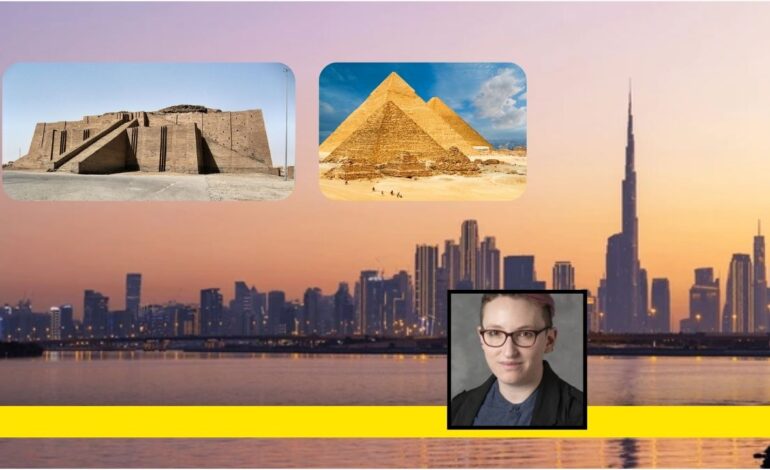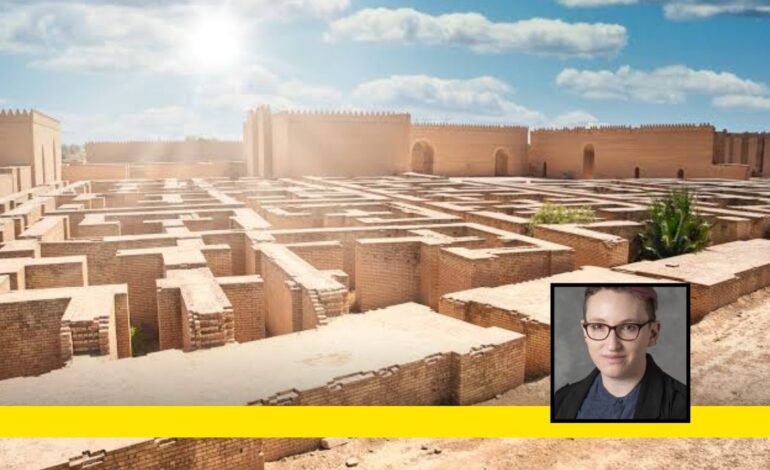
From towering ziggurats to sprawling urban grids, the legacy of ancient Mesopotamia continues to influence how we shape our cities today. This fascinating exploration takes you on a journey to the cradle of civilization, where the first blueprints for modern urbanism were drawn. The article delves into how the ingenuity of the Sumerians, Babylonians, and Assyrians – through their architecture, urban planning, and societal organisation – laid the groundwork for the modern cityscape. This is a study that has special relevance to our times, when the continuity of this great civilisation is sought to be stamped out through reckless military assaults led by US imperialism.
Published in two parts, this series uncovers the story of Mesopotamia’s innovative urban culture and its profound influence on the present. The first part focuses on the origins of urbanisation and the rise of monumental architecture like ziggurats and temples.
In the early 20th century, architects turned to a newly discovered past to craft novel visions of the future: the ancient history of Mesopotamia. Eva Miller traces how both the mythology of Babel and reconstructions of stepped-pyramid forms influenced skyscraper design, speculative cinema in the 1910s and 20s, and, above all else, the retrofuturist dreams of Hugh Ferriss, architectural delineator extraordinaire.
In a dramatic, monochrome rendering in ink and charcoal, a fractal of pyramids and steps regenerates at different scales and angles. Vertiginous towers, the tallest outgrowing the frame, ascend from a base of tiered structures—or ziggurats—rising in regular terraces. The roofs of lower blocks are dotted with minuscule trees that echo the larger, man-made shapes around them. They are the only living things visible at this scale, but an accompanying text tells us that this skyline is populated with people who enjoy the city’s elaborate roof gardens, sun porches, and open-air swimming pools.

This was how Hugh Ferriss imagined the future of urbanism in his treatise Metropolis of Tomorrow (1929). Born in St. Louis in 1899, Ferris trained as an architect and forged a career for himself in a role for which he invented his own job title: “architectural delineator,” bringing other architects’ projects to life on paper. His portfolio, now held by the Avery Art and Architecture Library at Columbia University, speaks to his proximity to numerous major works of modern architecture and engineering, including renderings of Rockefeller Center, Works Progress Administration infrastructure projects, World’s Fairs, United Nations buildings, and various mysterious, unnamed structures of his own imagination—visions swimming up to us through Ferriss’ dramatic wash of line and shadow.
City of Tomorrow
Metropolis is a portfolio of Ferriss’ images, annotated with reflections on the work he had participated in and the architectural changes he had witnessed during recent decades, when American cities, especially his adopted home of New York, exploded upward. He made modest trend forecasts for the near future: glass, he predicted, would be huge (true); hydroplanes would be everywhere (sadly not).
In the final, most memorable section of the book, he sketched a distant City of Tomorrow. This city would be planned along rational lines to maximize human health and spiritual happiness through a three-part plan with districts for art, science, and business, each centered on aesthetically appropriate superblocks.
Ferriss’ dramatic depictions of towering skyscrapers and lofty perspectives became, as media scholar Eric Gordon argues, the means by which “the image of the American urban future in the popular imagination took shape.” His futurism anticipated and influenced Norman Bel Geddes, as he created his Futurama for the 1939 New York World’s Fair, the Walt Disney Company’s Tomorrowland, TV’s “The Jetsons,” and numerous other prognostications of the rational planned city, the elevated expressway, and the heliport.

Yet Ferriss’s forward-looking vision also repeatedly evoked the ancient past. The pyramid skyscraper that he promoted was, in his own description, a “modern ziggurat,” the monumental architectural form of ancient Mesopotamian cities. Centered in modern-day Iraq, both Assyria and Babylon were geopolitical superpowers of the first millennium BCE, empires discussed in both biblical and classical traditions, which had once been considered lost to the desolating force of time. Beginning in the mid-19th century, the crumbled remains of ziggurat towers had inspired speculative reconstructions.
By the 1920s, German excavations had exposed the well-preserved urban fabric of Babylon’s 6th-century BCE city walls and gates, parts of which were also partially reconstructed in Berlin’s Pergamon Museum, looking rather Art Nouveau. Meanwhile, the nearby city of Ur was being excavated by thousands of workers in digs sponsored by the British Museum and the Penn Museum, turning up mass burials of gold-bedecked bodies. These new discoveries stirred those who read about them in the popular press to imagine an antiquity that was also somehow strangely modern: The women’s fashion in the Ur burials led to press jokes about the dead bodies being traces of the original flappers.
Ferriss was clearly not the only person who thought there might be some connection between the urban spaces of ancient Babylon and Assyria and the cutting edge of modernity. At a time when being modern, especially in architecture, often meant explicitly rejecting historical reference, it is notable how much the idea of an original urban form structured visions of the future.
Learning From the Past
At the time of Ferriss’ Metropolis, a question had bedeviled modern architects for decades: What could be learned from the traditions of the past? Were the great buildings of antiquity, particularly of classical Greece and Rome, eternal blueprints, a standard never to be bettered? Architectural training programs in the United States during the early 20th century suggested this was the case. But increasing numbers of builders worried that the adulation of the past produced dead, stagnant structures that were irrelevant to the modern world.

Wherever they came down on this matter (and there was a wide middle ground), numerous commentators with different aesthetic preferences could agree on damning random and eclectic historical borrowing—even if they might have disagreed on what constituted an example of that tendency.
Perhaps no writer treated this historicizing, classicizing eclecticism with more vitriol than the perpetually worked-up Ayn Rand. Her architectural-philosophical melodrama The Fountainhead, published in 1943 but set during the years that Ferriss was writing, was an insightful, if unsubtle, rant against these trends. She castigated architects who “competed on who could steal best, from the oldest source and from the most sources at once,” resulting in “shingled post offices with Doric porticos, brick mansions with iron pediments, lofts made of twelve Parthenons piled on top of one another.” She imagined a benighted public who celebrated a skyscraper which “offered so many columns, pediments, friezes, tripods, gladiators, urns, and volutes that it looked as if it had not been built of white marble but squeezed out of a pastry tube.”
Ferriss was against this kind of inauthenticity, too, advocating that modern buildings must follow the diktat of America’s great modernist innovator, Louis Sullivan: Form ever follows function. Architects of the future, Ferriss assures us: “…will dismiss, as sentimentality, the notion that architectural beauty was once and for all delivered to the builders of ancient times. The employment of modern construction to support what are little more than classic or medieval stage sets, they will look upon as, at its most harmless, a minor theatrical art, but no longer as being Architecture.”
He mocked this kind of “stage set” architecture in an illustration of the “Reversion to Past Styles” for Metropolis. He bemoaned this tendency’s persistence “despite the logical, and sometimes impassioned, pleas of leaders in modern design.” Still, stacks of “the same conventional forms” were appearing, and Ferriss believed it was his “duty to show what would happen if architects continued piling Parthenons upon skyscrapers!”
Ferriss nonetheless found in the past some examples of an ethos, if not an aesthetic, to imitate. He explained: “It can be recalled that there have been periods in the past when architects must have been quite aware of the influence of Architecture and consciously employed it for a specific object. Moreover, it is precisely these periods that are still spoken of as the ‘great periods’ of Architecture.”
His illustrative example is the Gothic cathedral, intended by its builders, through its very form, to exert “an influence for the betterment of mankind… It would seem, in fact, that Architecture was here consciously employed for no less an object than the elevation and evolution of Man.” This decidedly futurist conception of architecture’s possible benefits (“elevation,” “evolution,” and “Man” with a capital “M”) had a venerable, historical precedent.

Ferriss’ distinction—between mere regurgitation, on the one hand, and a deeper appreciation of the eternal power of certain forms and practices, on the other—was also made by architects who agreed that there might be lessons to be drawn from the approaches of medieval and ancient civilizations. The Swiss modernist Le Corbusier, perhaps the most famous prophet of planned future cities, cited the Parthenon as the apogee of an architecture of basic geometric forms, a “pure creation of the mind,” evoking “emotion of a superior, mathematical order” and embodying a spirit of “imagination and cold reason.” He detected an analogous spirit at work in the design of the telephone, the airplane, and the automobile.
Louis Sullivan agreed. In the same article in which he argued for form to follow function, Sullivan cited rare periods when architecture was a “living art,” which had produced “the Greek temple, the Gothic cathedral, the medieval fortress”—a grouping he argued was now being joined by “the tall office building.” In all of these examples, radical designs enabled by new technologies were nonetheless produced by the same animating spirit, the same eternal dicta, as the enduringly powerful forms of the past.
The Tower of Babel and Modern Babylons
While Greek temples and Gothic cathedrals were often cited in this period as architecture done right, they were also models tarnished by poor and unsuitable imitation and inauthentic to modern materials and methods of construction. For thinkers wary of mere historical reproduction but nevertheless in search of essential or eternal forms, ancient Assyria and Babylon were appealing places to turn to due to their simultaneous associations with modernity (a “newly discovered” past) and originality.
This latter association was forged both by historians who drew on archaeological evidence to identify these civilizations of ancient Mesopotamia as the cradle of (Western) civilization and by the enduring cultural power of one of the most familiar and transmitted stories about the origins of monumental architecture: the Biblical Tower of Babel (or Babylon—merely two English renderings of the same place name).
Western artistic traditions had often visualized the Tower of Babel as a spiral, a form that Frank Lloyd Wright famously adopted and described as a ziggurat or, when turned upside down for the Guggenheim, a “tarrugiz.” As historical knowledge of ancient Iraq grew in the latter decades of the 19th and early 20th centuries, archaeological reconstructions imagined the mythical urban tower as a stepped pyramid, similar to the descriptions of Babylonian buildings by the Greek historian Herodotus.

The brief but rich story of the Tower of Babel closes the series of primordial origin myths in the first part of Genesis: the end of humanity’s childhood. “Let us build ourselves a city and a tower with its top in the heavens, and let us make a name for ourselves; otherwise we shall be scattered abroad upon the face of the whole earth,” its builders resolve. God sees a threat in this cooperative venture, for humans who could complete such a project would be unstoppable, like gods. To prevent its completion, he turns their universal language into a nonsensical babble of tongues and scatters humans across the earth.
Part 2 to follow tomorrow.
This article was originally published on Wiki Observatory and republished via NewsClick.