

Ceasefire or Climbdown? Trump’s Shifting Positions and the Politics of Coercion

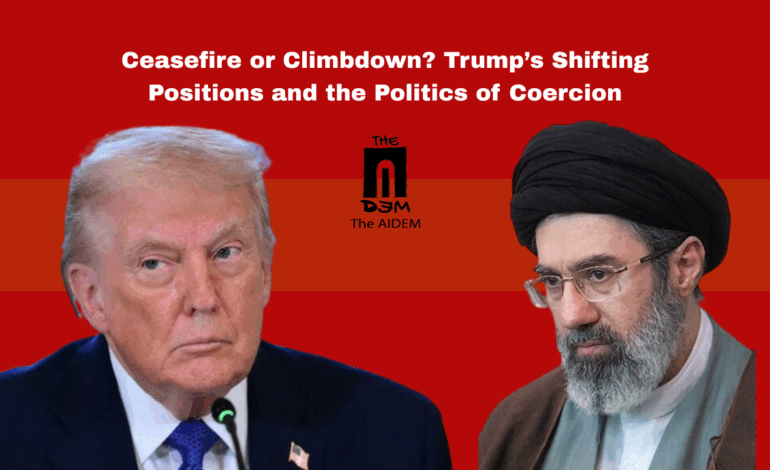
In the rapidly shifting theatre of the U.S.–Iran confrontation, former U.S. President Donald Trump has attempted to project the latest ceasefire plan as a decisive victory. Yet beneath that claim lies a striking reality: the ceasefire is to be discussed on the basis of Iran’s proposal—not Trump’s.
This alone exposes the central contradiction of the moment.
Even as Trump continues to issue threats—warning that “a whole civilisation will die”—the diplomatic process has moved onto terrain defined not by Washington’s demands, but by Tehran’s framework.
Iran’s 10-Point Plan as Actual Basis of Talks
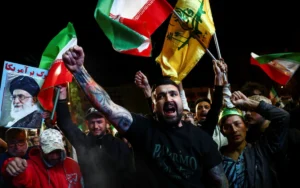
According to multiple confirmed reports, Iran’s proposal—described by Trump himself as a “workable basis”—includes the following core elements:
- Complete cessation of hostilities across all fronts
- A permanent end to war, not a temporary ceasefire
- Guarantees against future attacks on Iran
- Lifting of all U.S. sanctions
- Release of frozen Iranian assets
- U.S. military withdrawal from the region
- Reopening of the Strait of Hormuz under Iranian oversight
- Framework for secure and regulated maritime navigation
- Reconstruction funding mechanisms (including transit revenues)
- Continuation of Iran’s strategic and nuclear autonomy (implicitly retained in negotiations)
This is not merely a ceasefire proposal—it is a post-war settlement vision, rooted in sovereignty, security guarantees, and economic restoration.
Trump’s 15-Point Plan: Maximalism Without Clarity
By contrast, the U.S. “15-point plan” remains:
- partially undisclosed
- internally inconsistent
- and, at one point, even denied in full by the White House itself
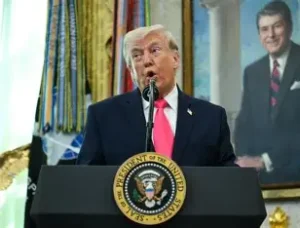
What is known, however, reveals its character:
- Complete dismantling of Iran’s nuclear programme
- Permanent prohibition on nuclear weapons capability
- Transfer or international control of enriched uranium
- Restrictions on missile programmes
- Rollback of regional alliances and proxy networks
- Reopening of Hormuz under non-Iranian control
Iran rejected this framework outright, calling it “excessive” and “illogical.”
The Critical Shift: Negotiations on Iran’s Terms
The most politically significant development is this: The ceasefire negotiations are proceeding on the basis of Iran’s 10-point plan—not Trump’s 15 points. Even Trump has acknowledged that Iran’s proposal is the “workable” foundation for talks. This marks a quiet but profound shift: From the U.S.-driven diktat to Iran-defined negotiation framework and from maximalist demands to reciprocal conditions. This also marks a shift from rabid threats of coercion to compelled engagement.
Ceasefire as Contradiction
But this is also where the contradictions sharpen.
Trump’s public posture remains one of overwhelming force: the threats of infrastructure destruction and warnings of civilisational annihilation and claims of total victory continue apace. Yet the diplomatic reality suggests something else, especially the acceptance of Iran’s framework and the abandonment (or dilution) of the 15-point plan as well as movement towards negotiated terms rather than imposed ones.
The ceasefire, therefore, is not a simple pause in war. It is a political balancing act—between escalation rhetoric and negotiated restraint.
From Coercion to Compulsion
The coexistence of these two tracks—threat and negotiation—reveals a deeper dynamic:
- The 15-point plan represented an attempt at unilateral restructuring of Iran
- The 10-point plan asserts mutuality, sovereignty, and long-term guarantees
Where the former demanded submission, the latter demands recognition.
That negotiations are now anchored in the latter suggests not dominance, but strategic compulsion.
Narrative vs Reality
This divergence is being actively managed in the narrative space. This is not unusual. In modern conflicts, perception management often runs ahead of political reality. The language of victory becomes a way to mask the necessity of compromise.
The emerging ceasefire is not simply about ending hostilities. It is about who defines the terms of peace. Trump’s threats of civilisational destruction suggest total war. His acceptance of Iran’s framework suggests negotiated limits.
Between these two positions lies the truth of the moment: The war has not ended—but its logic has shifted. And in that shift, the most significant development is this: not that a ceasefire has been declared, but that it is being negotiated on Iran’s terms.
An uneasy historical echo may be invoked here—not as equivalence, but as contrast. When Adolf Hitler’s forces entered Paris in 1940, it marked the culmination of total war and absolute military victory, leaving no space for negotiation, reciprocity, or shared terms. Power spoke then in the language of occupation, not dialogue.
The present moment, however, points in a different direction. Despite the rhetoric of overwhelming force and civilisational threat, the movement is not towards Paris like situation during the Second World War , but away from it—not towards unilateral triumph, but towards negotiated constraint. If anything, this underscores a fundamental reality: that even in an age of coercion, the limits of power assert themselves, compelling engagement where domination was once assumed.








“An insightful analysis of shifting strategies and the complex politics behind coercion and ceasefire narratives.”