

Empty Trains, Full Stages: The Political Optics Behind Vande Bharat’s Empty Seats

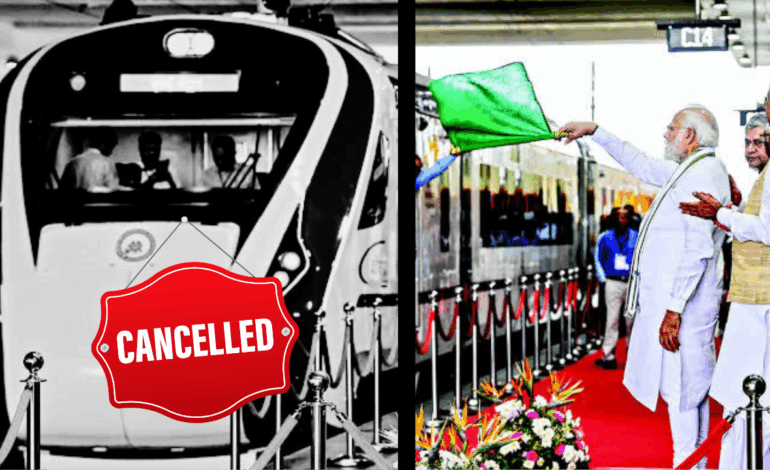
The Udaipur–Agra Vande Bharat is being withdrawn with the official explanation that “there are not enough passengers.” Behind that bland line lies a familiar story of headline-driven infrastructure, inflated optics and an unwillingness to confront basic arithmetic: demand, fares, travel time and public money.
A train that never added up
On paper, the Udaipur–Agra Vande Bharat was sold as a symbol of modern rail mobility. In practice, it struggled to attract even half the passengers it was designed to carry, reportedly running for months with roughly 30–40% occupancy, while conventional express and superfast trains on the same corridor were close to full and often went into waiting lists. The journey itself took about eight and a half hours end to end; the time saved over existing options was only about half an hour. Yet the AC chair car fare on Vande Bharat was roughly double the fare of a regular AC chair car on other trains on the route.
Launched in 2024 with the usual spectacle of drums, ribbon-cutting and photo ops, the service appears to have gone ahead without serious answers to basic questions: How many passengers travel daily between Udaipur and Agra? What is their paying capacity for a daytime premium service? How much genuine tourism demand exists along this corridor, and in what seasons? As subsequent occupancy figures suggest, the train was misaligned with both the volume and the profile of demand, and its coaches ran sufficiently empty that withdrawal became a matter of time.
Low occupancy is not an exception
Udaipur–Agra is not an isolated aberration; it is part of a pattern. The Prayagraj–Gorakhpur Vande Bharat, for instance, has struggled badly to fill seats. Reports from 2024 noted that the train was unable to achieve even 50% occupancy on many days, with hundreds of seats going empty from Prayagraj, even around peak periods such as Holi, while conventional intercity and express services on similar routes continued to run with long waiting lists.
The Gorakhpur–Patliputra Vande Bharat has been dogged by similar complaints. Here too, occupancy has frequently hovered below the 50% mark, with passengers pointing out that journey times are not dramatically better than those of existing express trains, while AC chair car fares in the ₹900–950 range make the service nearly twice as expensive as alternatives on the same route. In such a scenario, passengers rationally trade a modest increase in travel time for substantially lower fares.
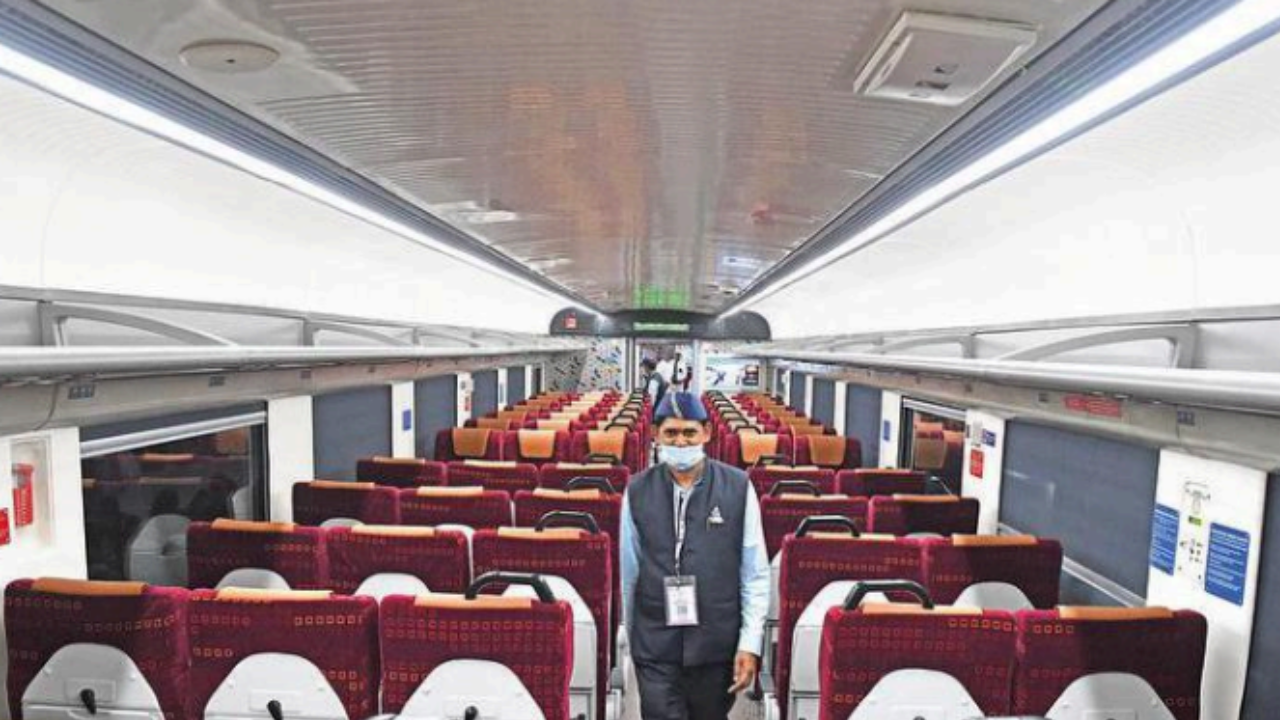
Across the network, several other Vande Bharat corridors show the same mismatch. Services such as Visakhapatnam–Durg, Nagpur–Sikandarabad, Madgaon–Mangaluru, Udaipur–Jaipur and Udaipur–Ahmedabad have all been reported at various points to be operating with load factors below 50%, in some cases forcing Indian Railways to cut coaches to stem visible underutilisation. By contrast, routes like Delhi–Varanasi, Delhi–Katra and certain Vande Bharat services in Kerala have routinely recorded 100–150% occupancy, with substantial overbooking and crowding. The contrast is instructive: where fares, route logic and timetables match real demand, Vande Bharat attracts passengers; where the service is pushed on corridors with weak demand or low paying capacity, the seats simply do not fill.
South Indian Performance
However , in the South Indian States , especially Kerala , Tamil Nadu and Karnataka , the Vande Bharat trains have performed relatively better . This is of course not accidental . It reflects a broader context of more diversified regional economies, higher levels of urbanisation, stronger tourism circuits and comparatively better last-mile connectivity that together create sustained, two-way travel demand. In states such as Kerala, Tamil Nadu and Karnataka, higher literacy rates and greater public awareness about service quality and value for money also shape travel choices more sharply. Passengers are often more responsive to reliability, punctuality and comfort, but equally sensitive to fare differentials and time savings. Where Vande Bharat services in the south align with dense intercity corridors, robust business travel and year-round tourism, they tend to perform well; where these structural factors are absent, even a premium train struggles. The difference, in other words, lies less in the brand and more in the underlying developmental ecosystem.
The election calendar as timetable
Overlaying these operational realities is a visible political pattern. The flagging-off of new Vande Bharat trains has repeatedly coincided with election cycles or moments of heightened political focus in specific states. In Himachal Pradesh, for example, a Vande Bharat service from Una was flagged off just ahead of state elections, with the Prime Minister’s presence on the platform plainly framed as a political message to a small hill state. In Gujarat, the high-profile Ahmedabad–Mumbai Vande Bharat was launched in the run-up to assembly polls, amplifying the narrative of connectivity and development in the Prime Minister’s home state.
South India has seen the same choreography. The first Vande Bharat in the region, between Bengaluru and Chennai, was flagged off amid intense political jockeying in Karnataka, and subsequent multi-train inaugurations from Bengaluru were scheduled close to the 2023–24 election season. More recently, India’s first Vande Bharat sleeper train was inaugurated on the Guwahati–New Jalpaiguri and associated Northeast–Eastern India corridor in January 2026, at a time when both Assam and West Bengal were politically salient in the national calculus.
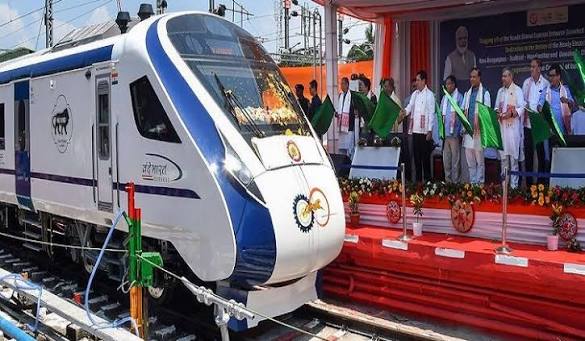
The pattern is not limited to state elections. The very first Delhi–Varanasi Vande Bharat was launched just ahead of the 2019 general elections from the Prime Minister’s own constituency, and later services such as Delhi–Katra have been pitched around politically important religious and regional hubs. A detailed analysis of Vande Bharat route launches and India’s “busy electoral calendar” explicitly noted the concentration of inaugurations in poll-bound regions, describing the trains as rolling symbols of development designed to ride straight into campaign imagery.
Inauguration as big-ticket event
If the timing is political, the scale of the inauguration events is financial. In 2019, an RTI-based report found that the inauguration of the first Delhi–Varanasi Vande Bharat Express involved spending ₹52.18 lakh solely on the function: tent, pandal, lights and allied arrangements. That figure now looks almost modest.
In November 2025, the Prime Minister flagged off four new Vande Bharat trains from Varanasi in a single, carefully staged mega event. An RTI reply obtained thereafter revealed that the North Eastern Railway’s Varanasi division spent ₹3,37,93,351 on that one ceremony alone, approximately ₹3.38 crore for a programme that included a few minutes of formal flagging-off and speeches. Broken down, this amounts to roughly ₹84.5 lakh per train, purely on event management and optics.
The pattern holds elsewhere. RTI-based reporting on Southern Railway expenditures showed that the inauguration of the Thiruvananthapuram–Kasargod Vande Bharat in Kerala cost around ₹1.48 crore, while the launch of the Chennai–Coimbatore Vande Bharat cost about ₹1.14 crore. In total, for just four Vande Bharat inaugurations in the south, more than ₹5.6 crore of railway funds were spent on stages, sound systems, publicity and payments to private event management firms.
All this sits uneasily alongside another RTI revelation: the Railway Board has admitted that it does not maintain separate, train-wise profitability or revenue records for Vande Bharat services. Instead, the financial performance of these high-profile trains is subsumed into broader categories, making it impossible for citizens — and perhaps even for internal planners — to clearly see which specific routes are generating sustainable revenue and which are bleeding money. Detailed figures thus exist for inauguration spending, but not for route-level financial viability.
Optics, arithmetic and accountability
The political class and the railway bureaucracy have responded to low ridership with a familiar argument: “the public is not buying tickets.” In this framing, the failure lies in the citizen’s reluctance to pay for a premium service. Yet when one examines the basic parameters, the reluctance looks more like a rational choice.
On corridors like Udaipur–Agra, Prayagraj–Gorakhpur and Gorakhpur–Patliputra, Vande Bharat trains offer marginal gains in travel time compared to existing express services, at close to double the fare for AC chair car. On several other new routes, particularly in less affluent regions, the paying capacity of the local population is modest, tourism demand is limited or seasonal, and alternative trains already provide acceptable connectivity at much lower cost. Under these conditions, running a high-fare, high-visibility service and then blaming passengers for not filling its seats amounts to a refusal to acknowledge flawed planning.
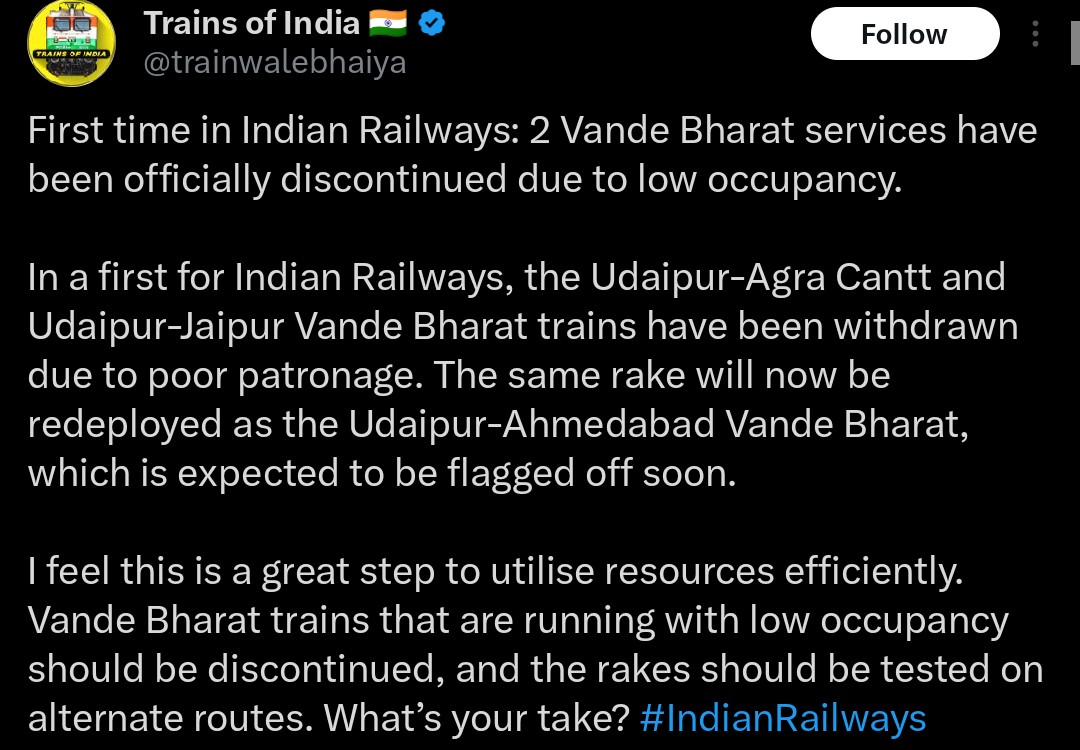
The real failure lies in the order in which decisions are made. Announcements, flagging-off ceremonies and camera-friendly speeches come first; detailed demand surveys, fare-sensitivity analysis, assessment of tourism flows and comparisons with existing services come later, if at all. The result is predictable: routes with strong, solvent demand, such as Delhi–Varanasi or some Kerala corridors, run packed, often uncomfortably so, while more politically chosen routes trundle along half empty until they are quietly curtailed or discontinued.
Meanwhile, inauguration budgets in crores are justified as public outreach or nation-building, even as the same system declines to generate or share train-wise revenue and cost data that would allow an honest reckoning of which Vande Bharat trains are viable and which are effectively rolling billboards funded by the taxpayer.
If Indian Railways is to function as a public transport system rather than a permanent campaign backdrop, it must invert this logic. Routes should be chosen on the basis of sustained, empirical demand and realistic paying capacity. Fares must be calibrated not to election-season grandeur but to regional incomes and the marginal benefit over existing services. And before crores are spent on a dais, a tent and a bank of cameras, there must be a clear, transparent case that the service itself will not be running half empty within a year.
Railways are sustained not by branding but by practicality and hard numbers: passengers per coach, rupees per seat kilometre, and a timetable that respects how people actually move. As long as Vande Bharat remains more attuned to the electoral calendar and visual spectacle than to these fundamentals, the gleaming trains will continue to run on partially empty tracks, while the full bill quietly lands on the taxpayer.








“This report captures the scale and anger behind the Bharat Bandh. It’s a reminder that public protest is not disruption—it’s a democratic warning sign that leaders should listen to.”
It shows that the lackluster approach from the Railways and the twisting of priorities from the part of the central government. Same fate is awaiting the Vande Bharat sleeper trains as well. It is startling to see that the routes are decided without conducting any reliable studies. The real consideration behind announcing a train is political and nothing else. Mostly, the timings and the running days of the trains are also decided without any studies. The results are there for everybody to see: even the profitable routes are turning into loss making!!