

On February 28, 2026, the United States and Israel launched coordinated strikes on Iran. Iran responded by effectively closing the Strait of Hormuz. From that moment began an economic catastrophe whose greatest price is being paid by a country that has fired not a single bullet in this war and sent not a single soldier: India.
Today, March 19, 2026, Brent crude stands at $111.23 per barrel. The “Indian basket” — the actual blend Indian refineries purchase — was $70.9 per barrel on February 26. It has now reached $136.56 per barrel, a 93% surge in just three weeks. The rupee has collapsed to ₹93.3 per dollar, touching historic lows. Goldman Sachs has cut India’s GDP growth estimate from 7.2% to 6.5%, and war-risk insurance premiums have risen more than tenfold.
This is no sudden natural disaster. It is the inevitable consequence of deliberate policy decisions made over a decade under American pressure, in pursuit of Israeli weapons, and in service of a corporate empire’s strategic ambitions. That corporate empire has a name: Adani.
First They Took Away Russian Oil, Then Handed India Inflation
This story begins in 2022, when India, unbothered by Western sanctions following the Russia–Ukraine war, began importing cheap Russian oil. At its peak, Russian oil constituted over 40% of India’s total oil imports. This was a natural and beneficial decision for India’s energy security: Russian oil was arriving $10–15 per barrel cheaper than international market rates. The Trump administration did not appreciate this.
America imposed a 25% base tariff and an additional 25% punitive tariff on Indian exports, directly linking them to India’s Russian oil purchases. The pressure worked. By January 2026, India had reduced its Russian oil share to below 20%. In February 2026, those punitive tariffs were lifted on the unspoken condition that India would buy American energy and Israeli weapons. In other words: abandon cheap Russian oil, buy expensive American LNG and Gulf crude — and when the Gulf catches fire, bear the consequences.

When Hormuz closed and India desperately needed oil, America issued GL-133 on March 5 — a mere 30-day temporary waiver allowing India to receive only those Russian vessels already at sea. No relief for the future. Treasury Secretary Bessent posted on social media: “India is an essential partner of America,” but in this partnership India can neither freely buy Russian oil nor Iranian oil, and must now beg America for insurance on Gulf oil. This is energy colonialism in its 21st-century form: tariffs and OFAC sanctions replacing cannons and armies.
What a Single Hormuz Voyage Now Costs
India imports 90% of its crude oil and 50% of its LPG, and three-quarters of that passes through the Strait of Hormuz. Before the war, the war-risk insurance premium was 0.25% of a vessel’s total value. The moment war broke out, it jumped from 0.25% to 1% and beyond. On March 1, insurance companies issued a Notice of Cancellation for hull war cover, meaning war insurance on the ship’s structure itself was withdrawn altogether.
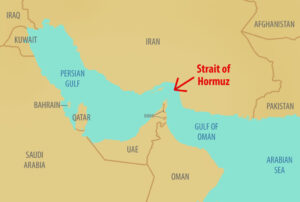
According to Moneycontrol, the voyage-specific war-risk cover for a single crude tanker worth $100 million transiting Hormuz has risen from $250,000 to $375,000 per voyage — a 50% increase in one instance. Hapag-Lloyd has imposed a war-risk surcharge of $1,500 to $3,500 per container on Gulf-bound cargo. When insurance, freight, crew-risk allowances, and fuel costs are combined, India is paying $10–15 extra per barrel — 7–10% on top of the already spiked market price. India has no domestic P&I (Protection and Indemnity) insurance base and is entirely dependent on international insurers, who are now refusing coverage. The result: India went cap in hand to America, asking for US-backed insurance for Hormuz oil shipping — the same America that started the war.
The Explosion in Oil Prices
On March 1, 2026, Brent crude was $77.13 per barrel. Today, March 19, it stands at $111.23 per barrel — a 44% surge in 18 days. The Indian basket has touched $136.56 per barrel, a 93% rise since the conflict began. Kotak Securities economist Kainat Chapwala warned: “Global oil prices could touch $120 per barrel in the near term and, if the conflict stretches beyond a month, could reach $150 per barrel.”
The rupee, which was ₹90.95 per dollar on February 20, 2026, is today at ₹93.3 per dollar. When the rupee falls and oil is purchased in dollars, every barrel becomes more expensive still. $136.56 multiplied by ₹93.3 equals ₹12,741 per barrel — nearly double the ₹6,430 per barrel of February. Every $10 rise in oil prices adds $13–14 billion to India’s annual import bill. The Indian basket has risen by $65 since the conflict began, pointing to a potential $85 billion increase in India’s annual oil bill.
The Relationship with Israel That Has Become a Festering Wound
India’s deepening proximity with Israel must not be seen merely as a diplomatic choice. It is a story of moral capitulation whose economic and human costs India is now paying simultaneously.
In 2015, India–Israel arms trade was a mere $5.6 million. By 2024, it had reached $185 million — a 33-fold increase. Between 2020 and 2024, bilateral defence trade crossed $20.5 billion. India today is Israel’s single largest arms buyer, purchasing 34% of Israel’s total defence exports, and Israel supplies 49.1% of India’s air defence systems and sensors. Israeli companies Rafael, Elbit, and IAI are establishing joint manufacturing plants in India under the Make in India programme.
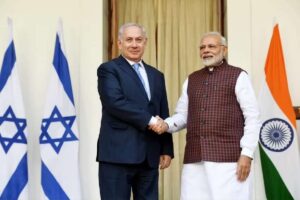
Yet this arms intimacy has not saved trade — it has damaged it. In FY2023, India–Israel bilateral trade stood at $10.8 billion, the highest ever recorded. By FY2025, it had fallen to $3.6 billion — a drop of more than 50%. India’s exports to Israel collapsed from $8.5 billion to $2.14 billion — a 75% decline. Defence closeness did not protect commerce; it exposed the country to the very fire that is now burning everything.
On February 25–26, 2026 — exactly two days before the Iran strikes — Prime Minister Modi was in Israel. According to the Jerusalem Post, agreements were reached on defence deals worth up to $10 billion, including Rafael’s SPICE 1000 guided munitions, Elbit’s Rampage air-to-ground missiles, the Ice Breaker naval cruise missile, and IAI’s supersonic Air LORA ballistic missile. When Modi was signing arms deals in Israel, two days later Hormuz closed and India’s economy began to unravel.
Adani’s Business That Flies Over Gaza
In 2018, Adani Defence and Aerospace formed a joint venture with Israel’s largest arms company, Elbit Systems — Adani-Elbit Advanced Systems India Ltd — in Hyderabad. The venture’s primary product is the Hermes 900 MALE UAV, an unmanned aerial vehicle capable of surveillance and precision strikes. This facility is the only plant outside Israel manufacturing the Hermes 900. During the Gaza war, the Israeli military deployed the Hermes 900 extensively for surveillance and targeted operations.
A Voice.Cymru investigation report contains an explosive revelation: following the Netanyahu–Modi meeting in February 2025, the Adani Group supplied 20 Hermes 900 drones for use in Gaza. In June 2024, after Israeli airstrikes on the Nuseirat refugee camp, fragments of a missile went viral on social media bearing the inscription “Made in India.” This is the face of Make in India that never appears in government advertisements.
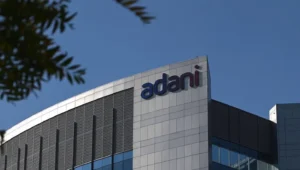
Also in 2018, Adani acquired a stake in Israel Weapon Industries (IWI) through a joint venture called PLR Systems. IWI manufactures the Galil, Tavor, and Negev rifles — weapons carried by Israeli soldiers in the West Bank and Gaza. At DefExpo 2022, Adani and IWI jointly launched ARBEL, India’s first AI-controlled firing system.
In 2023, Adani Ports acquired Israel’s Haifa port for $1.18 billion. According to the CFA report, Haifa port also serves as a base for Israel’s naval submarine fleet, considered part of the country’s strategic nuclear capability. Adani Ports’ acquisition thus directly binds Indian capital to Israel’s military-naval infrastructure. PLR Systems — Adani and IWI’s joint venture — is also a participating partner in the February 2026 $10 billion arms deals.
TCS, Infosys, Reliance: This Is Not Adani’s Story Alone
The Centre for Financial Accountability’s September 2025 report does not stop at Adani. TCS is working on Google’s Project Nimbus — cloud infrastructure reportedly used for surveillance and targeting in Gaza. Tata sold Land Rover vehicles to Israel, which were converted into MDT David armoured carriers and deployed in Gaza and the West Bank. Reliance Jio features in the report in the context of links with Israeli technology networks. The report’s conclusion is unambiguous: “Indian capital — across defence, technology, agriculture, labour, and infrastructure — is directly sustaining Israel’s military operations, settler-colonial practices, and systematic violence against Palestinians.”

The American Pressure: The Triangle That Stays Hidden
To understand India’s closeness with Israel, one must first understand the America–India–Israel triangle. America inducted India into I2U2 (India–Israel–UAE–USA), a grouping that serves as an extension of American strategic interests in West Asia. QUAD, I2U2, and the Indo-Pacific strategy are all parts of a larger geopolitical framework that has been steadily pushing India towards an anti-Iran, pro-Israel alignment. When America imposed sanctions on Iran in 2019, India obediently stopped Iranian oil imports — that same Iran which was once India’s third-largest oil supplier. The price of that submission is being collected today.
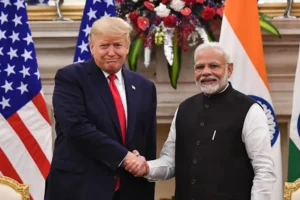
In an interview with The Wire, a CFA researcher said: “This relationship is not merely diplomatic or commercial — it is embedded in the technological and financial architecture that sustains Israel’s military operations.” New Internationalist carries the words of a Palestine solidarity activist: “Our central demand is an arms embargo on Israel and a halt to India’s weapons exports that are fuelling the genocide in Gaza.”
The $50 Billion Sword Over Remittances
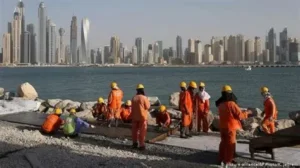
This war is not only an oil crisis. According to Al Jazeera, 9 million Indian migrant workers in Gulf countries remit $50 billion annually, and all of them are caught in the heat of this conflict. If the Gulf economy contracts, these workers lose jobs, remittance channels are disrupted, and the economic backbone of millions of families in Uttar Pradesh, Bihar, Kerala, and Tamil Nadu will be shaken. Beyond this, India’s $200 billion in exports to Gulf nations stands at risk. Indian airline flights to West Asia are being cancelled. Fertilizer factories are cutting production. LPG shortages are reaching household kitchens.
GDP Loss Estimated: The Reckoning as of Today
Goldman Sachs has cut FY27 GDP growth from 7.2% to 6.5% — a 0.7 percentage point decline. India’s GDP is approximately $4 trillion, implying a $28 billion direct GDP loss. The Indian basket oil rise of $65 points to a potential $85 billion increase in the annual oil bill. Hormuz transit insurance and transport costs alone create $14 billion in additional exposure. The $50 billion in annual remittances is under direct threat. India’s $200 billion in Gulf exports faces serious disruption. Multibagg.ai’s estimate puts direct economic loss at over $10 billion. GlobalData TS Lombard chief economist Shumita Deveshwar has warned that inflation could reach 6% by September–October 2026.
If the conflict continues for two to three more months, the total estimated combined direct and indirect loss to India’s economy stands at $80 billion to $100 billion. This is two and a half times India’s entire defence budget and three times its health budget.
The Silence That Cost the Most
When UN General Assembly resolutions called for a Gaza ceasefire, India abstained from voting. When the ICJ determined “plausible genocide,” India wrapped itself in silence. When more than 50,000 Palestinians, including thousands of children, were killed, India signed a Bilateral Investment Treaty with Israel. The CFA report states directly: “There has been a dramatic departure from India’s historical pro-Palestine position. Under the Modi government, India stands clearly alongside Israel.” This silence and this alignment are today damaging India’s standing across the Arab world, making the lives of 9 million workers more precarious, and creating friction in trade relations that India cannot afford.
The country that in 1947 was among the handful that voted against the establishment of Israel is today that country’s largest arms buyer. The country that practised non-alignment for decades is today a supplicant for American insurance and bends before OFAC sanctions. The country whose largest corporate group manufactures the drones flying over Gaza now has its citizens bearing the full weight of a ₹93.3 per dollar rupee, oil at $111 per barrel, an Indian basket at $136.56, and war insurance premiums that have risen tenfold.
Adani’s Hermes 900 drones fly over Gaza. Insurance for Hormuz is sought from America. Russian oil was surrendered under American pressure. And India’s 1.4 billion citizens are paying the price — from their pockets, from their kitchens, and from their livelihoods. That is the greatest and least spoken tragedy of this crisis.