Nepal’s Bloodbath: A Democracy In Peril or a Foreign Plot?

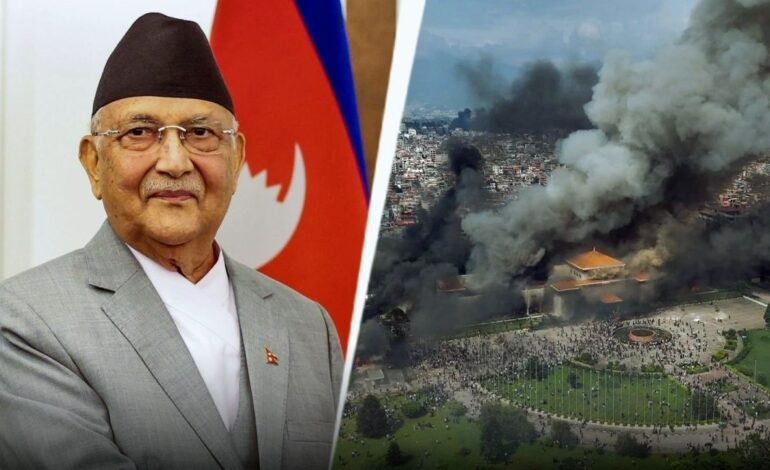
Kathmandu’s streets erupted on September 8–9 in what seemed like an explosion of public anger. At least twenty-two people were killed, parliament and government offices were stormed, and Prime Minister K.P. Sharma Oli was forced to resign. In the most shocking episode, the wife of a former Nepali prime minister was burned to death by a mob — a grim reminder that this was not a protest spiraling out of control, but an orchestrated descent into political violence.
The official account suggests that the unrest was a response to corruption, unemployment, and the government’s sweeping social media ban. But a closer look reveals this was no ordinary outburst of outrage. The speed, scale, and precision of the protests point to something larger — a carefully orchestrated movement, one that appears to bear the fingerprints of foreign ideological forces.
Timeline: Nepal’s Road to Manufactured Chaos
January–February 2025
- Small but symbolic pro-monarchy rallies appear in Kathmandu and Pokhara. Former King Gyanendra’s portraits are carried alongside Hindu religious banners.
- Sangh-linked cultural groups from India quietly step up activities in border districts, hosting “Hindu unity” events.
March 9, 2025
- A major royalist rally in Kathmandu displays posters of Gyanendra and Indian Chief Minister Yogi Adityanath side by side.
- Analysts note the first open blending of Nepal’s royal nostalgia with India’s Hindutva politics.
April–May 2025
- Royalist groups grow more vocal online, calling federalism a “failed experiment.”
- Social media campaigns show high coordination, with meme pages and slogans echoing Hindutva templates used in India.
June 2025
- Corruption scandals and governance failures fuel disillusionment among youth.
- Hashtags demanding reforms gain traction, but royalist accounts begin to steer the conversation toward monarchy restoration.
July–August 2025
- Nepal government announces stricter regulations on social media platforms.
- Protests against the ban start small and peaceful, led mostly by students and urban youth.
- Royalist and RSS-affiliated voices quickly amplify these protests, reframing them as a broader “civilisational struggle.”
September 8–9, 2025
- Protests erupt simultaneously across Kathmandu, Biratnagar, Pokhara, and other towns. Demonstrators march with unusual synchrony, some carrying the One Piece Straw Hat flag — a foreign cultural symbol whose spread is too rapid to be organic.
- Crowds storm Singha Durbar, parliament, and the prime minister’s residence. Violence leaves at least 19 dead.
- Prime Minister K.P. Sharma Oli resigns under pressure; dozens of MPs defect from the Rashtriya Swatantra Party.
- Royalists seize the moment, openly demanding Gyanendra’s return to the throne.
Aftermath (September 10 onwards)
- Nepal’s government is in disarray, scrambling to control unrest.
- Democratic forces weakened; royalists emboldened.
- India’s RSS emerges as the likely ideological architect behind the crisis, with the ultimate aim of reinstating an authoritarian Hindu monarchy in Nepal.
The Royalist Nexus
This unrest did not emerge in a vacuum. The rallies earlier in the year had already revealed the royalist-Hindutva nexus. The imagery of Adityanath in Nepal’s protests was not just symbolic; it was a signal of ideological export, a deliberate attempt to inject Hindutva’s majoritarian model into Nepal’s fragile democracy.
For the RSS, Nepal is more than a neighbour — it is the “lost Hindu kingdom,” a civilizational prize. Restoring monarchy would serve multiple goals: a symbolic triumph for Hindutva, a strategic buffer against China, and tighter control of Nepal’s political trajectory.
Hijacking a Youth Movement
Nepal’s Gen Z protesters had genuine grievances: unemployment, corruption, and the stifling of free expression. But their anger was hijacked. The speed with which local frustrations were redirected into monarchist slogans, and the eerie synchrony across multiple cities, were not organic. This was choreography, not coincidence.
In effect, Nepali youth became pawns in a larger ideological game — their movement weaponised to serve the dream of reinstating monarchy.

What unfolded in early September was not simply protest gone wrong. It was political engineering: a systematic effort to weaken democracy and revive authoritarian monarchy. The RSS’s fingerprints are visible in the sudden royalist resurgence, the propaganda playbook, and the strategic outcome — a fractured democracy and an emboldened monarchy.
For Nepal, the danger is existential. Its youth’s legitimate demands are drowned out by a cross-border ideological experiment. For India, the irony is stark: by meddling in Nepal’s politics, the RSS risks alienating democratic forces and pushing Kathmandu further into Beijing’s embrace.
Call for Accountability
If Nepal’s democracy is to survive this storm, it cannot afford silence. The September unrest must be investigated not only as a failure of governance but as a case of foreign interference. The evidence — from royalist rallies carrying Indian politicians’ portraits to the RSS’s growing ideological footprint — demands an independent, transparent inquiry into how a people’s protest was turned into a coup in disguise. Without accountability, Nepal risks trading its fragile democracy for an imported monarchy — and becoming the testing ground for a Hindutva experiment that serves neither Nepal’s people nor its future.