Supreme Court Pauses Aravalli Ruling Amid Environmental Outcry


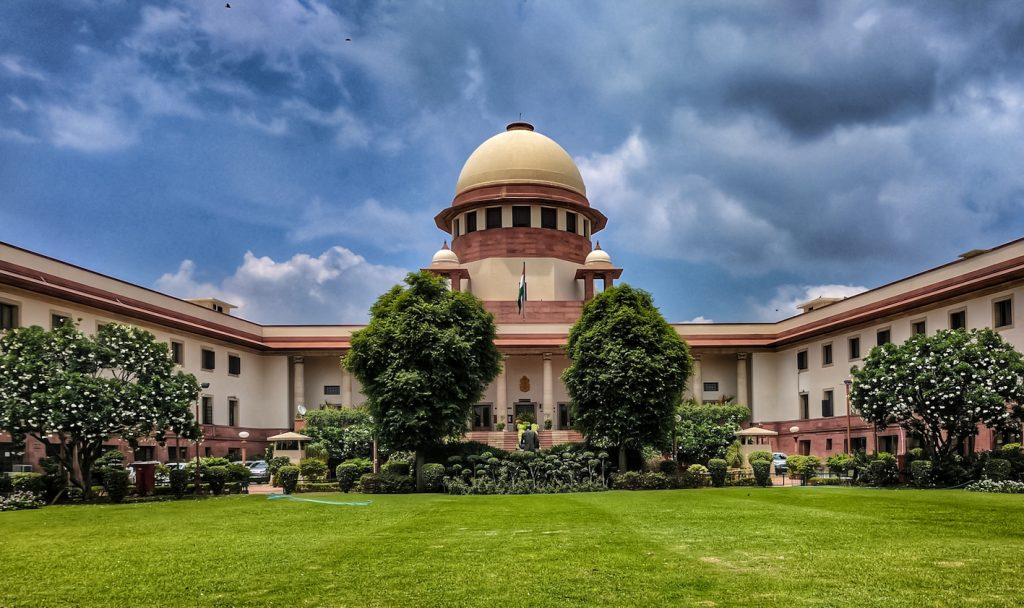
In a significant moment marking a calibrated judicial hesitation, the Supreme Court of India has stayed its own recent verdict redefining the Aravalli Hills for the purposes of mining regulation, acknowledging that the judgment requires urgent clarification before it can be allowed to stand. The case has been referred for further expert examination and will be heard again on January 21, 2026.
The pause follows mounting concern from environmental groups and local communities after the Court’s November ruling adopted a 100-metre elevation-based definition of what legally constitutes the Aravallis. Critics warned that such a metric risked stripping protection from large portions of the ancient range, effectively exposing them to mining and real-estate development.
When the matter was taken up again, the Court itself conceded that its earlier order may have been misunderstood—and perhaps misapplied. The bench observed that the judgment was never intended to dilute environmental safeguards, nor to authorise mining activity in ecologically sensitive areas merely because they fall below a particular elevation. It noted that the interpretation circulating in public discourse had raised “serious apprehensions,” making judicial clarification unavoidable.
Significantly, the Court acknowledged that the Aravallis cannot be viewed through a narrow administrative or cartographic lens alone. The bench remarked that ecological systems do not always conform to rigid human classifications and that an overly literal reading of the earlier order could have consequences far beyond what was contemplated. Until those implications are fully understood, the Court said, its directions could not be allowed to operate.
Acting on this reasoning, the Court ordered that both its earlier judgment and the recommendations of the committee it had relied upon would remain in abeyance. It indicated that a more rigorous assessment—potentially involving environmental experts with on-ground ecological knowledge—was necessary before any binding definition could be settled.
Appearing for the Union government, Tushar Mehta, the Solicitor General, told the Court that there were “misconceptions” surrounding both the government’s role and the intent of the judgment. He submitted that the Centre had no plan to permit fresh mining in protected areas and urged the Court to clarify that the order should not be read as a blanket relaxation of environmental norms.
The bench took note of these submissions but refrained from offering immediate assurances, underlining instead that clarity must emerge from a carefully reasoned judicial framework, not executive explanations. Until such clarity is achieved, it said, restraint was the safer course.
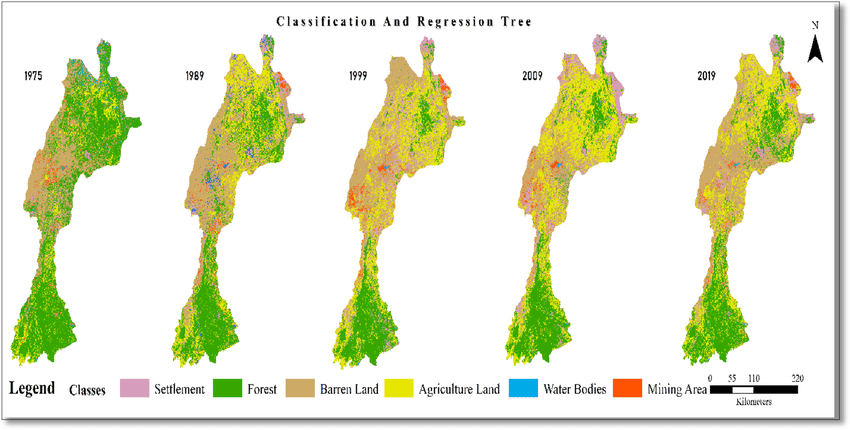
Outside the courtroom, environmentalists saw the stay as a tacit acknowledgment of what they had long argued: that the Aravallis cannot be reduced to contour lines on a map. Their ecological function lies as much in their lower slopes and degraded commons as in their visible ridges—areas that recharge groundwater, anchor forest cover, and moderate the climate of north-western India.
“This definition is arbitrary and ecological nuance has been ignored,” said Neelam Ahluwalia, founder of People For Aravallis. “The Aravallis are more than just peaks over a height. Their lower reaches sustain biodiversity and water systems that entire regions depend on.”
Similar anxieties were echoed by independent analysts, who cautioned that elevation-based protection could legitimise extractive activity precisely in zones most vulnerable to irreversible damage. “Reducing protection to a number creates a legal shortcut,” one researcher observed. “It isn’t science—it’s convenience, and ecosystems pay the price.”
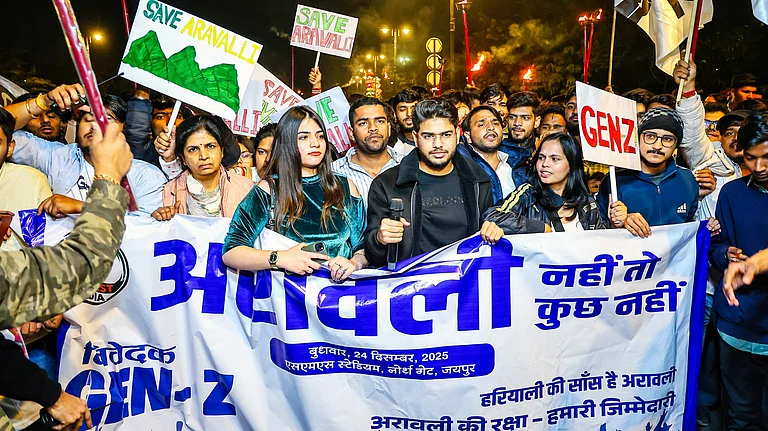
As the implications of the original ruling became clear, opposition moved beyond courtrooms. Across Rajasthan, particularly in districts like Bhilwara, thousands marched through hill tracts demanding stronger safeguards. For many participants, the issue was existential rather than abstract. “The Aravallis are our lifeline,” a protest organiser said. “You cannot measure their value by metres alone.”
For now, the Court’s stay has restored a fragile status quo. But it has also exposed a deeper tension—between administrative definitions and ecological reality, between legal precision and environmental complexity. Whether the next hearing produces a definition that reflects the living geography of the Aravallis, or merely a refined bureaucratic compromise, will determine far more than the fate of a single mountain range.