

The Cub Reporter and the Uncut Diamond

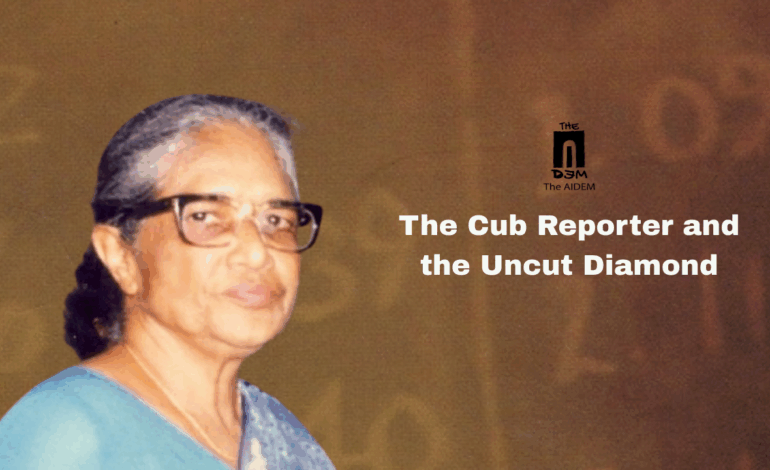
In the winter of 1973, a nervous, underage cub reporter for the India Press Agency (IPA) sat in the office of a formidable scientist at Mausam Bhavan in New Delhi. He was lean, lanky, poorly dressed, and armed with little more than ambition and a profound ignorance of his subject’s life work.
The scientist, Anna Mani, the Deputy Director-General of the India Meteorological Department, took one look at him and said, “Oh, you are a cub reporter! From your voice I thought you were a senior journalist.” She granted him five minutes and expected a professional interrogation.
He, hoping for a friendly chat, fumbled and asked why weather forecasters were so often the butt of jokes for their vague predictions. The question was met with anger, and the interview was summarily terminated. For decades, that was the entirety of my relationship with the name Anna Mani—a memory of professional embarrassment and a lingering, petty resentment.
All of that evaporated into the thin, humid air of Kayamkulam, Kerala, last month as I turned the final page of Asha Gopinathan’s superb biography, Anna Mani: The Uncut Diamond (National Book Trust, Pages 316, Rs 355). The book landed on my doorstep, delivered at considerable shipping cost, a physical testament to a lingering curiosity sparked by my friend Pamela Philipose’s Facebook post.
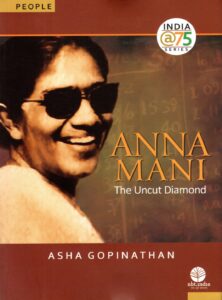
What I found within its pages was not a corrective to a decades-old slight, but a revelation. The curt, impatient administrator I had encountered was, in fact, one of modern India’s most brilliant and indefatigable scientific minds—a true pioneer in meteorology and solar energy, a woman whose life’s work was a quiet, persistent answer to the very question that had once gotten me thrown out of her office.
Gopinathan’s biography is not just a chronicle of a scientific career; it is a masterfully cut portrait of an “uncut diamond,” restoring Anna Mani to her rightful place in the firmament of Indian science and, in doing so, offering a profound meditation on dedication, indigenisation, and the quiet courage of a life lived in pursuit of knowledge.
The book’s title, borrowed from a comment by her mentor, the Nobel laureate C.V. Raman, is exquisitely apt. An uncut diamond, as Raman pointed out, possesses a raw, unvarnished brilliance that can be more precious than its faceted counterparts. Gopinathan’s narrative deftly reveals the many facets of this diamond, starting with her formation in the hilly terrains of Peerumedu in Travancore where this writer too was born.
The author paints a vivid picture of a time and place where a girl’s education was often seen as a mere “time pass” before marriage. Against this social grain, Anna Mani’s decision to choose Physics was an act of quiet rebellion. Gopinathan skilfully traces this nascent determination to her father’s influence, a man whose wisdom is beautifully encapsulated in the book.
His advice to his daughter, quoted in full, is a cornerstone of her character: “Let us learn to work hard… Remember Jesus Christ was a carpenter and Peter and Andrew were fishermen. If you ask me what the most honourable profession is, I will say the Bhangis and the Dhobis. They help to keep clean this earth of ours, which we so-called respectable people make dirty.”
This lesson in the dignity of labour and the rejection of false prestige becomes the guiding principle of her life. We see it in her willingness, upon joining Raman’s lab, to “forget everything about Physics and start afresh.” Gopinathan does a wonderful job of explaining the complex science of the “Raman effect” and Anna’s pioneering research on the light dispersal properties of rubies and diamonds.

It was this work that earned her Raman’s profound respect, leading him to call her the greatest “woman physicist”—a compliment that, as the author gently notes, also inadvertently exposes the casual sexism of the era. It is one of the book’s many tragedies that her original thesis was not considered for a Ph.D. due to a technicality about her master’s degree. Gopinathan rightly laments this injustice, and one finishes the book hoping that this is a wrong that might yet be posthumously corrected.
The most compelling section of the book, for this former reporter, is the chronicle of her life’s work at the India Meteorological Department. This is where the “uncut diamond” is put to the ultimate test and reveals its extraordinary strength. Thrown into a new field, she took to meteorology “like fish to water,” transforming the office in Poona into her home and her colleagues into her family.
But her vision was far grander than merely running a department. At a time when “Make in India” was not even a glimmer in the national consciousness, Anna Mani was single-mindedly pursuing a policy of total self-reliance. Gopinathan provides a staggering, though deliberately not exhaustive, list of the meteorological instruments she designed, developed, and got manufactured within the country.
The driving force was not just economic or political; it was scientific. She found the instruments imported from Britain and Germany to be unsuitable for Indian conditions and, in her hands, the indigenous versions became demonstrably superior. This was nation-building at its most fundamental and practical level.
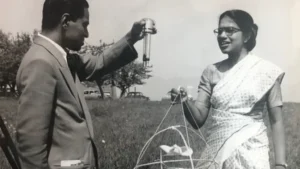
It is here that the book provides a poignant, retrospective answer to my long-ago question. My query about the mockery of weather forecasts was, in her eyes, an insult to the monumental struggle of her field. The book quotes her from October 1991, providing the context I was missing: “We still have a long way to go—particularly in forecasting the monsoon—despite more than 100 years of concentrated effort. I still place measurements first. Neither models nor super computers can give reliable short and medium range forecast unless their input of observed data (especially for the upper air) is reliable.”
She was not defending a failed system; she was defending the foundational, painstaking work of gathering data upon which all future accuracy would be built. Her anger in that 1973 office was not at me personally, but at a casual dismissal of a lifetime of dedicated effort. And her legacy is the proof of her philosophy.
The windmills I saw dotting the highways of Gujarat, and those now common across Tamil Nadu and Rajasthan, are a direct result of the wind maps she painstakingly created. The national conversation on solar energy owes its origins to her foresight. Her research on the ozone layer was not a theoretical exercise but a critical investigation into a direct danger to humanity. The book forces you to see that every modern weather forecast, every conversation about renewable energy, stands on the shoulders of giants like her.
Beyond the scientific achievements, Gopinathan shines a warm light on Anna Mani’s “qualities of heart.” The anecdote about the writer C. Radhakrishnan is particularly moving. Transferred to Poona to be disciplined by the supposedly strict Anna Mani for writing without government permission, he was instead met with a woman who asked to read his books and then famously wrote on his thick file of complaints, “Do not trouble him. Let him continue his writing.” He quit the job in 1964 to take to full-time writing. Radhakrishnan dedicated one of his books to Anna Mani.
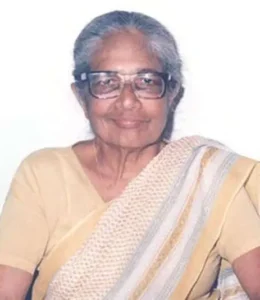
It reveals a woman of deep integrity, who valued creativity and was not cowed by bureaucratic pettiness. Her personal quirks are also lovingly detailed: her love for dogs, her passion for bird-watching, her nightly reading of the New Testament despite not being a church-goer and choosing cremation for herself. These details, drawn from the author’s meticulous research, transform a towering figure into a relatable, complex human being. Her final years, spent back at the Raman Research Institute in Bangalore, writing letters to former colleagues to keep them updated on scientific developments until Parkinson’s disease robbed her of that ability, are depicted with a quiet dignity that mirrors her life.
‘Anna Mani: The Uncut Diamond’ is more than a biography; it is a vital act of historical reclamation. Asha Gopinathan has done a profound service by meticulously piecing together the life of a woman whose contributions were monumental yet whose name remains largely unknown. The book is a lament for a time when India strove for self-sufficiency in high technology, and a pointed critique of a present that too often prefers to import even basic instruments from abroad, forgetting the legacy of self-reliance that Anna Mani embodied.
It is a call to remember that the foundation for a “manned lunar mission” was laid by people like her, standing shoulder-to-shoulder with Vikram Sarabhai at the Thumba launch site, erecting a meteorological tower.
For this reviewer, the book accomplished the most personal of miracles. It transformed a memory of youthful embarrassment and resentment into one of profound respect and belated understanding. I finished the book with a new feeling, one I could not have anticipated: pride. Pride that my path had once, however clumsily, crossed with hers. And a deep, abiding gratitude to Asha Gopinathan for cutting and polishing this “uncut diamond” with such care, allowing its full, dazzling brilliance to finally shine for all to see.
This book is an essential read for anyone interested in the history of Indian science, the story of women in STEM, or simply the inspiring tale of a life lived with unwavering focus, integrity, and a deep, abiding love for the truth, whether it was found in the light scattered by a ruby or the patterns of the Indian monsoon. It is a tribute not just to Anna Mani, but to the very idea of a life dedicated to asking better questions.





):
This article lays bare the gap between official reporting and lived reality, showing how the Dakp report sanitises complex demands that continue to simmer beneath the surface. By unpacking what is omitted as much as what is recorded, the piece exposes how selective documentation can blunt accountability and dilute public debate. The analysis is timely and necessary, reminding us that transparency is not just about publishing reports, but about confronting the full, uncomfortable truth behind unresolved demands.