

The Water Gandhi: Healing India’s Veins with a Spade and a Dream


Once dismissed by his father as “useless,” Rajendra Singh proved to be anything but. As India’s rivers suffocated under pollution and drought, a thirty-year-old Singh abandoned his government job, took a one-way bus ride into the arid Rajasthan desert, and picked up a simple spade. Refusing to wait for bureaucratic miracles or massive infrastructure, he armed himself with ancient wisdom and relentless grit, spending months digging a single pond in the scorching sun. That quiet act of defiance against a barren landscape sparked a grassroots revolution that resurrected dead rivers, transformed geography, and earned him the title of “Water Gandhi.”
There is a story told about Pachiyappa Mudaliar, the eighteenth-century merchant and philanthropist who founded Pachaiyappa’s College in Madras, that he bathed each morning in the Cooum River before beginning his day’s work. This was a hundred and fifty years ago. Today the Cooum is a sewage drain. The Adyar, Chennai’s other urban river, is not in much better condition. In the north, the Ganga Cleanup Mission has been running since the nineteen-eighties without achieving its stated purpose; a treatment plant in Haridwar alone is reported to discharge two million litres of untreated industrial effluent into the river daily. In Tamil Nadu, the Bhavani, the Amaravathi, the Noyyal, and the Cauvery have each absorbed the consequences of a dyeing industry, a hosiery export industry, and a viscose manufacturing plant that collectively treat the rivers as free infrastructure. The news about Indian rivers is almost uniformly bad, and has been for long enough that the badness has begun to feel permanent.
In Alwar district, in the Rajasthan desert, there is a small river called the Arvari that dried up after independence and, in the mid-nineteen-nineties, began to flow again. It has run year-round ever since. In a state that receives among the least rainfall in India, in terrain classified by government documents as drought-prone, a dead river came back to life. The question of how this happened is, in one sense, simple to answer: three hundred and seventy-five check dams were built in the Aravalli hills that feed the Arvari’s watershed, water percolated through the soil and recharged the springs, and the springs fed the river. In another sense, the question is more interesting. The check dams were built not by a government agency or a corporation but by village communities who had been organised, patiently and without fanfare, by a man with a pickaxe and a great deal of time.
“People say they changed history. We changed geography”. — Rajendra Singh
THE BUS TO THE END OF THE LINE
Rajendra Singh was born in 1959 in Daula, a village in Bagpat district of Uttar Pradesh, the eldest son of a large landowner. His father called him, with affection, ‘na layak’—useless—and the nickname attached long enough to be quoted in interviews decades later, as evidence of how thoroughly he had made the word inapplicable. He trained as an Ayurvedic physician and became involved, during his college years under the Emergency, in the student movement of Jayaprakash Narayan. JP’s movement shaped him in ways that a medical degree could not: it was there, he has said, that his life’s purpose became clear to him.

In 1980, he joined the government in Jaipur as an adult-education officer. A fire at Jaipur University drew him into relief work through an organization called Tarun Bharat Sangh—the Young India Association—which had been formed to help the victims. When he began asking questions about the organization’s purpose and direction, its leaders told him, in effect, that he could have it. They left. He was thirty years old, in possession of an organization whose membership was himself, and increasingly certain that government employment was not the medium through which he would do anything that mattered.

One day, in the manner of decisions that determine everything subsequently, he sold the contents of his house, collected four friends, and went to a bus station. He bought five tickets to whatever bus was leaving, to its final stop. The bus took them to Kishori village, in Thanagazi tehsil of Alwar district—a dry, remote settlement from which the young men had largely emigrated in search of work, leaving only the old and the very young behind. The five strangers who descended from the bus were regarded with immediate suspicion. It was the era of Punjab militancy; people who arrived unexpectedly in villages were not necessarily benign. A village elder interceded and arranged for the newcomers to sleep in the local Hanuman temple.
Singh spent the first weeks trying to work out what to do. He opened an Ayurvedic clinic; his friends organized informal classes for children. Then an old man named Mamu Meena stopped him on the road.
“What are you doing here?” the old man asked.
Singh explained: medicine for the poor, free tutoring for children.
“You can’t eat those things,” Mamu Meena said. “Bring a pickaxe and a spade tomorrow. We’ll dig a pond and catch some rainwater, and then people can grow things.”
Singh felt, he has said, that the old man was right in some way he could not yet fully articulate. He told his friends what Mamu Meena had proposed. Two of them left immediately—“We’re not taking orders from an illiterate old man”—and went back to the city. Singh arrived the next morning with a pickaxe, a spade, and a basket for moving earth. Mamu Meena, who was too old for heavy labor, showed him where to dig: across the path of a seasonal water channel, in a place where a pond could collect the runoff.
SIX MONTHS WITH A PICKAXE
For the next six months, Rajendra Singh dug. Mamu Meena could not join him physically, so he dug alone, eight to ten hours a day, in the Rajasthan summer and then the monsoon and then the autumn. The remaining two friends, watching this spectacle, departed within weeks. When the rains came, young men who had been working in cities returned to their villages for the agricultural season. Mamu Meena told them to help. They refused to work without wages. Singh managed to arrange some grain from voluntary organizations; a few of them helped occasionally. It took three years to complete a pond roughly fifteen feet deep.
In the third year, when the rains were good, the pond filled. The wells downstream of it filled too—an effect that Singh had not fully anticipated but that Mamu Meena evidently had. The old man sent word to relatives in surrounding villages: come and see what has happened. People came from several villages to look at the pond and at the water in the wells below it.
The following year, Singh and his colleagues walked to nine surrounding villages to explain what had happened and propose doing it again. Nine ponds were dug that year. The year after, thirty-six. Then seventy. The land that government documents had classified as drought-affected was reclassified, after crops began growing on it, as arable. “People say they changed history,” Singh has said. “We changed geography.”
BRINGING BACK THE ARVARI
The Arvari is a small river—forty-five kilometres from its source in the Aravalli hills to its confluence with a larger stream. It had dried up entirely in the years after independence, its watershed deforested, its seasonal channels no longer carrying enough water to maintain a perennial flow. The villages along its banks had adapted to its absence: they drew what water they could from whatever remained, and the young men went to the cities.
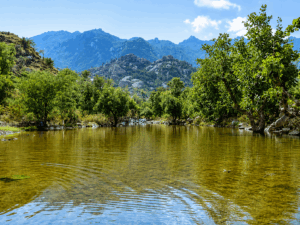
Tarun Bharat Sangh—which Singh had rebuilt into a functioning organization—began working in the Arvari watershed systematically. At the river’s headwaters in the Aravalli hills, a mud-and-stone check dam was built by the local community. Then another, on a side channel that fed the headwaters. Then more, on the slopes of the hills that drained into the Arvari’s basin. By the time the work was complete, three hundred and seventy-five check dams had been constructed across the watershed.
The mechanism by which these structures revived the river is not complicated, but it is worth understanding. Rajasthan receives roughly six hundred millimetres of rainfall per year, almost all of it in the three months of the monsoon. Without structures to slow and retain it, this water runs off the hard, sun-baked soil into channels that carry it quickly toward lower ground, where it evaporates or drains away before it can percolate into the water table. Check dams interrupt this process: they hold the water in place long enough for it to sink into the soil, recharge underground aquifers, and slowly release into springs. Springs feed rivers. Rivers, given enough springs, run year-round.
Since 1995, the Arvari has flowed continuously. Two harvests a year became possible along its banks. People who had left for the cities began returning. Agricultural produce from the revived area reached urban markets. And then, as is the way of things in India when a resource becomes valuable, the government arrived to claim it.
THE RIVER PARLIAMENT
The state government, which had shown no interest in the Arvari when it was dead, began issuing fishing licenses for it once it was alive. The villagers who had rebuilt the river—most of them vegetarian, for whom commercial fishing in their water was both practically objectionable and culturally offensive—refused to accept that a river they had resurrected belonged to an administration that had done nothing to save it. They went to court. The court found, in effect, that the people had a valid claim but needed a formal institutional structure through which to exercise it. Until that structure was created, the administration would retain jurisdiction.
The response was the Arvari Sansad—the Arvari Parliament—one of the more unusual governing bodies in India. It draws two representatives from each of the seventy-two villages that use the river’s water, giving it a membership of a hundred and forty-four. It meets twice a year to make policy, and maintains a standing committee for day-to-day management decisions. It has no legal authority—its rules are enforced by community consensus rather than statute—but it has, over nearly three decades, maintained a set of regulations for the river that are more thoughtful and more enforceable than most state water management policies.
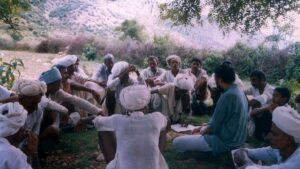
The rules the Arvari Parliament has adopted are worth examining in some detail, because they represent a working answer to the question of how a community can manage a shared resource sustainably without either the market or the state. Water-intensive crops—sugarcane, paddy—are prohibited; violators are fined. Between Holi and the start of the monsoon, no one may draw water from the river. Borewells in the watershed are banned. Cultivation on the upper catchment is restricted to drought-resistant grains; vegetables may be grown in the lower reaches. Commercial fishing is prohibited; fishing for household consumption is allowed. Wholesale trading of grain and vegetables grown in the watershed is banned—local production is for local consumption first. Factories of any kind are excluded from the entire four-hundred-and-five-square-kilometre watershed area.
The sugarcane rule generated the most resistance. Sugarcane is a cash crop; the income from it is real and immediate. After extended debate, the Parliament settled on a compromise: sugarcane may be grown on up to twenty-five per cent of any farmer’s land. The debate itself—the process of arriving at a number that acknowledged individual economic need while protecting the collective resource—was, in its way, a more sophisticated exercise in resource governance than most regulatory proceedings.
Gandhi’s observation that the earth contains enough for everyone’s need, but not for everyone’s greed, is quoted frequently in Tarun Bharat Sangh’s literature. The Arvari Parliament’s rules are a practical gloss on it: they draw, village by village and season by season, the line between the use of a common resource that sustains it and the use that destroys it.
The Arvari Parliament has no legal authority. Its rules are enforced by community consensus. For nearly three decades, that has been enough.
THE TIGERS
Not all of Tarun Bharat Sangh’s work in the Aravalli hills went as smoothly as the Arvari revival. The Sariska Tiger Reserve, which lies within the range of the organization’s activities, had become the site of extensive illegal limestone and marble quarrying. The quarries created large pits that captured rainwater intended for the watershed’s natural water systems, redirecting it away from the springs and streams that fed the land downstream. The excavated material was dumped in ways that degraded the tiger reserve’s habitat. The ecological disruption was severe; the quarrying operations were expanding rapidly.

Tarun Bharat Sangh organized local communities and filed a public interest petition in the Supreme Court. In 1991, the court prohibited quarrying in the Aravalli hill range. The following year, the central Ministry of Environment and Forests extended the ban to cover limestone and marble quarrying across the entire Aravalli zone. Four hundred and seventy quarries were closed.
The consequences for Singh and his organization were immediate and severe. Tarun Bharat Sangh workers were threatened and physically attacked. More than three hundred legal cases were filed against Singh and the organization—one accused him of poaching tigers; a newspaper published a story claiming he had committed rape. The cases were eventually dismissed, but they occupied years and resources that might have gone elsewhere.
The eventual resolution came not through the courts but through the administration’s own observation of what Tarun Bharat Sangh was actually doing. Senior forest department officials visited the field, saw the water structures, and concluded that the organization was an asset rather than a threat. The government asked Singh to extend his water-harvesting work to the entire forested area surrounding the Sariska reserve. He did. The tiger population, which had stood at five in 1985, reached twenty-six by 2001. Water, it turned out, mattered for tigers as well as farmers: before the ponds and water bodies were established, poachers had been exploiting the scarcity of water in summer by stationing themselves near the few lorry-filled watering points and shooting tigers that came to drink in the dark. When water was available everywhere, finding a tiger became harder, and approaching one undetected became correspondingly more dangerous.
THE WATER SCHOOL
In addition to its field operations, Tarun Bharat Sangh runs the Tarun Jal Vidya Peetha—the Young Water Knowledge Centre—which provides training, without degrees or certificates, to village-level leaders across India in the practical skills of water management and community organisation. The curriculum covers traditional water-harvesting techniques, contemporary hydrology, legal mechanisms for resource protection, and methods for building consensus in communities that may have competing interests. It trains the people who will, in their own villages, do what Singh did in Kishori: dig the first pond, organise the neighbours, and wait for the water to come.
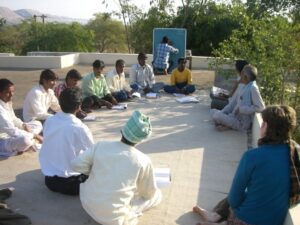
The centre also coordinates state and national seminars on water governance, attempting to build a bridge between the accumulated traditional knowledge of India’s water communities—the ‘johad’ builders and tank maintainers whose methods predate modern hydrology by centuries—and the administrative systems that currently govern water at scale. This bridge-building is not easy. Government water bureaucracies have their own institutional cultures, their own preferred solutions (almost always infrastructure-intensive), and their own definitions of expertise that tend to exclude the knowledge of people who learned hydrology by digging ponds rather than attending universities.

The national campaign to protect the Ganga brought Singh into collaboration with Swami Sanand—the name taken by G. D. Agarwal, a civil engineering professor who had studied at Roorkee and the University of California, taught at IIT Roorkee, and played a central role in drafting India’s environmental laws and establishing its environmental governance structures. Agarwal twice undertook indefinite fasts to compel the government to develop a serious Ganga protection plan, and his campaigns resulted in the Ganga being declared a national river in 2009 and the establishment of a National Ganga River Basin Authority. A dam project on the Bhagirathi, a primary tributary of the Ganga, was abandoned in consequence. Agarwal, who served as vice-president of Tarun Bharat Sangh, died in October 2018 after a third fast. He was eighty-six years old, and had been fasting for one hundred and eleven days.
THE STOCKHOLM PRIZE
In 2015, Rajendra Singh received the Stockholm Water Prize—often described as the Nobel Prize of water—for his work in reviving rivers and building participatory water governance in Rajasthan. The prize committee cited the revival of the Arvari and four other rivers in Alwar district, the water structures built with local communities across more than a thousand villages, and the model of the Arvari Parliament as a replicable approach to decentralized water management. Ten years earlier, the Rivers Australia organisation had given Tarun Bharat Sangh the Thiess River-prize for the Arvari work specifically.

The prizes are significant not primarily as recognition but as a form of documentation: they establish, in the language of international institutions, that what happened in Alwar district is real, measurable, and reproducible. This matters because the dominant paradigm of water management in India—and, indeed, in most of the world—is centered on large infrastructure: dams, canals, piped water systems, treatment plants. These are capital-intensive, technically complex, dependent on functioning state institutions for their operation, and almost entirely top-down in their design. They are also, in the Indian context, frequently compromised by the same combination of corruption, mismanagement, and political interference that afflicts other large government projects.
The check dam is not a replacement for large infrastructure. It does not serve cities. It cannot regulate the flow of a major river. What it can do—as the Arvari watershed demonstrates—is recharge a local water table, revive a seasonal river, support two harvests a year in a desert climate, and provide the foundation for a self-governing community whose members have, over decades, developed a practical understanding of how their watershed functions and what it requires. This understanding cannot be imported from outside; it has to be built, village by village, through the kind of slow, unglamorous, persistent work that Rajendra Singh began in Kishori in 1985 and has not stopped doing since.
The earth contains enough for everyone’s needs, but not for everyone’s greed. The Arvari Parliament’s water rules are, in practice, a working gloss on this observation.
WHAT THE OLD MAN KNEW
Mamu Meena, the old man who stopped Rajendra Singh on the road in Kishori and told him to bring a pickaxe, was illiterate and had no formal knowledge of hydrology. What he had was a lifetime of observation: he knew where the water went when it rained, where it collected, where it disappeared, and where it might be persuaded to stay. This is a form of knowledge that modern water management tends to classify as either nonexistent or anecdotal, and to ignore accordingly.
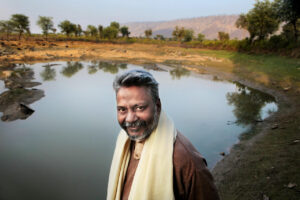
The lesson that Tarun Bharat Sangh has drawn from thirty-five years of field work—and that the success of the Arvari revival makes difficult to dismiss—is that traditional water knowledge and contemporary science are not alternatives but complements. The check dam is a traditional structure; its design principles have been understood in the Indian subcontinent for millennia. The hydrology that explains why it works—the percolation rates, the recharge dynamics, the relationship between vegetation cover and water retention—is contemporary science. Bringing the two together, in a specific watershed, in conversation with the people who live there, is the work that Singh has spent his life doing.
It is work without a clear endpoint. Rivers can be revived, but they can also be killed again: by a factory upstream, by a borewell that drains an aquifer faster than the check dams can recharge it, by a policy change that overrides the Arvari Parliament’s rules. The Stockholm Water Prize does not protect the Arvari. The court orders that closed the quarries have been tested repeatedly by interests that did not accept them. The organization’s workers continue to be harassed. The work continues because it continues: because the communities that depend on the river have concluded, through experience, that the alternative to managing it carefully is losing it, and because there are people who are willing to keep organizing those communities, village by village, for as long as the work requires.
Singh was called useless as a child. He took a bus to the end of the line and dug a pond for six months by himself. Forty years later, there are rivers running that were not running before. The word, in his case, did not stick.
Translated and adapted from the Tamil original. The Arvari Parliament’s rules are drawn from Tarun Bharat Sangh’s published documentation. The tiger population figures are from forest department records cited in Tarun Bharat Sangh reports. G. D. Agarwal (Swami Sanand) died on October 11, 2018, after one hundred and eleven days of fasting.









A powerful reminder that real revolutions are not always built with speeches or slogans — sometimes they begin with a single spade, a wounded river, and one person’s stubborn hope. “The Water Gandhi” reflects how ecological justice and human dignity are deeply connected. Inspiring, humane, and urgently relevant.