



On a quiet Tuesday in January 2026, the Supreme Court of India delivered a ruling that will outlast its bench. The Court rejected the bail plea of Umar Khalid, a scholar and activist who has now spent more than 1,800 days, nearly five years, in pre-trial detention. In April, his review petition was also dismissed. The charge? Orchestrating a conspiracy behind the 2020 Delhi riots. The evidence? Speeches advocating peaceful protest and a network of student activists. We are witnessing the transition of India from a civil democracy to an ethnic democracy, where the law does not protect the citizen, but rather manages the “enemy.”
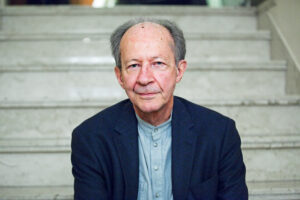
By making bail nearly impossible and trial a distant mirage, the state has moved Khalid into a “zone of indistinction.” According to Giorgio Agamben, the “zone of indistinction” (often referred to as the zone of indistinguishability) is the conceptual space where the usual boundaries between law and lawlessness collapse.
The law is still on the books, but it is no longer being applied to protect the individual. Instead, the law is used to isolate or suspend the individual’s rights.
The “zone of indistinction” is the mechanism through which the state enforces its ethnic democracy: it treats a specific group of people as “bare life,” making them susceptible to state violence (via the jail cell or the lynch mob) without ever having to engage with them as equal citizens.
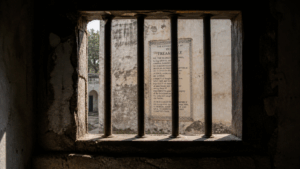
Umar Khalid has been rendered as Homo Sacer: the figure who is included in the political order only through his exclusion. In this state, Khalid is “bare life.” He occupies a “living tomb” where the Constitution is cited in every hearing but never applied to his person. His incarceration is a message to the minority collective: your rights are not inherent; they are temporary concessions that the state may revoke at will.
To understand why this case matters beyond the fate of one man, we must look beyond the narrow confines of legal reporting. We must see Umar Khalid not as an isolated defendant of democracy but as a mirror. His lost years in jail are not a failure of the system; they are a feature of a new political order, what scholars call an ethnic democracy. And his body, suspended between the prison wall and the Constitution, has become what philosopher Giorgio Agamben calls Homo Sacer: a life that can be taken or destroyed without the act being considered a crime.

It can certainly be argued that the legal siege against Umar Khalid is part of a direct continuum with the lynch mobs of Rajasthan, Uttar Pradesh and elsewhere in India. The gavel and the noose are two instruments of the same sovereign project: to reduce the Indian Muslim from a citizen to a subject, and finally to bare life. (I use the term “gavel and the noose” as a necropolitical metaphor: The gavel is the noose dressed in a black robe. The noose is the gavel released from the courtroom and let loose on the street. Together, they form a continuum of elimination: the state does not need to hang every Muslim. It only needs to show that it could, and that the law will not protect them. The gavel represents the formal, legal, state-sanctioned apparatus of subjugation. It sits in the judge’s hand. It is the UAPA, the remand orders, the bail rejections, the endless adjournments. The gavel does not kill the body quickly. Instead, it performs a slow civil death, the destruction of legal personhood, the erasure of years, the systematic dismantling of a life through “due process.” The noose represents the extra-legal, mob-driven, street-level apparatus of subjugation. It is the rope around a Muslim cattle trader’s neck in Rajasthan, or the iron rods in a Jharkhand village. The noose does not wait for trial. It delivers quick physical death.)
The Facts of a Legal Vacuum
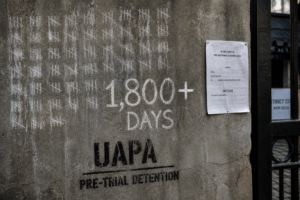
Let us first recall the facts. Umar Khalid was arrested in September 2020 under the draconian Unlawful Activities (Prevention) Act (UAPA). The prosecution alleges he was the “principal architect” of a broader conspiracy behind the February 2020 riots in Northeast Delhi, which left 53 people dead. Crucially, Khalid never picked up a stone or a weapon. His alleged crime was speech, namely speaking against the Citizenship Amendment Act (CAA) at Jamia Millia Islamia and other public forums. Under Section 43D(5) of the UAPA, bail becomes nearly impossible once a court deems the allegations “prima facie true.” This inverts the foundational principle of criminal law: the presumption of innocence.
In January 2026, the Supreme Court granted bail to five co-accused, including former JNU student leader Natasha Narwal, but singled out Khalid and Sharjeel Imam for continued detention, citing their “central and formative role.” By April 2026, when Khalid’s review petition was dismissed, the message was unmistakable. The bench acknowledged the five-year delay but declined to call it “constitutional impermissibility.” In plain English, indefinite detention is legal, provided you can be branded a threat to the nation. This is not justice. This is a state of exception camouflaging as a judgment.
Foucault’s Biopolitics: Manufacturing the Internal Enemy
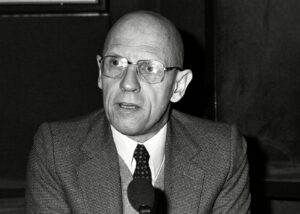
To grasp the scale of what is happening, we turn to Michel Foucault. In his lectures on biopolitics, Foucault described how modern states shift from merely punishing crime to managing entire populations as living risks. The state learns to “make live and let die.” It identifies certain groups, whether racial, religious, or political, as threats to the biological health of the majoritarian social body. In India, the Muslim community has been systematically cast as an internal enemy. The proof is not merely in Khalid’s jail cell. It is in the data. It is in the speeches of elected leaders calling for economic boycotts. It is in the bulldozers that systematically raze Muslim-owned homes after communal violence, a practice euphemistically termed “bulldozer justice.”
Agamben’s Homo Sacer: The Living Tomb
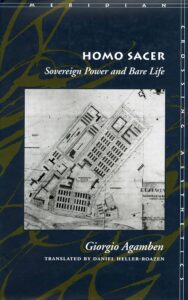
In his masterwork Homo Sacer, Agamben argues that the true foundation of modern sovereignty is not the rule of law but the power to suspend it. This is the state of exception: a legal black hole in which the sovereign decides that the Constitution does not apply to certain people. The figure who lives in this black hole is the Homo Sacer, the “sacred man” of ancient Roman law. This person could be killed without it being considered murder, yet he could not be sacrificed in a ritual. He was outside the protection of both divine and human law. He was reduced to bare life: pure biological existence without political meaning- a body that had already been rendered for a civil death.
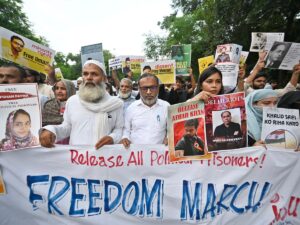
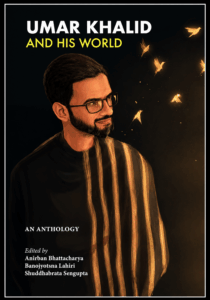
Umar Khalid has become the Homo Sacer of 21st-century India. His prison cell is not a place of punishment for a proven crime; it is a “living tomb”. He breathes. He eats. But his legal personality, his right to a fair trial, his presumption of innocence, and his dignity as a political being have been extinguished. He has been stripped of all political rights. By refusing to intervene, the Supreme Court has ratified and legitimised this tomb. It has been said, in effect, that a Muslim activist can be buried alive in the legal system, and that is not a crisis. It is a solution.
The Word and the Flesh: Where Theology Meets Jurisprudence
There is a strange and dark convergence between two seemingly distant statements. The first comes from the Gospel of John: “The Word became flesh and dwelt among us.” Here, divine law descends into material reality, taking on a body that can be seen, touched, and wounded, and at least be crucified. The second comes from Giorgio Agamben, who argues that law desires to have a body – that sovereignty is never fully satisfied with abstract statutes; it craves a physical site upon which to inscribe its power, to test its limits, to display its authority.
In a functional democracy, that body is the citizen. The law protects it, nourishes it, and guarantees its flourishing. But in an ethnic democracy, the law requires a different kind of body: one that can be marked, suspended, and violated without any consequence. The Indian Muslim body has become that flesh.
The UAPA is an abstract text, words on paper assented to by the President. But those words remain lifeless until they find a body to seize.
Khalid’s body is that Word-made-flesh. The law desired a defendant, and it found one in him. His five years without trial are not a failure of the law; they are the law fully realised. The “zone of indistinction” is not a metaphor. It is a cell. It is handcuffs. It is a body denied sleep, denied dignity, denied time.
When a crowd beats a Muslim man to death over a cow or a suspected love affair, they are not acting outside the law. They are acting as the law’s surrogate. The sovereign desire to mark the Muslim body as killable flows from the legislature (through the UAPA and hate speech) to the street. The mob gives the law the body it craves. The noose is the Word becoming flesh in its most outrageous form.
Mbembe’s Necropolitics: From the Courtroom to the Killing Floor
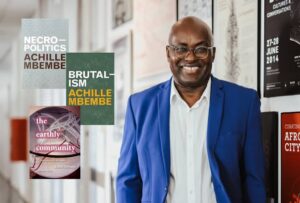
Achille Mbembe took Agamben’s ideas one step further. He coined the term necropolitics, the politics of death. Necropower is not merely about letting die (Foucault) or suspending law (Agamben). It is about actively creating “death-worlds”: social and political spaces in which entire populations are marked for destruction, whether through direct killing or through the shared use of violence and the slow violence of neglect, as is happening in Gaza.
This is where the courtroom meets the lynch mob. Over the past seven years, India has seen dozens of high-profile mob lynching cases, from Alwar to Jharkhand, in which Muslim men were beaten to death over cow slaughter or transport. In almost every case, the perpetrators were celebrated by right-wing groups, granted bail within weeks, and often never convicted.
What is the difference between a lynch mob and a UAPA court? Only the terminology, but ontologically the same: a necropolitical point of tangency at which a Muslim body is rendered for death. The mob uses iron rods and petrol. The court uses adjournments and Section 43D(5). Both produce the same result: the Muslim body is rendered killable or destroyable. The mob kills the flesh; the court kills the years of invaluable life. Both are necropolitical instruments.
Consider the contrast. A Hindu accused of lynching a Muslim is often at home on bail within a month, garlanded by politicians. A Muslim activist accused of giving a speech is held for five years without trial. This is not a failure of judicial neutrality. This is a success of ethnic hierarchy. The judiciary assigns differential value to human lives; a sort of biopolitical jurisprudence is evolving through precedent, eviscerating constitutional morality.
Ethnic Democracy: When the Exception Becomes the Rule
The political scientist Sammy Smooha defined ethnic democracy as a system in which the state belongs exclusively to a dominant ethnic group, while minorities are granted conditional, inferior rights. Israel has been described as an ethnic democracy for its treatment of Arab citizens. Northern Ireland, under the Protestant Ascendancy, was another. Increasingly, India fits the definition.
In an ethnic democracy, the majority need not abolish the Constitution. It merely needs to hollow it out. The Supreme Court remains. Fundamental rights remain. But for the minority, those rights are on a leash. They can be pulled back the moment the majority feels insecure. The UAPA is that leash. Preventive detention is that leash. The refusal to grant bail for five years is the hand pulling hard.
Umar Khalid’s case is thus a signal. It tells every Muslim in India: you are a guest in this nation, not a co-owner.
Your speech is a privilege, not a right. Your life has value only so long as you do not organise, do not protest, do not speak too loudly.
And if you cross that invisible line, we will not kill you outright, which would attract international condemnation. Instead, we will place you in a living tomb. We will let the years drain out of you. And the Supreme Court will call it due process.
The Death of the Citizen
We began with a man in a cell. We end with a nation on a precipice. Umar Khalid is not a terrorist. He is not a conspirator. He is a political dissenter who had the courage to speak against the government in a democracy. That he still sits in jail while the Supreme Court looks away is evidence of a profound transformation.
Umar Khalid is the primary site of this transformation. His case proves that the “rule of law” has been replaced by the “rule by law,” where legal mechanisms are repurposed into tools of ethnic subjugation. As long as the Homo Sacer remains in his cell, the Indian Republic’s claim to be a civil democracy remains a haunting fiction. The exception has become the rule. India was once a civil democracy with a messy, beautiful pluralism. It is becoming something darker: an ethnic democracy where one religion is the sovereign and the others are subjects.
The lynch mob and the judge’s gavel are two sides of the same necropolitical coin. The mob delivers a quick death. The court delivers a slow one. Both announce that the Muslim is the Homo Sacer of the Hindu Rashtra. In 2026, Umar Khalid remains in his living tomb. But his case is not really about him. It is about whether there remains any institution in this country that will say: five years without trial is tyranny. It is about whether we will recognise that when the law applies differently to different bodies, it has ceased to be law. It has become a weapon.
And a nation that turns its courts into weapons has already begun to die- one adjournment, one lynching, one silent prison cell at a time. The “Living Tomb” of the prison and the “Public Spectacle” of the lynching are the twin pillars of a necropolitical regime that has successfully redefined who belongs to the nation and who is merely permitted to exist within it.








“A deeply unsettling reflection on how prolonged incarceration without closure can erode the very spirit of democracy. The piece doesn’t just speak about one individual—it raises urgent questions about justice, dissent, and the cost of silence in contemporary India.”