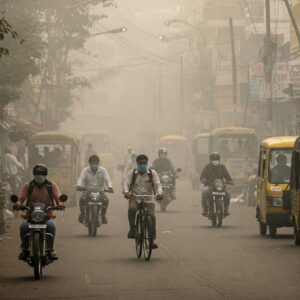
India is suffocating under hazardous air pollution as major cities across the nation experience catastrophic Air Quality Index (AQI) levels that far exceed global safety standards. On 24 November 2025, Delhi’s AQI surged to a hazardous 559, with PM2.5 concentrations at 331 µg/m³—over 22 times the World Health Organization’s recommended limit of 15 µg/m³. The National Capital Region (NCR) faces similarly dire conditions: Ghaziabad recorded 437, Noida 418, Greater Noida 399, and Gurugram 295. Beyond the NCR, the crisis has engulfed other major cities, with Bhopal (302), Kota (300), Kurukshetra (288), Haldia (279), and Kolkata (256) all experiencing dangerously poor to very poor air quality. Mumbai (176), Patna (154), and Lucknow (183) registered unhealthy levels posing serious health risks to millions.
Nationwide Pollution Emergency
The air quality crisis extends far beyond the NCR, engulfing cities across India in toxic smog. A shocking 94 out of the world’s 100 most polluted cities are in India, and 173 of 238 Indian cities exceeded the national air quality standard of 40 µg/m³ during the 2024–25 winter season. Alarmingly, not a single Indian city meets the WHO guideline of 5 µg/m³ for PM2.5 pollution. Northern states such as Uttar Pradesh, Haryana, and Punjab face extreme toxicity, with cities like Hapur (420 AQI), Bahadurgarh (392 AQI), Muzaffarnagar (382 AQI), Meerut (364 AQI), and Panipat (351 AQI) recording pollution levels that threaten the health of tens of millions.
Death Toll and Life Expectancy Crisis
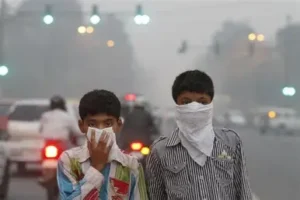
The health consequences of India’s air pollution catastrophe are staggering. Air pollution caused over 1.7 million deaths in 2022, a 38% increase since 2010, with fossil fuels accounting for 752,000 of these fatalities. Air pollution is now the third-highest cause of death among all health risks in India, ranking just above smoking. Toxic air is stealing years from Indian lives: exposure to polluted air reduces average life expectancy by 3.5 years nationwide. In Delhi, residents could live 8.2 years longer if air quality met WHO standards. Across South Asia, including India, people are losing over 2.6 years of life expectancy due to combined indoor and outdoor pollution.
Government Inaction and Policy Failures
Despite the mounting death toll, government action remains inadequate and poorly executed. India’s National Clean Air Programme (NCAP), launched in 2019 with the goal of reducing particulate pollution by 20–30% by 2024, has achieved only a 10.7% reduction as of 2023, with just 38% of targeted cities showing substantial decline. These failures stem from weak enforcement, under-resourced pollution control boards, poor coordination between agencies, and fragmented policies lacking accountability. Even measures like the Graded Response Action Plan (GRAP) have failed to reverse the crisis—pollution levels continued to rise even after Stage IV restrictions were imposed in the NCR.
The Political Will Deficit: Transport Neglect and Industrial Centralisation
India’s air pollution crisis is fundamentally a political-will problem, marked by failure to invest in public transport and decentralise industry—two measures that transformed air quality in Beijing and Paris. Indian cities heavily prioritised expensive metro projects, allocating ₹1.4 lakh crore to metro and high-speed rail between 2019–24, while urban bus systems received a mere ₹4,048 crore, only 3% of the metro budget. Public transport remains overcrowded, poorly maintained, and insufficient, forcing millions to rely on personal vehicles that choke city air. Meanwhile, there has been no serious attempt to decentralise industry, allowing polluting units to remain concentrated in already overburdened urban centres.
Beijing’s Clean Air Revolution: What Political Courage Looks Like
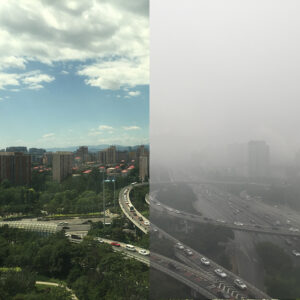
Beijing’s dramatic pollution reduction shows what determined political leadership can achieve. Between 2013 and 2022, Beijing slashed PM2.5 levels by 64–66.5% and sulphur dioxide by 89%, preventing thousands of premature deaths annually. The city implemented a sweeping “coal-to-gas” transition, reducing coal consumption by nearly 11 million tonnes by 2017 and eliminating coal-fired power plants and boilers from the core city. Strict industrial emission standards, closure of high-pollution enterprises, and strong vehicle emission controls ensured that even as the number of vehicles tripled, total emissions decreased. Crucially, Beijing established legally binding accountability systems, making officials personally responsible for meeting air quality targets.
Paris’s Transport-Led Transformation
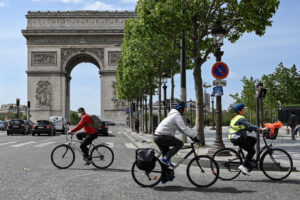
Paris tackled air pollution by fundamentally restructuring urban mobility, targeting diesel vehicles responsible for 40% of fine particle emissions. The city banned high-polluting diesel vehicles by 2020, promoted electric mobility, and invested massively in alternatives to private cars. Paris built 1,400 km of cycle lanes, expanded the Vélib’ bike-share system with 1,279 additional stations, and offered financial incentives for citizens to surrender cars in exchange for public transport passes. During pollution spikes, authorities made public transport free and implemented temporary odd-even restrictions on vehicles to cut emissions.
The Questions India Refuses to Answer
As 1.7 million Indians die every year from breathing toxic air:
- Why does the government continue treating this catastrophe as a seasonal inconvenience rather than a national public health emergency?
- When Beijing reduced PM2.5 pollution by 64% in less than a decade through accountability and enforcement, why has India’s NCAP achieved barely 10% with no officials held responsible?
- If Paris can invest in 1,400 km of cycle lanes and a comprehensive public transport ecosystem, why does India allocate 97% of urban transport budgets to metros serving elite corridors while millions continue to suffocate?