


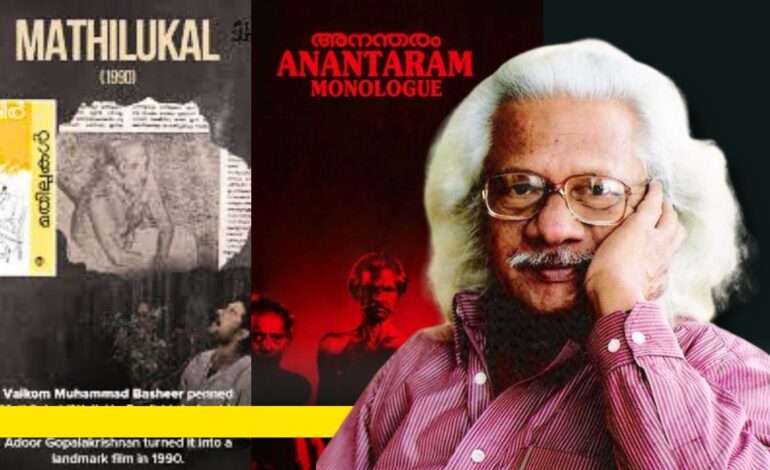
In this third part of Professor V Vijayakumar’s essay on Adoor Gopalakrishnan, the focus narrows to interior lives—dreams, wounds, stammers, and silences. While Adoor’s earlier films engaged history and society through collective memory and political movements, here he turns to individuals. Anantaram, Kathapurushan, and Mathilukal trace how the self forms under pressure—through violence, institutions, language, and love. Though these films emerged over nearly a decade, they share an intimate texture. And while Kathapurushan (1995), was made after Vidheyan (1993), its meditative solitude and pared-down emotional register make it a spiritual sibling to Anantaram and Mathilukal. The chronology bends to better serve the inner arc.
Examining Adoor’s films collectively does not undermine their autonomy. Each stands fully realised. Yet Anantaram (Monologue, 1987) diverges distinctly from the preceding quartet. This work lacks overt links to Kerala’s sociopolitical fabric. Its meaning demands careful excavation. Some questioned whether it even adhered to a recognisable narrative form. For others, the protagonist’s hallucinated reality seemed to inflect Adoor’s own style, transforming it with erratic whimsy. Adoor may have realised he was depicting Ajayan’s unraveling life through tangible symbols. The film’s title, Anantaram (“Afterwards”), did not yield an immediate explanation. Yet, this title offered the earliest thread connecting it to Adoor’s previous works. It suggested a narrative continuation, a reflection on what ensued. It could be interpreted as an extension of the filmmaker’s established thematic concerns. In this sense, Anantaram becomes legible as “Then Ajayan,” signaling consequences. The film’s title foreshadows aftermath—Ajayan portrayed as the cinematic residue of a fractured social order.

Anantaram presents Ajayan as a character who questions convention, struggles to distinguish reality from hallucination, and is frequently marginalised despite his extraordinary intellect. The filmmaker was capturing deep anxieties about the trajectory of Kerala’s youth. He foresaw a generation unmoored, disoriented by illusions, and systematically excluded or pressured into oblivion. Ajayan personified the youth of the 1980s—forced to endure a society enamored with illusions and constructed by ideological forces like Damodaran, Mathukutty, and Sudhakaran of Mukhamukham. It sees a world that drives sensitive minds toward drugs, psychosis, or suicide. Adoor has spoken of youths who saw Ajayan’s journey as mirroring their own. One such viewer, after multiple viewings of Anantaram, approached Adoor to affirm that many moments on screen were reflections of his lived reality. These personal testimonies affirm that Ajayan’s life echoed that of Kerala’s later youth. Thus, the film maintains thematic continuity with Adoor’s prior works. Notably, no effort has been made to anchor Anantaram within Kerala’s historical timeline. Such opportunities were sparse. Beyond the aesthetic appreciation of Adoor’s unique cinematic idiom, the film’s social resonances remain largely unexplored.
Stagnation and inertia do not challenge authority—they sustain it unconditionally. In such a milieu, dissenters become threats. A society that embraces institutional norms without interrogation regards dissent with suspicion and devalues vibrant, subversive expressions. Ajayan is one such casualty. His educators, unwilling to validate his brilliance, fail to nurture his innovative potential. The brilliance that Ajayan displays is unacceptable to them. Ajayan’s intellectual luminosity becomes intolerable. Consequently, he grows envious of Baluvettan, who achieves success through perseverance.

Enigmatic imagery warps creativity. Raman Nair, the cook, the compounder, and the driver Mathai—all of whom fail to teach Ajayan to interpret reality directly—immerse him instead in layers of enigma. Mathai becomes a hen, a fairy, an elixir for grownups—each an elaborate strategy to mystify rather than clarify. These deceptions compound the mystique in Ajayan’s young consciousness. When his imagination is routinely dismissed or diminished, seeds of rejection and melancholy flourish within a terrain saturated with fantasy. Thus, his artistic visions twist into psychological rupture. In adulthood, that spark mutates: he sees his aunt Suma as the phantom lover Nalini—an invention shaped by the shadowy figures of myth. The spectral forces of mystery derail his imaginative trajectory. Emotional entanglements—love and rivalry toward Baluvettan—intertwine with this internal chaos.
Observe Ajayan’s ordeal at the village fair. The organiser, perturbed by Ajayan’s consistent victories in a game of darts, becomes hostile. He leads him behind the grounds and assaults him. A costumed dancer, hidden behind the stage, questions the motive: “If he wins every game, why are we even doing this?” Here, Ajayan’s ingenuity is not only stifled—it is violently suppressed to preserve economic interest. The rejection of his talent stems from greed. Adoor foresaw that future Kerala would exalt wealth over intellect, profit over creative merit.
Childhood moulds the psyche. Ajayan’s mental fabric is woven in an environment that suppresses inquiry and vitality. His mentors and guardians belong to a society entrenched in traditionalism. Rather than fostering inherent gifts and offering direction, they exert authority to silence and subdue. These figures reflect the social ecosystem that cultivates a generation vulnerable to psychological collapse, self-destruction, or violence. Adoor’s overt critique of political hegemony in Mukhamukham reappears in Anantaram with greater nuance—as an indictment of ideological machinery: the home, the school, the normative institutions. Adoor mourns the transformation of familial and pedagogical structures into repressive systems that suffocate the creative spirit.

The deep unease over societal forces that stifle and marginalise creativity forms the core of Adoor’s cinematic vision—echoing the anguish present in the works of all true visionaries. Where the spark of wonder is caged by fear, where the questioner is labeled deviant, where wealth sits crowned above wit and vision—there, childhood fades into shadow. There, Ajayan walks—a boy with galaxies in his eyes, beaten behind tents by men in masks, his arrows truer than their lies. And Adoor writes not just cinema, but the lament of a land that traded its dreamers for obedience.
If Anantaram is Adoor’s most internal film, Kathapurushan (1995) returns to the historical and political, but now from within the subject’s life itself. The film sustains thematic and stylistic continuities with his early works, yet its scope is broader. The script, penned by Adoor himself, draws a compelling parallel between the protagonist’s trajectory and the historical unfolding of Kerala. Institutions such as the judiciary, police, and political organisations intervene significantly in shaping the fate of the central character, Kunjunni. But it is the insidious severity of formal learning that reshapes his identity. The young Kunjunni is seen eagerly heading to the ezhuththukalari under the tutelage of Veluchar. Clutching a palm leaf, with Veluchar shielding the boy a straw umbrella, they tread past meadows, wooded patches, and rural paths. Adoor enriches these sequences with unique aural textures. At one point, Kunjunni implores Veluchar to snare a bird he points at, but Veluchar declines, citing the day as inauspicious and promising to try on Sunday.
Kunjunni expresses doubt on Veluchar’s memory. Also, he wonders whether Veluchar can pronounce from Ah to Am accurately. He already grasps the vowel sounds. We then see Kunjunni stooping to splash water on his palms at a stream, after which Veluchar lifts him onto his shoulders to ferry him across. Kunjunni’s weary whisper— “this learning has no end”—is heard as well. As they walk, Veluchar narrates fragments of his life and worldview. Later, in ezhuththukalari scene, Kunjunni is visibly distracted while Asan drills him on letters; his gaze follows a goat munching dangling leaves. When Asan rebukes him harshly and demands recitation, Kunjunni, shaken, begins to stutter. Adoor constructs this moment as the genesis of Kunjunni’s speech impediment. There’s also a portrayal of Kunjunni stammering through the alphabet with a friend. What we term stammering, emerges as a rupture between utterance and meaning – gaps that our educational system aggressively fills.
Another poignant scene features a child weeping after school, humiliated by his teacher Ramakrishnan who labelled him “petty bourgeois.” Such incidents underline the indifference of our pedagogy toward the psychological toll of punitive instruction and ridicule. Prevailing didactic practices crush innate inventiveness, breed anxiety in problem-solving, and mold skewed cognitive frameworks. As Malayalam Poet Edassery articulates in a poem, the journey of education estranges us from one another and from the natural world. Learners become alienated from instinctive competencies. The mastery of rigid grammar alienates them from lyrical expression. The mechanisms that institutionalise ultimately produce a stammering mind.

It is not institutionalised learning but rather formative, experiential moments in Kunjunni’s childhood that cultivate his intrinsic goodness. A lifelong stammered, Kunjunni eventually authors a novel titled Kharaksharangal. Upon discovering that the government has proscribed his work, he renounces from stammer and experiences a liberating transformation. The filmmaker positions Kunjunni as a figure who confronts his stutter with writing of a novel. Just as the educational machinery rendered him a stammered, the triumvirate of state, law, and police – which censored his novel – collectively debilitated him. Yet Kunjunni’s inner defiance withstands them all. His self-fashioned literary creation becomes the very agent of the emancipation that he experienced. Could Adoor be implying that the imaginative arts, literature, expression, creativity – hold the latent power to rupture structures of prohibition?
In a metaphor that echoes the opening and closing of the film, just as a prince combats a beast in the embedded tale, Kunjunni perseveres in his resistance, emboldened by the knowledge that power does not guarantee victory. While Adoor’s earlier films often depict disintegration and the erosion of creative potential, here the protagonist carves out pockets of dissent amid dissolution. This film discloses the filmmaker’s sustained optimism, even within the detritus of social decay.
The film’s narrative trajectory unfolds from roughly ten years before Gandhi’s assassination to the period of Nayanar’s governance in the 1980s. It opens with a midwife’s reflective account of Kunjunni’s mother’s agonising labour, interwoven with indigenous beliefs tied to childbirth. Kunjunni is born into a landowning Nair household of high caste, and his milieu is profoundly moulded by entrenched Nair traditions—rituals deeply rooted in Kerala’s sociocultural fabric of the time. Even during Kunjunni’s childhood, figures like Veluchar and Kalari Asan refer to him as “Kunjejamane,” a form of address shaped by the caste system’s hierarchies.
Although the setting is saturated with caste-specific norms, the film refrains from explicit representations of entrenched caste oppression. Apart from Veluchar’s lone remark identifying Kunjunni’s teacher Ramakrishnan as a chokon, caste stratifications remain largely implicit. The film, arguably, maps the lineage of an upper-caste, emergent middle-class Nair family against Kerala’s historical canvas. The director adopts a compassionate yet discerning lens toward this family. The depiction carries undertones of Nair insularity, hierarchical pride, or social hauteur. Interpreted historically, Adoor depicts the gradual disintegration of the privileged caste structure with sombre sensitivity.

Kunjunni’s maternal grandmother exemplifies inclusive compassion, extending her warmth not only to Veluchar and Janamma’s household but to all she encounters. Kunjunni’s uncle Vasumman transitions from being a Congress activist during the independence movement to a committed Communist, spending years underground and in incarceration. In his twilight, he returns cloaked in saffron, expressing a yearning only for inner peace. The assertion in his words that communism and saffron are separated by merely a fine line risks in rehabilitating historical Nair ideology and caste hierarchies. It is indulging in a reductive analysis that ignores their fundamental contradictions. From his college days, Kunjunni is drawn to Communist ideology, and later he endures a prison sentence during his involvement in the Naxalite struggle – left physically impaired by police brutality. The filmmaker also hints through some scenes that elements of empathy are growing in Kunjunni’s son as well, like Kunjunni. Ultimately, Adoor filters the political and social conflicts of the era almost exclusively through the prism of this Nair family. Consequently, the lived realities of other castes, faiths, and economic strata remain marginal, if not entirely effaced. Dileep M. Menon’s critique – that Adoor Gopalakrishnan, alongside M.T, nostalgically reconstructs the erosion of Nair caste privilege, heritage, and matrilineal superiority as a universal human condition – resonates powerfully here. This critical lens arguably applies to Adoor’s earlier works as well if focused in a different way.
The word walls evoke images of obstruction, confinement, and servitude! Both in Basheer’s novel and Adoor’s cinematic adaptation, we encounter the walls of a prison – walls that make servitude and confinement. These are exceptionally high walls, far taller than what would be necessary to prevent visibility between those standing on either side. This wall separates the men’s prison from the women’s prison. The narrative reveals it as a wall of gender segregation. The world of gender segregation is fundamentally the world of sexuality. We confront here the implicit meaning that this world constitutes a prison cell. In this film that exposes the world of sexuality, women remain invisible – only a female voice is heard. The world of sexuality becomes a space inhabited solely by men. In other words, Adoor employs a technique that, while subtly suggesting how the world of sexuality is a patriarchal world. Then the Director moves toward other problematisations. When the jailer tells Basheer “You’re free to go to the free world,” the protagonist responds: “Which free world? I’ll just be entering another larger prison.” The film’s Basheer perceives the outside world as equally carceral. The world of sexuality is a prison as vast as the world itself. The condition inside the prison – where men and women stand divided, unable to face each other across the walls – mirrors precisely the world outside. Everywhere in this world, invisible walls raise high, separating women from men – walls constructed from the bricks of sexual morality and values. In the film, Narayani calls this an “unrighteous wall.” Through these metaphors of walls and prisons, the film portrays humanity’s sexual servitude more effectively than any other attempt before or since.
33 Years Of The Classic #Mathilukal pic.twitter.com/P33JdrhVqo
— jaleel_jr (@jaleel_jr_) May 18, 2023
Adoor’s film was made after Michel Foucault wrote The History of Sexuality (though Basheer’s novel predates even Foucault). Foucault’s demonstration that our understandings of sexuality – deeply rooted in all of us – are social constructs was one of the most significant intellectual contributions of the last century. Sexuality is not merely a biological issue but a social construct – a perspective that poses major challenges to biological determinism. No other creature lives within the conscious framework of sexuality as humans do. Humans construct value systems around sexuality, prescribe moral codes for it, and this indicates that sexuality has a social history. It further suggests that the conceptions and beliefs about sexuality prevailing in different eras have played crucial roles in determining human identity. Colonial powers compelled us to adopt Victorian moral values; Malayali’s sexual morality was shaped in the crucible of caste system, Brahminism, and colonialism.

The wall of gender segregation does not merely separate women and men, making them invisible to each other – it also intensifies their sexual longing. How many stories we have heard about solitary individuals tormented by sexual desire! When a long-term prisoner hears a woman’s voice or perceives a woman’s scent, he experiences extraordinary pleasure. One prisoner tells Basheer about inmates’ sexual longing that leads them to make holes in the gender-segregating wall, attempting to see each other. Basheer recounts the incident to Narayani, though she remains already apprised of the circumstances. Subsequently, the prison’s sadistic warden orders the aperture sealed with cement. The protester was tied to a beam and given thirty-six lashes, while men and women on both sides of the prison counted each stroke in anguish. Such are the episodes where sexual longing is judged deserving of punishment!
Amidst the joy of being released along with all political prisoners, Basheer becomes deeply despondent upon learning that no release order exists for him alone. Even the modest happiness he had found in prison life disappears. He is left to endure the prison in near solitude. Then, quite unexpectedly, Narayani’s voice awakens him. Basheer begins waiting eagerly for the rising stick that signals Narayani’s presence beyond the wall and for the sound of her voice. Between Basheer and Narayani’s conversations, one can discern suppressed sexual longings breaking through. The stick rising above the wall becomes a visual metaphor for these erupting sexual desires. This stick desperately seeks to breach the wall of gender segregation. The film concludes by depicting Basheer’s sorrow and anger as he must depart for the larger prison of the outside world, unable to respond to Narayani’s presence. The recurring image of the rising stick gradually fades away. Like a hole created by human sexual longing to overcome the towering wall of gender division, this rising stick too proves ineffective. The world continues to deny love and sexual freedom!

While this film primarily exposes the subtle operations of power within sexual morality that regulate male-female relationships, it simultaneously reveals much more. A significant portion of the prison inmates are political prisoners – those who fought against colonial powers for the nation’s independence. Basheer himself is imprisoned on charges of sedition. He comforts Rasaak, who killed his sister’s abusive husband. An unfortunate man imprisoned for eighteen months on fabricated housebreaking charges shares his grievances with Basheer. A school friend of Basheer arrives in prison convicted of theft, only to have his sentence extended for assaulting a warden, leaving him chained and bedridden. Despite imprisonment, Basheer receives tea, pickles, and beedis. He stays awake all night keeping vigil for a condemned man, fulfilling his last wish for tea. Some jail officials even provide Basheer with paper to write stories, which he does from his cell. Adoor visually represents how this walled space transforms into an arena where numerous subtle societal contradictions play out.
Part Four: Power, Submission, and the Female Condition follows tomorrow.
To read the other blogposts in the ‘Adoor- The Maestro’, click here.









Enthralled by this majestic piece of analytical film writing . There is little doubt that this is one of the most substantial analysis of Adoor Gopalakrishnan’s body of work . Eager to read more articles like this
Thank you Professor Vijaya Kumar and thank you Aidem