


In an India still fractured by caste and religion, who gets to tell divine stories and who is silenced remains a deeply political question. When devotion becomes the battleground for hierarchy, scriptures like the Bhagavata Purana are twisted into tools of exclusion. But was that ever their intent? This article journeys through the life of Vyasa and the soul of the Purana to challenge Brahminical gatekeeping.
This is the 15th article in Senior Journalist and author Nalin Verma’s fortnightly column in The AIDEM titled ‘Everything Under The Sun’. Nalin Verma does not attempt to reclaim traditions here, but unmask them. He reminds us that Krishna’s song was never meant to echo within walls, but to ring out freely under the open sky.
vidyā-vinaya-sampanne brāhmaṇe gavi hastini
śuni caiva śva-pāke ca paṇḍitāḥ sama-darśinaḥ
The wise, endowed with learning and humility, behold with equal vision a learned and gentle Brahmin, a cow, an elephant, a dog, and an outcaste. — Bhagavad Gita (5.18).
A disturbing video from Dandarpura village in Etawah, western Uttar Pradesh, went viral on social media, igniting outrage. It showed two kathavachaks (storytellers) from the Yadav community, Mukut Mani Yadav and Shyam Kathariya, being humiliated by members of the Brahmin community. The kathavachaks were allegedly forced to shave their heads, rub their noses on the ground, beaten, and made to touch the feet of Brahmins.
A yadav got assaulted for doing katha in a Brahmin village ( context below )
byu/Happy_Bid_8102 inuttarpradesh
Their crime? Belonging to the Shudra caste, deemed “lower” in the Varnashrama system upheld by texts like the Manusmriti, they dared to narrate the Bhagavata Purana, a sacred text that some Brahmins claim is their exclusive privilege to recite. The incident sparked violent clashes between backward castes and upper-caste Hindus in India’s Hindi heartland. Samajwadi Party president Akhilesh Yadav honored the two kathavachaks with Rs 72,000 each, while cadres of the Rashtriya Swayamsevak Sangh (RSS) and Bharatiya Janata Party (BJP) reportedly provided tacit administrative and moral support to the Brahmins, further inflaming tensions.
But this column isn’t another report on caste violence in the name of the Bhagavata Purana—one of the 18 major Puranas, revered for its profound spiritual, philosophical, and literary qualities. Traditionally attributed to Sage Vyasa and dated to the 9th–10th century CE (though some scholars suggest earlier origins), this Sanskrit text comprises 12 skandhas (books) with approximately 18,000 verses. It weaves narratives, theology, and devotion, centering on Lord Krishna’s life and teachings.

Celebrated globally by scholars of literature and Indology, the Bhagavata Purana is a masterpiece of devotional poetry, with rhythmic verses, vivid imagery, and rich metaphors that convey complex philosophical ideas accessibly. Krishna’s lila (divine play), for instance, is depicted with lyrical elegance, evoking both awe and intimacy. The text has inspired saint-poets across castes, communities, and genders—Surdas, Raskhan, Malik Muhammad Jayasi, Dadu, Tukaram, Raidas, and Mirabai—who sang of Krishna and Radha’s divine love in their vernacular ballads.
Its lyrical grandeur has also shaped classical dance forms like Kathak and Bharatnatyam.
Who was Vyasa? Is the Bhagavata Purana a divisive text? Did Vyasa intend it to be narrated solely by Brahmins? Does this scripture, which interweaves cosmology, mythology, and ethical teachings, permit Brahmins to monopolize it or punish outcastes for sharing its stories? Did Krishna, in his childhood lilas—stealing butter, herding cows, or playing his flute—discriminate based on caste or creed? Did Sage Shuka, narrating Krishna’s story to King Parikshita in the Bhagavata Purana, aim to sow hatred against outcastes or explore profound questions of bhakti, yoga, karma, dharma, and moksha (liberation)?
Let the stories of Vyasa and the Bhagavata Purana provide answers.
The Birth of Vyasa:
Vyasa, also known as Krishna Dvaipayana Vyasa, the legendary author of the Mahabharata and compiler of the Vedas and Puranas, including the Bhagavata Purana, was born to Satyavati, a fisherwoman of humble origins. Satyavati, born to a fish (due to a curse on her mother, Adrika, an apsara transformed into a fish), was raised by a fisherman chieftain. Though radiant in beauty, she bore the lingering fishy odor. While ferrying passengers across the Yamuna River, she met Parashara, a revered Brahmin sage and scholar. Captivated by her enchanting aura, Parashara proposed a union, assuring her it was divinely ordained.
Satyavati, conscious of her status and its implications, consented only after Parashara’s assurances: he enveloped the area in mist for privacy, transformed her odor into a divine fragrance, and promised she would remain a virgin post-birth. From their union on a boat in the Yamuna, Satyavati gave birth to a son, instantly mature due to Parashara’s divine powers. Named Krishna Dvaipayana (dark-complexioned, born on an island) for his birthplace on a river island, Vyasa was destined for greatness.
Parashara proclaimed him a future sage, and Vyasa, endowed with divine wisdom, left his mother to pursue penance, promising to return when needed. Satyavati later married King Shantanu, becoming the matriarch of the Kuru dynasty, while Vyasa compiled the Vedas and authored the Mahabharata and Puranas. His birth, uniting a fisherwoman and a Brahmin sage, symbolizes the transcendence of social boundaries through divine will, establishing Vyasa as a bridge between the mortal and divine realms.
The Bhagavata Purana:
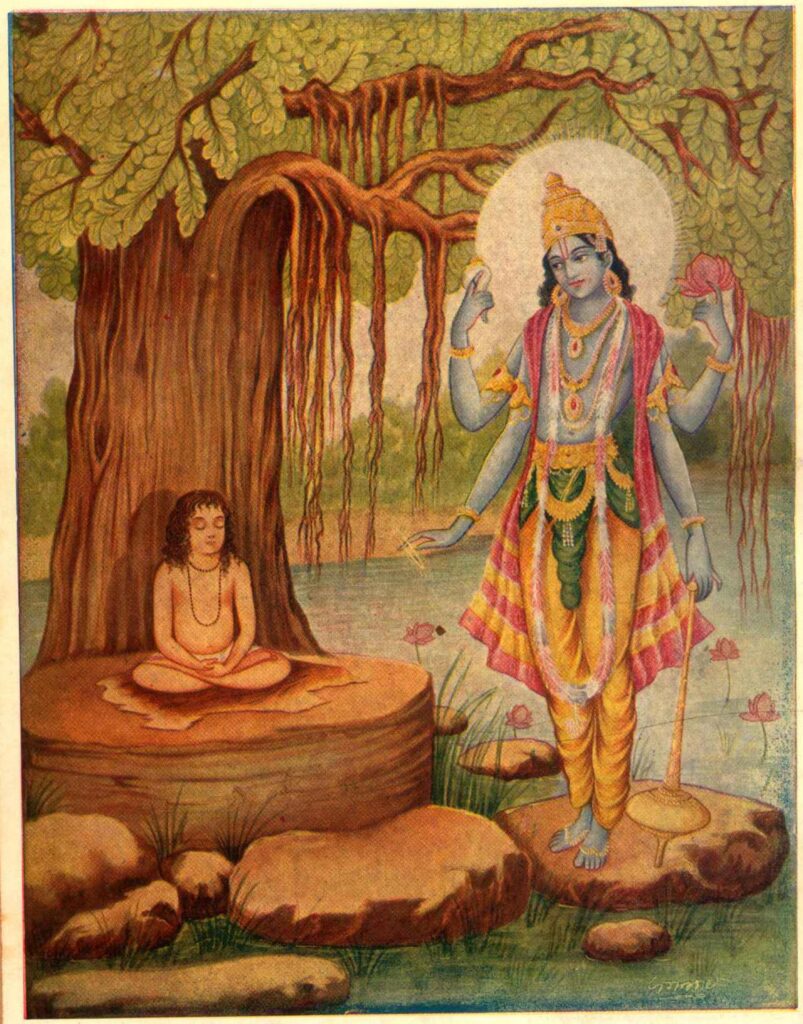
The Bhagavata Purana, composed by Vyasa, is a cornerstone of Hindu devotion, celebrating Lord Krishna as the Supreme Being. Written to counter ignorance and suffering, it was inspired by Vyasa’s guru, Narada, to foster bhakti (devotion). Spanning 12 cantos, it explores the universe’s creation, the lives of devotees, and Vishnu’s avatars, including Narasimha, Rama, and Krishna. The 10th Canto, its heart, vividly narrates Krishna’s life—his miraculous birth in Mathura, his playful childhood in Vrindavan with cowherds and gopis, his defeat of demons like Kansa, and his role as a king and teacher in Dwaraka.
The Rasa Lila, where Krishna dances with the gopis, symbolizes divine love and the soul’s yearning for God. The 11th Canto, with Krishna’s teachings to Uddhava, emphasizes detachment, devotion, and self-realization. The Bhagavata Purana teaches that bhakti transcends caste, creed, or status, offering liberation to all. Krishna, portrayed as the embodiment of love, compassion, and universal wisdom, guides humanity toward righteousness and unity with the divine.
Far from divisive, the text is a timeless call to devotion, love, and spiritual awakening.
Back to the Present:
North India stands divided, with some political parties rallying behind the humiliated kathavachaks and others, like the RSS-BJP, allegedly fueling caste-based animosity. Certain Left groups dismiss the Bhagavata Purana as a Brahminical oppressive tool, inadvertently ceding space to orthodox Brahmins under the RSS banner to claim Vyasa’s legacy—a sage born to a fisherwoman.
Meanwhile, these orthodox factions replay a tired pattern of erasing non-Brahmin voices like Kabir, Raidas, Tukaram. Mukut Mani Yadav and Shyam Kathariya, if they are true kathavachaks, should draw inspiration from Tulsidas, who faced scorn for narrating Rama’s story in Awadhi, the people’s tongue. The humiliation of non-Brahmins by orthodox Brahmins is no anomaly, it is as old as the Vedas and Puranas. Instead of succumbing to political divisiveness, they should refine their storytelling, sharing the Bhagavata Purana’s universal message of love and devotion with those who cherish its spiritual essence and poetic beauty.