

Lores of Love & Saint Gorakhnath – Interview with Co-Author Nalin Verma

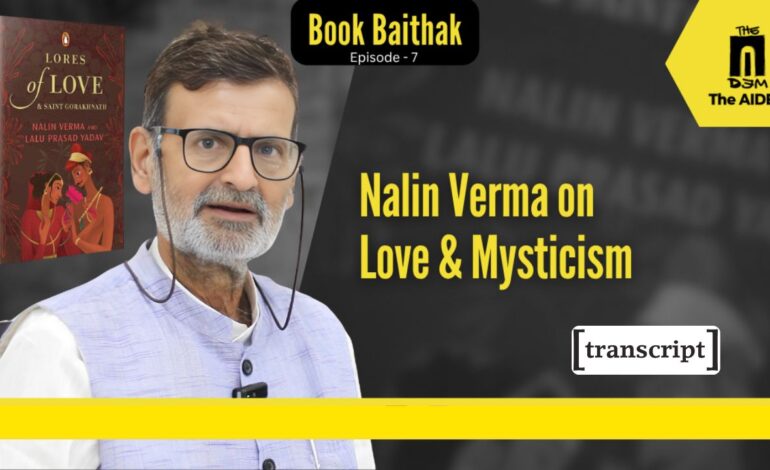
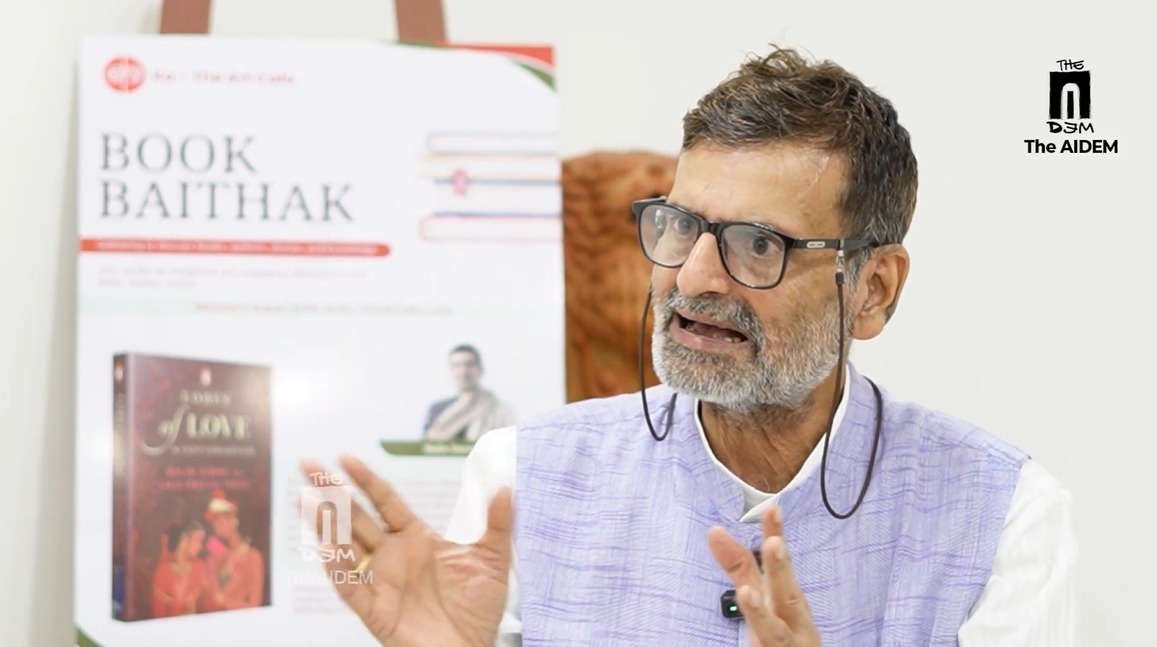
The following is the English transcript of the Book Baithak Interview featuring author Nalin Verma speaking about his latest work, Lores of Love & Saint Gorakhnath, co-authored with Lalu Prasad Yadav.
Gaurav Tiwari:
In the seventh episode of our podcast today, we are joined by senior journalist and author Nalin Verma. He has recently co-authored a new book with Lalu Prasad Yadav titled Lores of Love and Saint Gorakhnath. We’ll be discussing this book today.
Nalin ji, welcome.
Nalin Verma:
Thank you for inviting me to your platform. My heartfelt thanks and best wishes to your listeners as well.
Gaurav Tiwari:
Sir, let’s begin with our first question: Who was Saint Gorakhnath, and which aspect of his teachings inspired you to write this book?
Nalin Verma:
Saint Gorakhnath was a saint from the 11th century. As far as his philosophy is concerned, we won’t go too deep, but it’s clear that without Gorakhnath, the devotional movements led by saints like Kabir, Nanak, Dadu, and Wajid might not have taken shape. Gorakhnath played a central role in both the Bhakti and Sufi movements.
The most in-depth work on India’s saint tradition has been done by Osho Rajneesh. Sumitranandan Pant, a renowned Hindi poet, once met Osho to understand the Indian saint and Sufi traditions. He asked Osho to name twelve key saints from the Indian tradition. Osho listed names like Patanjali, Buddha, Krishna, and others. Then he said the list was too long and should be reduced to seven. Even in that shorter list, Gorakhnath’s name remained.
Pant then suggested narrowing it down to four names. Osho named Krishna, Patanjali, Buddha, and Gorakhnath. When Pant asked why Gorakhnath should be included in the final three, Osho replied that if Gorakhnath were removed, the entire post-11th-century tradition of saints, devotional and Sufi movements, literature, and yogic practices in India would collapse. Gorakhnath is as important as Krishna, Buddha, and Patanjali. This understanding came to me through study.
The second thing that influenced me was the stories from Gorakhnath’s time. For example, the timeless tale of Heer-Ranjha, written in Punjab and adapted into films — you must be familiar with it. In our region, the story is sung in the form of Sorathi-Birjabhar. In Banaras, Awadh, and Bhojpuri areas, yogis sing it. Punjab, with its rich literary tradition, has many writers who have retold it. British author Neil Rathmell also helped us and reinterpreted Waris Shah’s Heer-Ranjha.
In our region, Sorathi-Birjabhar has been sung widely — by yogis and performers alike. The scale of retelling was so vast that I felt it was no less than Heer-Ranjha. That was one source of inspiration for me to work on it.
Most of these stories are love stories from Gorakhnath’s era. Despite being rooted in a great saintly tradition and central to the Bhakti movement, Gorakhnath can also be seen as India’s first “love guru.” For instance, Ranjha was his disciple and loved Heer. In Sorathi-Birjabhar, Birjabhar too was his disciple.
He guided Pingala and Bharthari away from lust and toward yogic life. Rani Saranga and Sadabrij were also his disciples. All of them were deeply in love. The story of Sorathi and Heer-Ranjha is especially tragic and painful in the end.
These stories are so entertaining that people enjoy reading them. They include demons, ghosts, jinns, witches — all elements that make them dramatically engaging. So from both literary and entertainment perspectives, people truly enjoy them. These two aspects inspired me to write this book.
Gaurav Tiwari:
When we discussed the foundation of this book, you mentioned that it includes four well-known love stories — such as Heer-Ranjha, Sorathi-Birjabhar, Bharthari-Pingala, among others. During our conversation, a question naturally arises: your co-author, Lalu Prasad Yadav, is seen by the general public in a very different light. People don’t usually associate him with themes of love or saintly traditions. So how did this collaboration come about, and what role did he play in the making of this book?
Nalin Verma:
Lalu ji’s role in this book has been quite significant. Let me share that in 2017–18, I wrote his autobiography, Gopalganj to Raisina. At that time, he was in jail, and it was quite difficult to spend time with him. Still, whenever possible, we would talk for hours — sometimes even in the hospital.
It was Lalu Prasad Yadav who first narrated the story of Sorathi-Birjabhar to me. We were in a hurry then, as his connection with the outside world had nearly vanished. People came to see him, but being in jail, he couldn’t meet them. In the public’s mind, he was a mass leader — and that’s the image we were capturing in his political biography. But again and again, he would drift from political questions and say, “Why don’t you write about Jalim Dev, Verma ji?” And then he would start singing Akiya Horama.
I was surprised — how could such a tough, mass leader, even while in jail, be so deeply interested in folk tales? But that very curiosity inspired me. He didn’t remember the full stories, but fragments stayed with him. He didn’t know these tales were inspired by Gorakhnath, nor had he studied them academically. But he kept mentioning Baba Gorakhnath — a name he had heard growing up.
He spent his childhood in Phulwaria village, located on the border of Deoria district in Uttar Pradesh and part of Gopalganj. There, he grew up surrounded by Sorathi-Birjabhar songs, Heer-Ranjha tales, yogis’ dances, and folk music. That cultural tradition still lives within him.
When he shared these stories, I initially saw it as a digression from the political biography. But once the book was published, I realised that this side of Lalu Yadav’s personality is known to very few. Yes, he speaks in everyday language, uses idioms and proverbs, and connects with people’s speech. But within him lies a deep connection to folk life and storytelling.
In that sense, his contribution is invaluable. Had we not had those conversations at that time, I might not have been inspired to write this book — or perhaps much later. So I’m glad you asked this question. It’s important for readers to know this side of him — and now, they will.
Gaurav Tiwari:
Sir, this book contains four stories, each centered around a key character. Could you briefly tell us about them? Also, please explain how these are not just love stories, but carry a deeper spiritual message as well.
Nalin Verma:
The first story is of Surathi and Birjabhar. When these characters came to earth, they were given these names. But originally, they were celestial beings — fairies in Indra’s court: Panchshikha, Sumala, and Sunanda. They were exceptionally beautiful and powerful.
The story goes that Gorakhnath was a great yogi, deeply immersed in meditation. Indra always felt threatened by saints, fearing they might challenge his heavenly authority. So he sent Agni to disrupt Gorakhnath’s meditation. But Agni’s weapons failed — he couldn’t even touch Gorakhnath.
Then Indra sent his most graceful dancers and singers — Panchshikha, Sumala, and Sunanda — to enchant Gorakhnath. As they entered the forest, flowers bloomed, peacocks danced, rain fell — the atmosphere became blissful. Yet Gorakhnath remained unaffected. When they danced within the boundary of his meditation, he became disturbed. In anger, he raised his hand, and fire emerged, burning the fairies.
They fell at Gorakhnath’s feet and begged for forgiveness. He told them they could no longer return to heaven — they must live on earth and endure many lifetimes of struggle. Panchshikha became Birjabhar, and Sumala and Sunanda became Surathi. Their reunion took place only after many births and hardships. This story is not just about love, but also about spiritual struggle and the journey toward liberation.
The second story is of Bharthari and Pingala. Pingala was very beautiful but unfaithful. She fell in love with a horseman and betrayed Bharthari, who was unaware. Gorakhnath revealed the truth by changing his form and showing Bharthari the reality. He explained that the world is full of desire and illusion — unless one rises above it, the same patterns repeat. Eventually, Bharthari renounced worldly life and became a revered saint in the Nath tradition.
The third story is of Rani Saranga and Sadabrij. They too were celestial beings in previous births and endured many lifetimes of struggle — facing ghosts, witches, forests, and tantric forces — before finally reuniting.
So these stories are not merely tales of love. They reflect the soul’s journey, rebirth, liberation, and the depth of folk tradition. The spiritual message is that love is not just worldly attraction, but a path for the soul’s evolution. Saints like Gorakhnath guide these characters from desire toward yoga and spiritual discipline.
Each story involves transformation — Bharthari’s renunciation, Surathi-Birjabhar’s reunion, or Saranga and Sadabrij’s trials. Though immersed in love, these characters ultimately move toward self-realisation and liberation.
That’s why these folk tales offer not just entertainment, but a profound spiritual message — one that remains just as relevant today as it was in their time. This is why we chose to preserve these stories in Lores of Love and Saint Gorakhnath.
Gaurav Tiwari:
The stories are truly beautiful and have been written with great care. For a general reader like me, who had no prior knowledge of these tales, reading them was a deeply engaging experience. The book is easy to read, and it holds your attention throughout.
In nearly every story, caste is mentioned. It appears as an obstacle in the path of love, and you’ve noted that these stories date back to the 11th century. So even then, caste was a barrier to love. What are your thoughts on this?
Nalin Verma:
Yes, the theme of caste is clearly present in these stories, especially in the tale of Rani Saranga and Sadabrij. The hierarchical structure of the Hindu varna system is ancient — its influence dates back to the Manusmriti and post-Upanishadic times. But Saint Gorakhnath was a staunch opponent of this system. He was deeply inclusive. Forget caste — in his monastic tradition, people from all backgrounds were welcomed.
By the 11th and 12th centuries, Islam had also spread across India. In the story of Heer-Ranjha, Ranjha was a Muslim. In Gorakhnath’s tradition, it was never the case that only Brahmins could be priests. The community included weavers, dyers, Dalits, and Muslims. They would go on alms rounds, play the sarangi, and the distinction between guru and disciple was often blurred. Even the guru would beg alongside the disciples. Most of them came from marginalised communities, yet they were revered as yogis.
Gorakhnath’s character was profoundly universal. Among his disciples was Vardhanath, whom he initiated. Gorakhnath, while wandering, stopped with Vardhanath at a place where the Gorakhnath temple now stands. Locals built a small shrine there, and that place eventually became known as Gorakhpur.
His influence on the public consciousness was so deep that by the 17th–18th century, the site had become a modest pilgrimage center. At that time, Baba Buddhanath was the temple priest, and Baba Roshan Ali was a Sufi fakir. They lived together. Nawab Asaf-ud-Daula donated 52 acres of land for the temple, and Buddhanath and Roshan Ali together laid the foundation for the grandeur we see today.
In the 1930s, a shift began. In 1937, Savarkar became president of the Hindu Mahasabha, and Digvijaynath became its chief in Gorakhpur. The earlier mahants were ascetics, detached from politics. But Digvijaynath contested elections and won. After him, Avaidyanath entered politics, followed by Adityanath, whom everyone knows today.
Since the 1930s, Gorakhnath’s inclusive tradition — linked to Kabir, Nanak, and the Sufi lineage — gradually faded. A new political symbol emerged, which was completely contrary to Gorakhnath’s original spirit.
Even today, the Gorakhnath temple stands in a Muslim-majority area, directly across from Baba Roshan Ali’s shrine. Western scholars have researched this — many Muslim yogis in Punjab, Rajasthan, and Nepal are connected to Gorakhnath’s tradition. The Gorkhas of Nepal also trace their roots to this lineage.
So through these stories, our hope is that readers will understand the essence of social harmony. In every tale, the central figure is Saint Gorakhnath himself, appearing in different forms across different eras. His message is one of love, inclusion, and spirituality — and it remains just as relevant today.
Gaurav Tiwari:
In these stories, there is a central figure — Saint Gorakhnath himself — who appears in different forms across different times. His guidance is present throughout each narrative.
So in terms of social harmony, what are your expectations? Do you believe that after reading these stories, readers will be able to see Guru Gorakhnath’s tradition as one rooted in inclusivity and cultural unity?
Nalin Verma:
When people read these stories, especially in today’s context — where community life in villages is gradually fading — I believe they can spark a new awareness. Earlier, people used to listen to stories; yogis would sing them. That tradition has changed. Since the 1990s, new technologies and economic shifts have reached villages, and community life has been overshadowed.
These stories are entertaining, and even today, children are drawn to them. A young person once reminded me of Mowgli talking to pigeons and birds in the jungle — children still watch that attentively. Ghost stories, whether you believe in them or not, always captivate children. Ruskin Bond has written that ghost stories are entertaining. Every generation has had a craze for horror tales.
So when people read these stories, at the very least, they’ll wonder — who was Gorakhnath? How fascinating are his stories? If they remain as they are, what’s the harm? They’re original. When readers engage with them, they’ll feel connected. That connection will spark curiosity, and curiosity will lead to knowledge. With knowledge comes sensitivity.
In that way, these stories will influence society — and perhaps take a small but meaningful step toward social harmony.
Gaurav Tiwari:
In today’s context, how do you see the relevance of Saint Gorakhnath’s teachings? How do these stories help convey his messages and philosophy to the public? In what ways do they bring his worldview closer to the people?
Nalin Verma:
Look, whatever the present era may be, we were just talking offline and the story of Mowgli came to mind. The tale of Heer-Ranjha, written by Waris Shah in the 18th century, and the stories of Sorathi — these are old, yes, but stories themselves are never outdated. It’s the eras that keep changing.
Don’t think of eras as belonging to Lalu Yadav, Akhilesh Yadav, or Narendra Modi. These are fleeting — five, ten, fifteen, twenty years at most. If there is a true era, a lasting influence, it spans five hundred, six hundred, even seven hundred years.
Gorakhnath, Kabir — both from your own city of Banaras — their era hasn’t ended. It’s still ongoing. That’s the era these stories belong to. The political or social layers we often call “eras” come and go.
That’s why Kabir’s era, the Bhakti era — these are universal stories, timeless stories. They aren’t bound by time. We’re not saying anything new; we’re simply echoing what has been said for centuries. Why shouldn’t we know the story of Heer-Ranjha? Once you know it, you’ll understand it in any era.
If we don’t know Heer-Ranjha, the Bhakti movement, Kabir, or Gorakhnath, then that’s a gap in our understanding. And it’s essential to know them, because these stories transcend time.
Why is it important to know? Because if you don’t know your mother, your father, your ancestors, your traditions, your heritage — how will you move forward? I once asked a student: who are our ancestors? One set is biological, but the other set is cultural — Kalidasa, Banabhatta, Tulsidas, Kabir, Hemingway, Aryabhata.
Humanity isn’t confined by borders. Seventy-five years ago, India was different — there was no Pakistan, and Bangladesh was part of India. Go further back, and the geography changes again. National boundaries aren’t permanent. Germany was once East and West, and then it unified. Borders keep shifting.
But human values — a mother’s love, a lover’s longing, a father’s affection, emotional sensitivity — these remain constant. Stories emerge from these values. That’s what makes them timeless.
They never change. If a child in England or Europe is hungry or suffering, the pain felt by their mother is the same as that felt by an Indian mother. Pain and joy aren’t divided — that’s the human story.
And these human values rise above all others. They transcend nationalism, religious identity — whether it’s Hindutva or Islam. They can’t be confined by boundaries. They belong to everyone. That’s the essence of these stories.







Thank you for this English transcript. It reads well as a text interview. Helps in getting a better understanding of the Hindi video too .