

Unmasking the State: Caste, Colour, and Institutional Violence in “The Menon Investigation”


Not just whodunit: a moral reckoning that confronts India’s oldest prejudices and institutional failures.
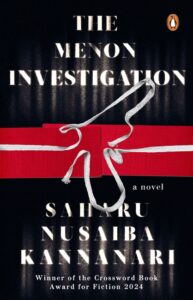
In this powerful second novel, Saharu Nusaiba Kannanari turns a gripping murder mystery into a searing social critique, exposing how caste and colour shape the idea of justice in Kerala and beyond. This novel is less of a whodunit and more a moral reckoning, exposing how justice itself is shaped by hierarchy.
In “The Menon Investigation”, Saharu Nusaiba Kannanari does not merely tell the story of a murder, he unravels the anatomy of power itself. What begins as a taut, Kerala-set crime thriller soon grows into something far more unsettling: a searching moral inquiry into caste, colour, and the quiet cruelties of institutions that claim to protect us. Through the eyes of a high-ranking officer reopening an eight-year-old case, Kannanari turns the framework of a police investigation into a mirror reflecting the moral rot at the heart of the system.
Saharu Nusaiba Kannanari transforms this crime story into something far larger- a dissection of power, caste, and conscience in modern India. What begins as a gripping murder mystery set in Kerala unfolds into a deep social inquest, asking uncomfortable questions about who gets justice and who is denied it.
The novel’s surface is that of a police procedural: taut, suspenseful, and cinematic. Yet beneath it lies a moral tension that refuses to stay buried. When Inspector General Vijay Menon reopens an eight-year-old case, he is not merely chasing a killer. He is uncovering a much darker truth, one that implicates not only individuals but the State itself.
The murder victim, Sub-Inspector Kannan Moses, is a Dalit Christian whose death was hastily covered up years ago. The reopening of his case cracks open a world of hidden hierarchies and quiet cruelties. As Menon revisits old files and forgotten witnesses, the line between victim and perpetrator blurs. In the process, he confronts the many shades of privilege that have long shielded his own kind.
Kannanari portrays Kerala not as the picture of perfection it is often made out to be, but as a land riddled with contradictions. Progressive in rhetoric, yet chained by caste, colour, and class. The author’s sharp eye for detail captures the subtle hierarchies that still govern even the most “modern” minds. Through the personal unease of his protagonist, a dark-skinned upper-caste officer, the novel exposes the deep psychological wounds inflicted by colourism, a prejudice that masquerades as taste or culture but in truth speaks the same language as caste.
“The nation’s original sin”
In one of the book’s most striking passages, Kannanari calls caste the “nation’s central quarrel,” its “original sin.” This idea runs like an undercurrent throughout the story. When the investigation reopens, it is not just one police officer’s murder that faces scrutiny. The probe unearths decades of institutional rot: an encounter killing of a Communist worker, the Church’s exploitation of Adivasi lands, and the enduring caste bias that shapes even converted Christian communities.
As old secrets tumble out, Menon is forced to face his own hypocrisy- as a law enforcer, as a father, and as a man of privilege. His elder daughter’s relationship with a lower caste, dark skinned youth becomes a mirror to his inherited biases, compelling him to confront the dissonance between his public values and private discomforts.
What gives “The Menon Investigation” its weight is not just its moral argument but its portrayal of institutional violence, the quiet, bureaucratic cruelty that sustains the caste order. The police, the political class, and the Church, the so called pillars of justice and morality, appear here as extensions of the same power nexus. Their silence and complicity make the crime possible and its cover up inevitable.
Kannanari suggests that in this unholy trinity of law, justice, and politics, caste finds its most ruthless expression. The State, he seems to say, is not merely blind; it is wilfully partisan, protecting its own and punishing those who dare to transgress the unwritten codes of hierarchy.

Saharu Nusaiba Kannanari, a Malayalee from Areekode in Malappuram district, writes with both intimacy and anger. His earlier novel “Chronicle of an Hour and a Half”, which won the Crossword Award for Fiction in 2024, had already revealed a writer of promise. With this second work, he proves himself a novelist of purpose.
His language is unforced, his tone empathetic yet unsparing. He writes of Kerala with the love of an insider and the detachment of an observer. What makes Kannanari’s writing especially evocative is his ear for the landscape. The chattering of rain in Kozhikode, the echo of temple drums fading into the sea breeze, the low hum of ceiling fans in government offices, and the occasional muezzin’s call slicing through the monsoon air all inhabit the novel like invisible characters. Kerala in “The Menon Investigation” is not viewed from a tourist’s distance but felt from within: its damp walls, its crowded police quarters, its streets washed in rain. Through this acoustic realism, the author turns setting into mood and geography into emotion.
The scenes move seamlessly, from the narrow lanes of Kozhikode to the cold interiors of bureaucratic offices, rendered with cinematic precision. Given its layered storytelling and visual flair, the novel has the potential for a powerful film adaptation. One can easily imagine its narrative adapted into Malayalam, Tamil or Hindi cinema, where its themes would resonate across diverse audiences and cultural contexts.
Beyond a mere murder mystery, this is a mirror held up to society. “The Menon Investigation” is at once a compelling thriller and a sobering moral inquiry. It reminds us that crime fiction, in the right hands, can be the most political of genres. By turning the spotlight on the institutions that claim to uphold justice, Kannanari exposes the violence woven into the very fabric of power.
The novel’s pace never falters, but its real success lies in how it leaves the reader uneasy, aware that the questions it raises have no easy answers. How do we confront the caste within ourselves? Can fairness ever be cosmetic when the bias runs in our bloodstream? And what happens when the State itself becomes the criminal?
Kannanari’s achievement lies in transforming the familiar framework of a thriller into a reckoning of conscience. His fiction dares to ask what many of us prefer to ignore: in a land that prides itself on literacy and enlightenment, how deep does prejudice still run?
By the end of The Menon Investigation, what lingers is not just the satisfaction of a mystery solved but the unease of a truth exposed, that violence in India is rarely random – it is structured, sanctioned, and sustained by the very systems that claim to dispense justice.
With this work, Saharu Nusaiba Kannanari places his signature amongst the most exciting new voices in contemporary Indian English literature. He demonstrates that serious fiction can be both thrilling and thought-provoking – regionally rooted in its cultural nuances, and yet universal in its ramifications.
It is not merely a novel to be read; it is a truth to be faced.









Riveting- the review and of course the book . Salaams to Nizar and Saharu
Dear Baburaj,
I’m so glad the review did the book justice.
Thanks so much for taking the time to reach out and comment!
Nizar Peruvad