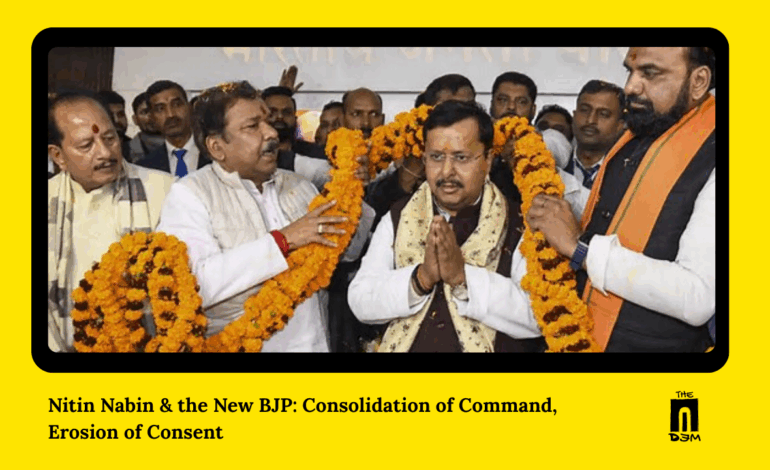
Nitin Nabin’s rise as the Bharatiya Janata Party’s ( BJP) National Working President is being showcased as generational change and reward for organisational work, but it also underlines how tightly centralised and cabal-driven the saffron party has become. His elevation looks less like the outcome of an open inner-party contest and more like the careful placement of a loyal, low-risk functionary into a crucial organisational post.
A manufactured “grassroots” success story
On paper, Nitin Nabin’s journey ticks every ideological and organisational box: early association with the RSS–ABVP ecosystem, senior roles in the BJP’s youth wing, five consecutive wins from the Bankipur Assembly seat after entering through the 2006 bypoll, and ministerial portfolios such as Road Construction and Urban Development and Housing in Bihar. In the 2025 Bihar Assembly election, he secured 98,299 votes in Bankipur and defeated RJD candidate Rekha Kumari by a margin of 51,936 votes, reinforcing his image as an electorally “safe” leader.
Yet the starting point of this “grassroots” narrative was anything but ordinary. He entered electoral politics after the sudden death of his father, veteran BJP leader and MLA Nabin Kishore Prasad Sinha, and was fielded by the party in the resulting by-election, effectively inheriting a prepared seat and network. The party now downplays this inherited advantage when presenting him as a pure product of hard work from below, even though his first step was enabled by precisely the sort of family capital it attacks in opponents.
Loyalty as qualification, silence as asset
Despite nearly two decades in public life, Nitin Nabin is not known for strong public ideological positions, major national-level speeches or open internal contestation; his reputation is that of a polite, accessible and organisationally disciplined operator. Party accounts of his work in Chhattisgarh highlight his focus on ticket distribution, booth management and micro-level coordination, not on asserting an independent political line.
That profile is exactly what makes him attractive to a highly centralised leadership. Unlike older heavyweights such as Shivraj Singh Chouhan, Manohar Lal Khattar or Dharmendra Pradhan, who carry their own stature and histories, Nabin poses no risk of becoming an alternative pole within the party. In today’s BJP, the safest route upward is to be indispensable in execution while remaining politically unobtrusive, and his appointment signals to the cadre that unquestioning loyalty and low-friction deference are now the core qualifications for top organisational roles.
Anti-dynasty rhetoric, dynastic comfort
The BJP’s relentless campaign against “parivarvaad” stands in awkward contrast to Nitin Nabin’s entry path. His father, Nabin Kishore Prasad Sinha, was a four-term MLA from Patna West and a founding figure for the party in Bihar, and Nitin’s first ticket came directly in the wake of that legacy. While he has since built his own record—winning repeatedly, holding ministerial office, and taking on national organisational responsibilities the fact remains that his political story begins from a level many ordinary workers cannot realistically access.
This exposes a selective morality: dynasty is framed as a structural sin when it pertains to rivals, but becomes acceptable when the beneficiary remains fully aligned with the central command and does not use inherited influence to bargain. Nitin Nabin’s trajectory, despite his work ethic, ends up personifying this double standard rather than disproving it.
Caste arithmetic and a compliant core
Nitin Nabin hails from the Kayastha community in Bihar, an upper-caste group that is relatively small in numbers but seen as an urban, educated, consistently BJP-leaning vote base. His appointment does not dramatically expand the party’s caste coalition; instead, it reassures a loyal segment that has long supported the BJP without making sustained, aggressive demands for representation.
This fits a broader pattern in the party’s caste politics: leadership posts are used to symbolically acknowledge dependable blocs while avoiding experiments that could generate new internal centres of bargaining power. By choosing a Kayastha leader with an already secure seat and no history of confrontational identity mobilisation, the BJP gains comfort and continuity, not new social risk or innovation.
The “Chhattisgarh factor” and command politics
Much of the justification for Nitin Nabin’s sudden elevation has been tied to his role as co-in-charge and then in-charge of the BJP in Chhattisgarh, where the party returned to power in the 2023 Assembly elections and later won 10 of 11 Lok Sabha seats. Reports credit him with meticulous organisational planning, reconfigured ticket distribution and revived booth-level structures that helped dislodge the Bhupesh Baghel-led Congress government despite adverse predictions.

But even this “Chhattisgarh success” reinforces the same pattern: Nabin is praised as the executor of a centrally determined strategy rather than as an independent strategist who reshaped the party’s ideological message. His reward being made National Working President at 45 shows that in the current BJP, those who flawlessly implement decisions coming from the apex are elevated, while those with distinct political lines are kept at arm’s length from organisational command.
The shrinking space for argument
In formal terms, Nitin Nabin’s CV would satisfy any internal merit checklist: five-term MLA, minister in a key Hindi-heartland state, successful election manager in another state, and long experience across the RSS–ABVP–BJYM–BJP ladder. The critique is not that he is unqualified, but that his selection confirms how narrow and controlled the field of “acceptable” top-level candidates has become.
For a party that once prided itself on multiple strong leaders and internal ideological churn, the elevation of a low-profile, centrally dependent manager to one of its highest organisational positions illustrates a decisive shift from a culture of argument to a culture of obedience. The story of Nitin Nabin, especially when read alongside his dynastic entry, safe caste location and uncontroversial persona, becomes less an inspiring tale of grassroots ascent and more a revealing case study of how the new BJP rewards those who never disturb the hierarchy that now defines it.