Capitalism Killed My Father

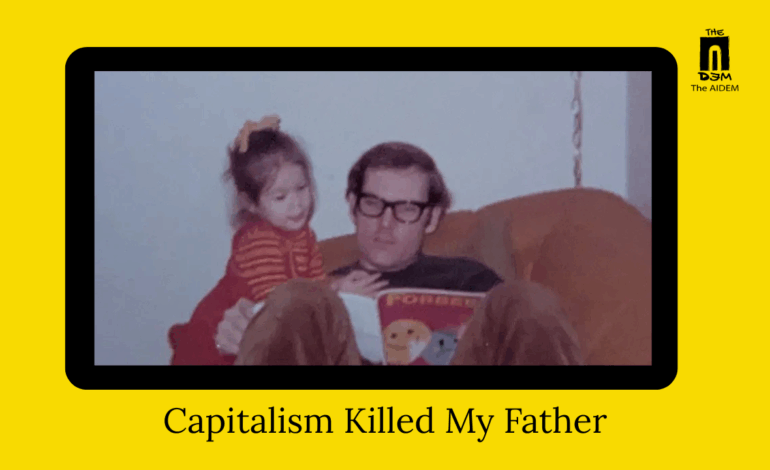
What does it mean when a man becomes worth more to his family dead than alive?
A daughter traces back her father’s sudden death not to illness or misfortune, but to the quiet, grinding violence of economic expectation. Set against the backdrop of middle-class America in the 1980s, the story dismantles the myth of the American Dream piece by piece, revealing how debt, status anxiety, and the relentless demand to “keep up” can hollow out a life long before it ends.
This is not merely a memoir of loss. It is an indictment of a system that turns dignity into liability, survival into performance, and love into collateral; where capitalism does not simply fail its people, but consumes them.
When I saw my father’s body, one of the very first feelings I experienced was an overwhelming sense of relief. I was relieved for him, the broken person prone on the filthy, greasy garage floor. I recognized that my father’s suffering and degradation were finally over. He had found peace in his own way.
You might think that my father had lost his battle to cancer, or some other long and painful illness. But you would be wrong, as my father was a physically fit 43-year-old who was perfectly healthy, except for “trace atherosclerosis of the coronary arteries”, as the autopsy would subsequently reveal. His death was sudden, unexpected and brutal.
His cause of death was carbon monoxide poisoning.
My father had turned the ignition of our silver 1976 Monte Carlo with the garage door closed, his three children sleeping inside the house, and succumbed to the fumes.
My 17 years on this planet had taught me that there are things worse than death. Just how had I arrived at this realization? How is it that a teenager growing up in middle-class, Midwestern America in the 1980’s would think that death was a form of respite from the entanglement of modern society?
My parents lived the American Dream. My mother was a Chinese immigrant who met my father in the late 1960’s, when he was stationed in Taiwan with the Air Force. He fell head-over-heels for this stunning Asian beauty. She thought he was cute.
Her mother, my future Chinese Grandma, pronounced him “a very nice boy” and gave her approval.

He returned to the States, promising to return for her when he had earned enough money to get married. She thought this was a load of bullshit. She promptly forgot about him and moved on with her life. Then she got the letter—the letter that would upend the architecture of her life and form the scaffolding for my life to be.
The letter said that he was on his way. He had purchased his plane tickets and made arrangements. They could be married soon! She panicked, having mentally filed him away in the annals of the past. But he had already bought plane tickets. He was expecting her to marry him. And he sounded so happy. After consulting with her mother and considering her options, she took the leap, which landed her smack dab in the American Midwest.
The transformation from nightclubbing in downtown Taipei, Taiwan, to slumming it in Wichita, Kansas was shocking to a 23-year-old urbanite. Her hot pants, halter tops and waist-length raven hair were equally shocking to my father’s extremely white parents and eight siblings, descendants of sturdy German Catholics.
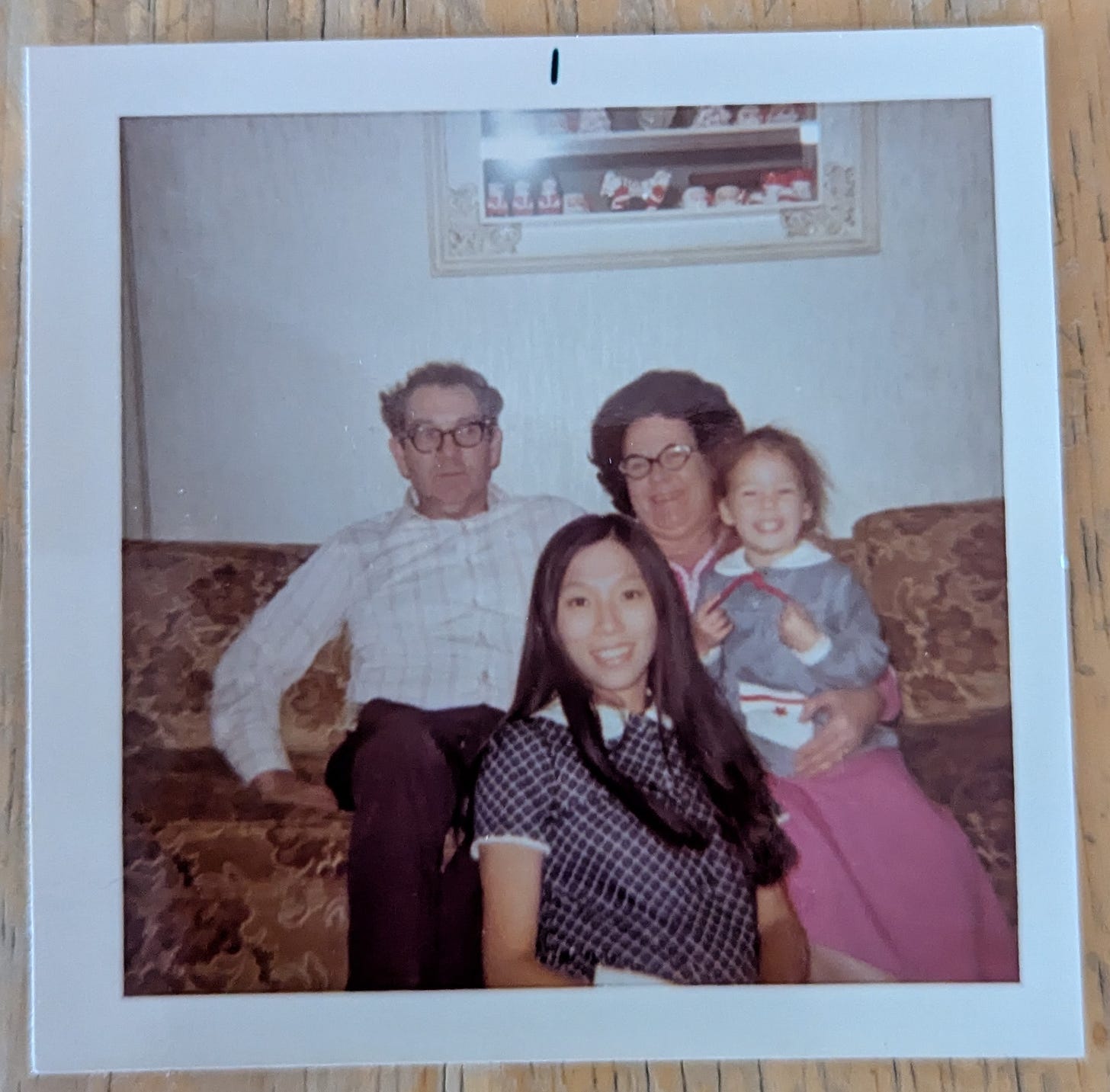
The mixture proved explosive, leading to my father’s estrangement from his family in the years that followed.
Then there were the children.
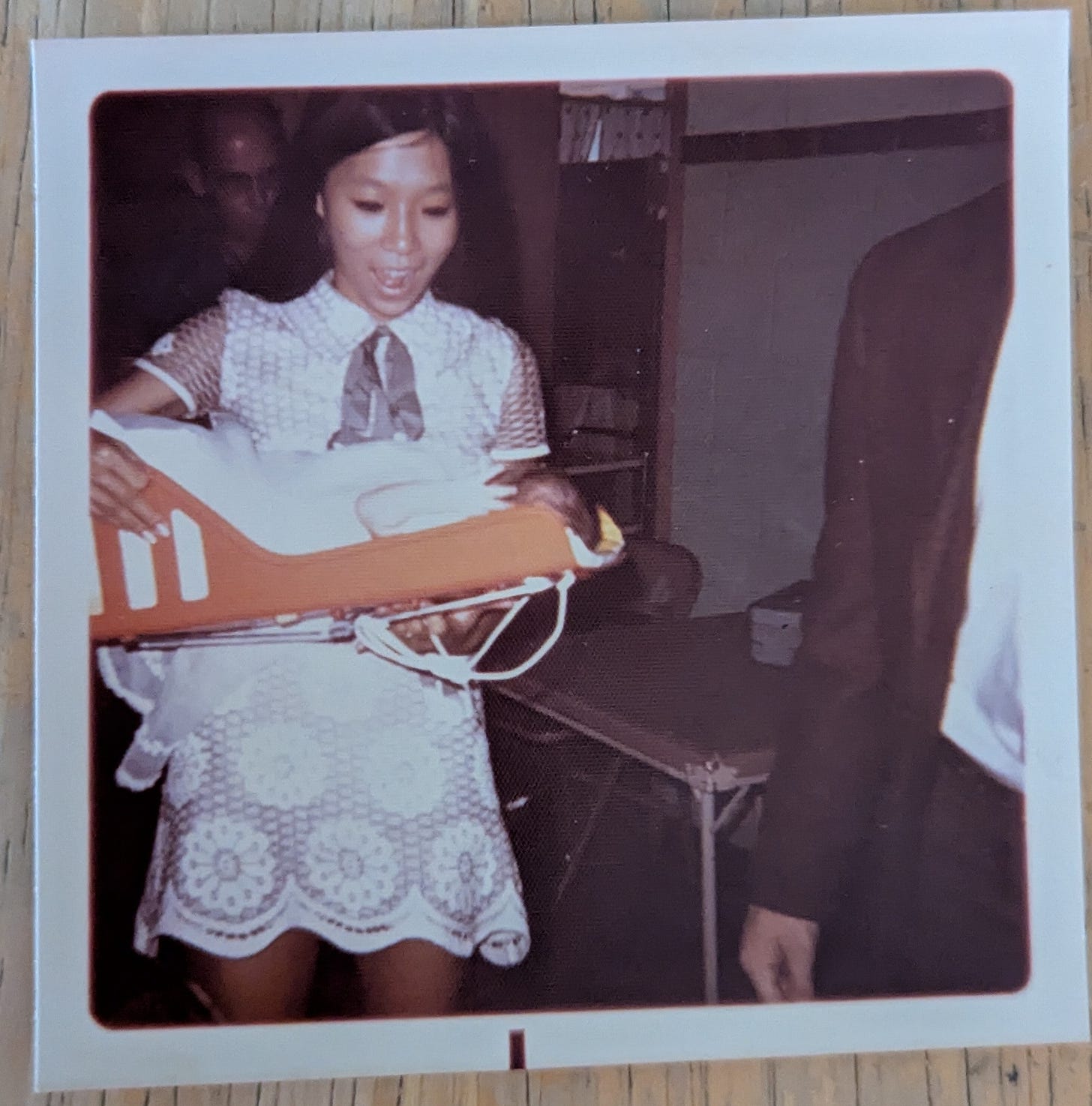
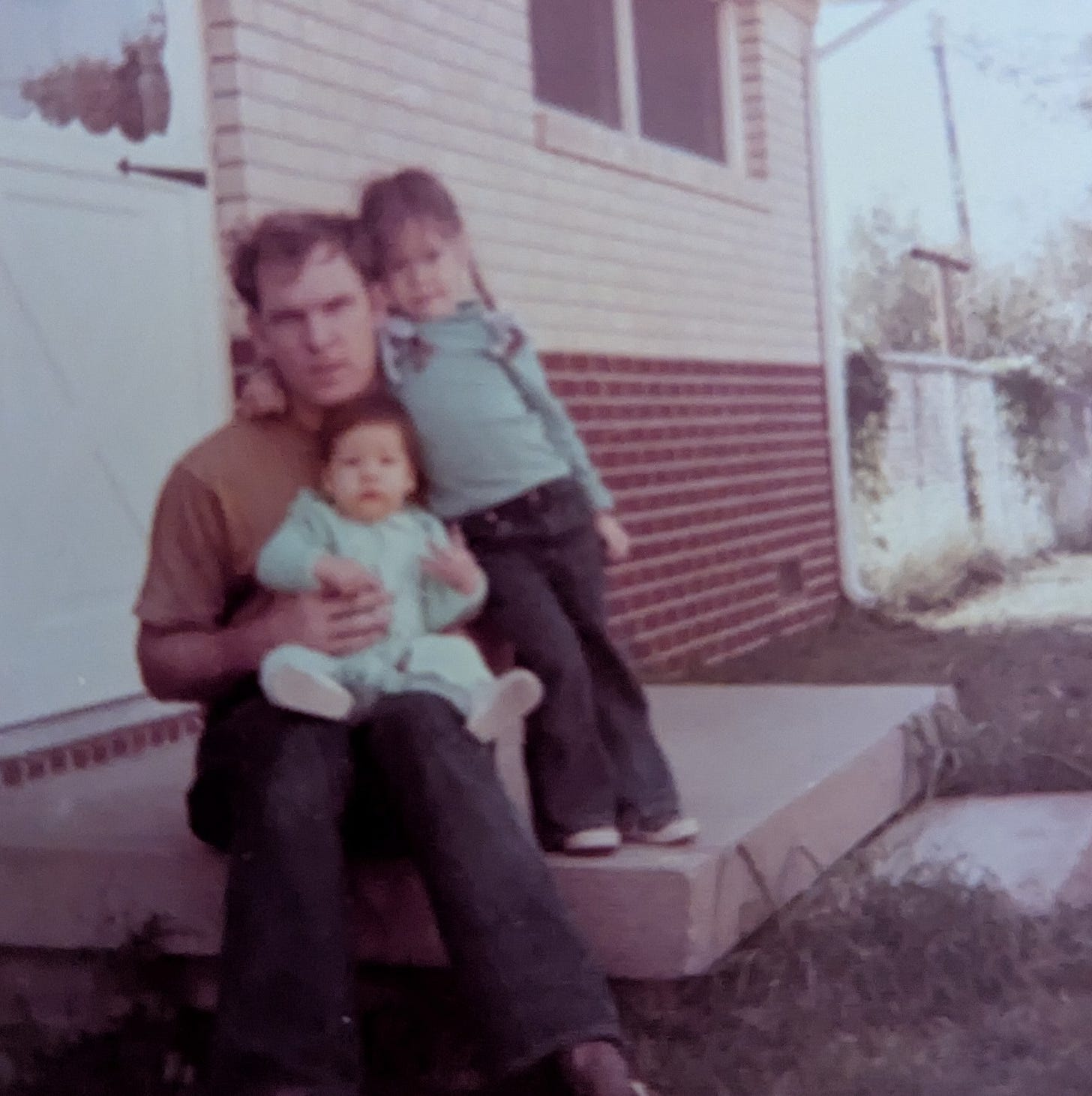
First me. Two years later my sister. My brother arrived four years later, initially an unwanted surprise and later a treasured gift from God.
My father had worked two jobs, as long as I could remember. He would work in the mornings as a stockbroker, come home for a late lunch, then leave for his second-shift job as a TWA ramp-service agent. Those are the people who load luggage, fuel the planes and clean up the mess between flights. They do this job in the sweltering heat, pouring rain or driving snow, day in and day out. During the brief interlude between jobs, he would make himself dinner to take with him to the airport. His favorites were a fried egg or bologna curled up between two slices of white bread, tucked in a plastic bag and stuffed into a coat pocket for later. He would be home at 11 PM, careful to be quiet so he would not wake the house.
Although this job was grueling, I think it suited him. He seemed to glean some satisfaction from it. Occasionally, he would talk about a friend named “Chick” who got a perm in the early 80’s to hide his evolving bald spot. He would sometimes bring home food left over from the plane, and we would share the spoils. Once in a rare while, he would bring home some treasure left behind by a passenger. Usually this was a magazine, a book or—one memorable time—a green canvas pencil holder with multicolored markers that instigated a war between my sister and me.
It was the other job that brought him down.
He was a beneficiary of the GI Bill. Upon returning from his post in Taiwan, he enrolled at Wichita State University and got his business degree. He then took some qualifying exams and became a stockbroker. One of my earliest memories was playing on the vast green lawn of a college campus with my mother. As we walked among ivy-covered buildings my mother explained that passing these exams would allow my father to have a “more respectable” career. Our family would flourish. However, this turned out to be my father’s downfall.
He was never a successful stockbroker. For one, he did not have a salesman’s bone in his body. More than half of his job was to attract new customers and sell them on the latest stock tip. My soft-spoken, deferential father did not have it in him. Also, not to speak poorly of the dead, but he appeared to be a pretty shitty picker of stocks. I once asked him to help me with my 7th grade assignment which involved ”buying” two stocks and following them for one month. Mine both tanked. But more significantly, his own stock picks were consistently losers. Month after month, year after year, he threw good money after bad, trying to hit the jackpot. As the losses mounted, his strategies became increasingly desperate. He began purchasing stock options, offering high-yield for high-risk. To finance this, he borrowed money on credit cards, dozens of them. After he died my mother discovered more than 30 credit cards, maxed out each and every one. Then he borrowed money from his parents, asking them to cosign on several bank loans. Finally, he borrowed money against our house, the pearl at the center of our capitalist oyster.
Why, you might ask, would a man do such a thing? Why would my father jeopardize the very stability of our family in the pursuit of wealth? The answer is simple: because we were pursuing the American Dream.
We had moved when I was six-years-old to a “nice house” in a “nice neighborhood”. All of the streets were named after golf terms, although there was no golf course in sight. We lived on Chipper Lane. In case you are wondering, a chipper is a type of golf club used for short-distance shots. Yeah, I had to look that one up.
When one buys a nice house in a nice neighborhood, one also fills the house with nice furniture and nice decorations. Then, the kids get to go to a nice school, instead of that public school with all those colored kids.
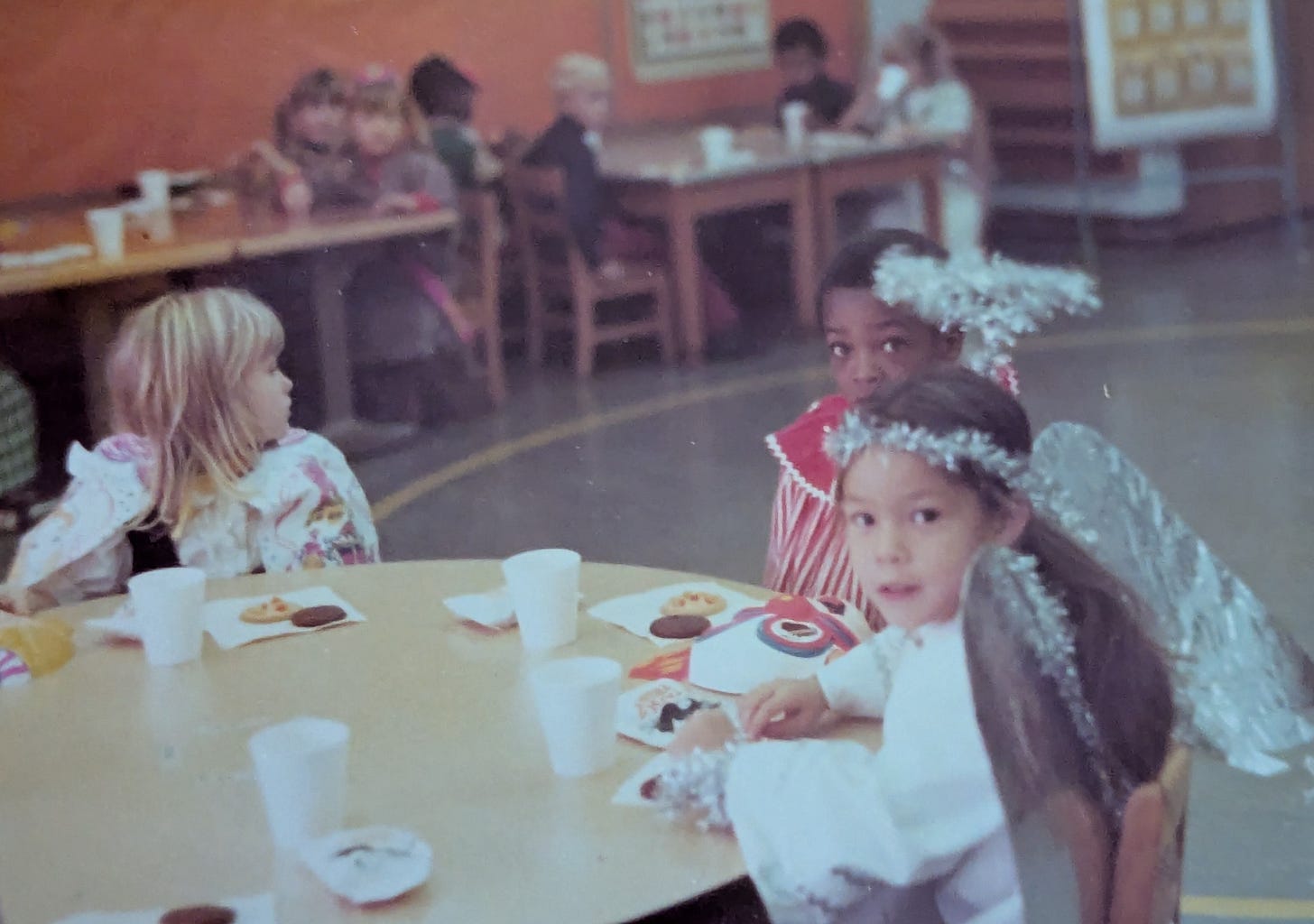
I was enrolled in Christ the King Catholic School where first-graders were routinely paddled, tied into their chairs for sharpening their pencils too often or had their mouths taped shut for talking out of turn. That had never happened at my old school. Also, I really missed the “free-dance” we had at my old school during which for one hour a week we were invited to move our bodies as we imitated our favorite animals, pretended to fly or just swayed back and forth. But this new school was more respectable than my old one. We wore plaid uniforms. My mom also signed me up for golf lessons.
With golf lessons come golf clubs, golf shoes and golf clothes. Oh, and the piano and piano lessons. Also, the new station wagon. With three kids in the new neighborhood the old car wouldn’t do. After all, the lady across the street who sold Mary Kay drove a pink Cadillac.
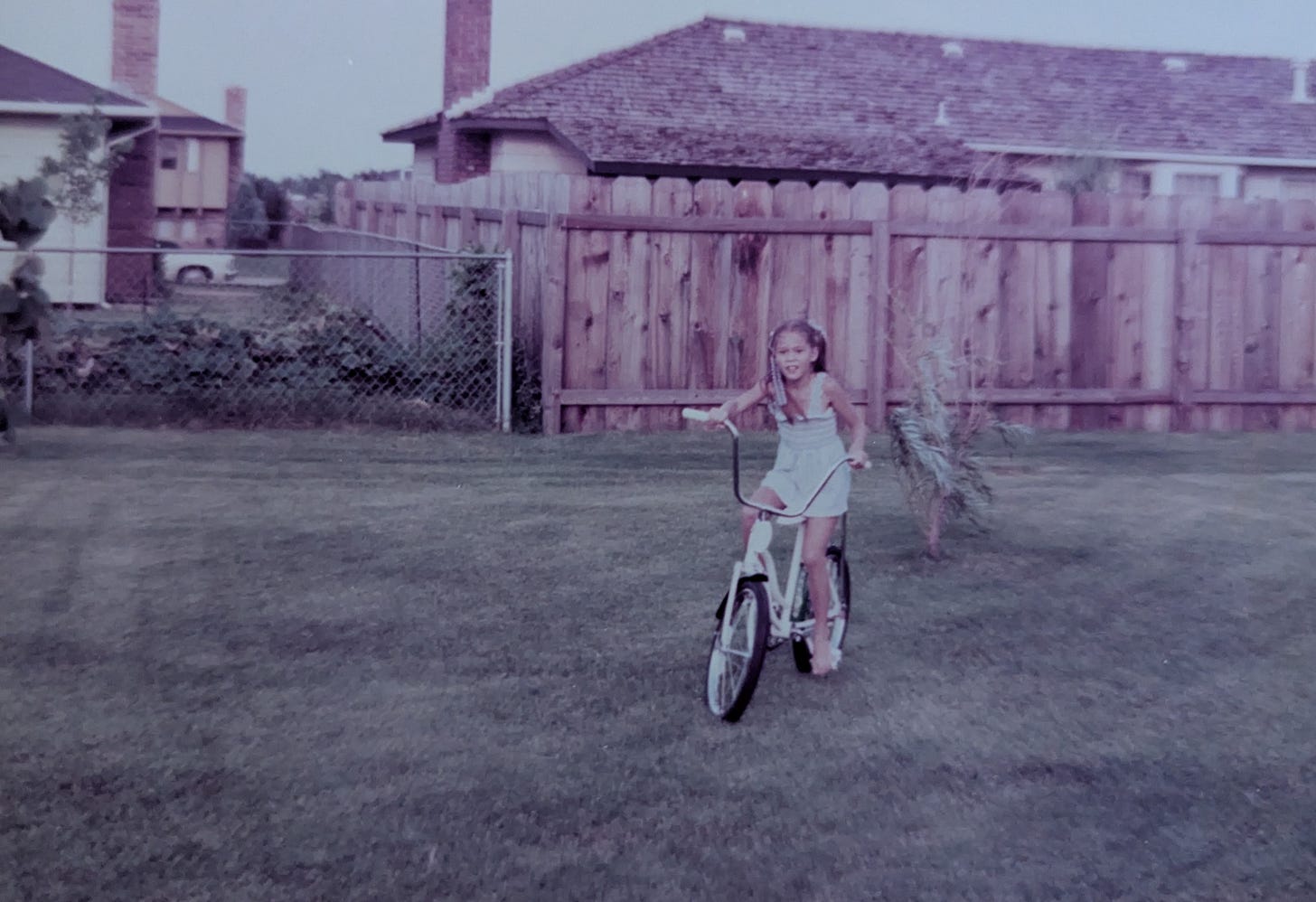
Children are cognizant of familial strain and financial uncertainty, contrary to what most adults believe. From a very young age, I was acutely aware that we were not what we seemed. I felt like an imposter, wearing Nike knock-offs from Kmart, with the “Swoosh” going the wrong direction. I dreaded picture day because I didn’t have “the right thing” to wear. I remember the day my dad, his sturdy shoulders bent by shame, negotiated our tuition with Father McGread (yes that was his real name), because we had failed meet our tithe to the Church.
My mom would talk about the day we would buy a “really big house” and live like millionaires. Sometimes, just for fun, my parents would load us into the station wagon, and we would drive through the “rich” neighborhoods. My mom would pick out her favorites while my siblings and I got car-sick in the back seat.
So it was. Day after day, year after year, working 14 hours a day, maintaining the house, maintaining the lawn, maintaining the illusion of a happy, successful middle-class American family. The systems that were meant to support him—his Church, his family and his community—were instead draining him dry.
Capitalism killed my father. When he died at the age 43 of carbon monoxide poisoning, the police ruled the suspicious death an “unfortunate accident”. I learned later that they often did that in hardship cases so the family could collect the life insurance. At the time of his death, he had accumulated over $400,000 in debt. We were about to lose our home. My mother was losing her mind. Dad had taken out $500,000 in life insurance. It was a simple calculation. He was worth more dead than alive.
The system had crushed him. However, in the end, he manipulated the system in his own way. He ultimately provided financial security and relief for his family in the only way he could. Capitalism in action.
This piece was inspired by a Substack Live with Cryn Johannsen, Godfrey Moase and Ryan Ward on the subject of Death and Capitalism . I was listening while folding a load of laundry and had to put down the socks to take notes. This led me down the rabbit hole of Deaths of Despair and Alienation in our Capitalist society. Please check out the thought-provoking work of Cryn Johannsen, Deaths of Despair and the Social Question of the 21st Century. Another recent article well worth your time is by Daniel Tutt, Death and the Social.
Originally published on Substack