



It is often said that love knows no language, but when that love arises in the heart of a man who has vowed celibacy, it transcends even the language of the body. Few episodes in Mahatma Gandhi’s life reveal the conflict between moral conviction and profound human vulnerability as poignantly as his intense, yet ultimately unconsummated, relationship with Saraladevi Chaudhurani. This was a brief, passionate bond that simultaneously inspired his service and unsettled the very foundations of his public life.
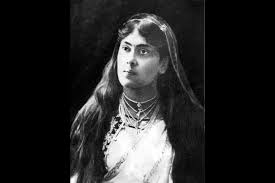 Sarala Devi Chaudhurani (1872-1945)
Saraladevi was no ordinary woman and her background explains the magnetic force she exerted. Born into the celebrated Tagore family, she was the niece of Rabindranath Tagore, the daughter of the nationalist writer Swarnakumari Devi and the reformist Janakinath Ghosal. She was a living embodiment of the intellectual and artistic fervor of the Bengal Renaissance. A polymath, a poet, singer, political activist, and orator. She had already earned acclaim as a leading voice of women’s awakening and national consciousness. Her presence carried the weight of cultural authority and revolutionary spirit. Gandhi was impressed with her talent in their first meeting in the Calcutta Congress Meeting in 1901.
Their close association began in 1919. Gandhi, freshly returned from South Africa and still learning the complex landscape of Indian politics, stayed at her Lahore home while her husband, Rambhaj Dutt Chaudhary, was imprisoned for nationalist activities. During this period of shared solitude, political turmoil and emotional need, their intimacy deepened rapidly. What began as admiration between two comrades-in-arms quickly evolved into an intense spiritual and emotional companionship that defied easy categorization and challenged Gandhi’s self-imposed discipline.
Spiritual Sublimation
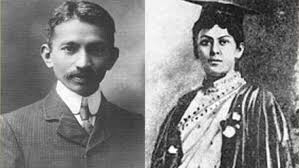
Young Gandhi and Sarala Devi
The core evidence of their bond exists in an extraordinary flurry of correspondence. They began exchanging letters—sometimes two or three a day—overflowing with warmth, devotion, and intense introspection. These surviving letters reveal a man torn between ascetic ideals and powerful human emotions. Gandhi wrote with startling, almost romantic intensity, confessing that “Saraladevi has been showering her love on me in every possible way.” and in one of the letters he wrote that “You still continue to haunt me even in my sleep. No wonder Panditji (her husband) calls you the greatest shakti of India. You may have cast that spell over him. You are performing the trick over me now.”
In a struggle to rationalize and contain this flood of emotion, Gandhi desperately sought to frame their bond in moral terms, describing it to friends like Hermann Kallenbach as his “spiritual wife.” He confided that they were very close and often travelled together, calling their relationship “indefinable.” His close associate Mahadev Desai termed it an “intellectual wedding,” capturing Gandhi’s attempt to sublimate deep affection into moral discipline dedicated to the national cause. Their letters became moments of communion amid the turbulence of the national movement, with Gandhi’s attendance at certain political gatherings serving as a quiet pilgrimage of the heart to be near her.
Rajaji’s Intervention
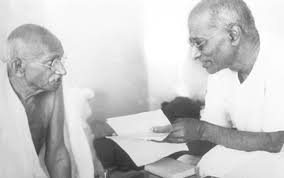
C. Rajagopalachari (Rajaji) and Mahatama Gandhi
The emotional experiment reached its dramatic peak when Gandhi contemplated a public declaration. He wrote to his close political associate, C. Rajagopalachari (Rajaji), that he was thinking of taking their friendship a step further—perhaps even making a public proclamation of their spiritual marriage.
Rajaji’s response was immediate and devastatingly frank. The trusted advisor, deeply alarmed, issued a stark warning that such an act would “bring unmentionable shame and ruin to you, destroy all saintliness, all purity and all of India’s hope in you.” As Ramachandra Guha observes, this intervention was a crisis point, revealing how close Gandhi’s emotional experimentation came to shaking the very foundation of his moral and public authority. His entire movement was predicated on his saintly image, this relationship threatened to shatter that carefully constructed persona.
Further emphasizing the political fragility, Gandhi’s closest associates feared that his involvement might compromise the public discipline of the movement. Rajaji even traveled to Lahore to meet Saraladevi, later admitting he “failed to see any greatness in the lady,” a harsh, protective judgment that wounded Gandhi deeply.
Confession and Separation
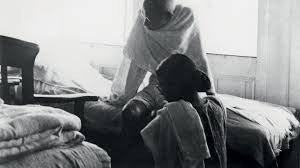
Gandhi at an Ashram
Despite the intensity, Gandhi maintained that the relationship was never physically consummated, a fact central to his self-perception as a brahmachari. Yet, the struggle was real and deeply personal. He later admitted to a Gujarati colleague that the danger of succumbing was profound, a rare moment of candour that most scholars attribute to his time with Saraladevi. He revealed that “sex does not discriminate between the young and the old. Even today I have to erect all sorts of walls around me for safety… I was in danger of succumbing a few years ago.”
Under the relentless pressure of his own conscience, coupled with the fears of his inner circle, Gandhi began the painful process of withdrawal, describing their bond as “an inspiration that must now become a discipline.”
Saraladevi, however, was not a passive recipient of Gandhi’s spiritual guidance. Gandhi sought to be her “Law Giver,” guiding her toward his restrictive vision of moral womanhood, but she fiercely resisted this control. Her defiance revealed the limits of Gandhi’s idealism when confronted by a brilliant woman who insisted on equality rather than obedience. “You would make me your pupil,” she once told him, “but I wish to walk beside you, not behind.”
The eventual separation came in mid-1920. Gandhi’s farewell, while gentle, was final: “The inner bond shall remain,” he wrote, “but the outward expression must cease.” Saraladevi was left with a deep wound, confessing later that she had “committed the folly of choosing Bapu and his laws over all the joys of the world.”
Gandhi and the Story He Chose Not to Tell
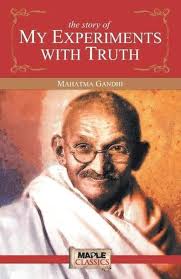
Gandhi’s Book ‘The Story of My experiment with Truth”
Years later, when Gandhi began writing The Story of My Experiments with Truth, he initially intended to speak honestly about his emotional bond with Saraladevi—just as he had confessed other personal weaknesses. But this time, his candour met firm resistance. His son Manilal, along with several close associates, urged him to omit her name entirely. They feared the revelation would damage his saintly public image, unsettle his followers, and create unnecessary controversy around the national movement.
Gandhi defended the principle of honesty, yet ultimately accepted their caution. The decision to exclude Saraladevi from his autobiography reflected a delicate balance between truth-telling and the protective instincts of those around him, who believed that some truths, especially those revealing his private vulnerabilities, might overshadow his larger mission.
Legacy of Silence
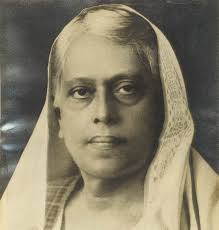
Sarala Devi
Though the intense romance ended, their intellectual and national connection endured. They continued to correspond on matters of Khadi work, national service and women’s upliftment. Saraladevi went on to champion female education and literary reform, while Gandhi subsumed his powerful emotions into his larger experiment with truth.
Strikingly, seventy-nine letters from Gandhi survive, but Saraladevi’s replies were largely destroyed to protect Gandhi’s image. Furthermore, neither Gandhi nor Saraladevi ever mentioned each other in their respective autobiographies—The Story of My Experiments with Truth and Jivaner Jhara Pata. This shared silence speaks volumes: what could not be publicly confessed was perhaps privately sanctified as a necessary lesson in restraint—a critical, deeply human test of the Mahatma’s moral evolution.

Sarala Devi’s Autobiography “Jiboner Jhar Pata”
When Saraladevi died in 1945, Gandhi remembered her not as a temptation but as a comrade—one who had tested his humanity and expanded his moral horizon. This poignant episode stands today not as a scandal, but as a mirror, showing that even a Mahatma could wrestle with the elemental forces of love, doubt, and self-restraint. In Saraladevi, Gandhi encountered not weakness, but equality; not deviation, but a reflection of his own complex humanity. Between love and renunciation, they both sought the same light—and, in doing so, revealed the delicate human heart beneath the halo of sainthood.









Beautifully written with restraint, clarity and understanding6
Wow. Its so nice to know that Subhashini madam have commented on this story. All the more reason for me to read more about Gandhi