

The ‘Young Professional’ Trap: How the Government’s New Hiring Fad Is Breeding an Anxious Generation

For many ambitious graduates in India, scrolling through a notification from NITI Aayog or the Ministry of External Affairs seeking “Young Professionals” (YPs) feels like a moment of arrival. The proposition is undoubtedly attractive: a chance to work within the prestigious corridors of the Government of India, a consolidated remuneration that often outpaces entry-level corporate salaries, and the unique satisfaction of contributing to national policy. It is a welcome initiative that brings fresh energy and contemporary skills into the traditional framework of governance. However, as the scheme matures, it is increasingly important to pause and evaluate whether this model is truly serving the long-term career interests of youth, or whether it inadvertently places them at a professional crossroads with few signposts for the future.
To be fair, the Young Professional scheme was designed with a progressive vision. For the government, it offers a swift mechanism to onboard specialists, be it in data analytics, law, or economics, without the long gestation period of the UPSC or SSC recruitment cycles. It infuses the system with agility and new perspectives. For the young professional, the initial years are often rewarding. The exposure to high-level governance is unmatched, and the monthly stipend, typically ranging from ₹60,000 to ₹70,000, provides a comfortable start in cities like Delhi. Yet, the challenge arises when one looks beyond the three-year horizon. The engagement is strictly contractual, usually for a year and extendable based on performance, but rarely beyond three years. Unlike a corporate ladder, where a contract often evolves into a permanent role, or the permanent civil service, which offers lifetime security, the YP role has a defined expiry date. This creates a unique form of “career anxiety.” A professional who joins at 25 leaves at 28, often finding themselves too experienced for entry-level private-sector jobs but lacking the specific corporate grind that recruiters seek. They are also, in many cases, running out of attempts or years for government competitive exams.

A significant concern that often goes unnoticed until a crisis hits is the structure of the compensation package. While the “consolidated pay” looks healthy on paper, it lacks the protective layer of social security that defines formal employment in India. Regular government employees, from the lowest cadre to the highest, are covered under the Central Government Health Scheme (CGHS), ensuring that their medical needs are met. Young Professionals, despite working in the same offices and often putting in long hours, are not extended these benefits. There is typically no provision for a Provident Fund (PF), Dearness Allowance, or, most critically, health insurance coverage. In a metro city, where healthcare costs are rising, the lack of employer-supported medical insurance leaves these young individuals vulnerable. They are essentially operating as consultants, meaning that a sudden medical emergency can severely impact their savings, a stress that a regular employee does not have to carry.
Even more unsettling is the termination clause embedded in these agreements, which stands on shaky legal and moral ground. Unlike a regular government employee, who is protected by constitutional safeguards under Article 311 and cannot be dismissed without a proper inquiry, a Young Professional is often subjected to a “hire-and-fire” regime. Most contracts explicitly state that services can be terminated by the administration at any time, often with just a month’s notice, ‘without assigning any reason.’ This summary dismissal clause acts like a Sword of Damocles hanging over their heads, potentially violating the fundamental legal principle of audi alteram partem (no one should be condemned unheard). In a functioning democracy, the State is expected to be a ‘model employer,’ setting the standard for fairness rather than mimicking the ruthless efficiency of the gig economy. By retaining the power to terminate a professional without a show-cause notice or a chance to be heard, the system exercises arbitrary power that is antithetical to the principles of natural justice. It creates a palpable sense of vulnerability; a professional might hesitate to offer frank, critical advice—the very fresh perspective they were hired for—out of fear that disagreeing with a superior could lead to an abrupt, unexplained exit. This lack of due process not only affects their peace of mind but also fundamentally undermines the dignity and professional security that should accompany public service.
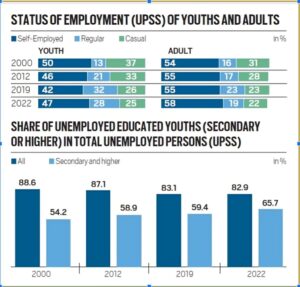
This palpable anxiety is not merely anecdotal; it is increasingly supported by empirical evidence. The ‘India Employment Report 2024’, jointly published by the International Labour Organisation (ILO) and the Institute for Human Development (IHD), explicitly flags the rising trend of ‘contractualisation’ among educated youth. The report underscores a grim reality: highly qualified graduates are increasingly entering roles that offer no long-term social security, creating a workforce that is technically employed but professionally vulnerable. Furthermore, surveys by Lokniti-CSDS have repeatedly highlighted that ‘job security’ remains the paramount concern for Indian youth, with over 60% preferring permanent government roles specifically for the health and pension benefits they offer. By stripping these very benefits away, the Young Professional scheme places these aspirants in a psychological pressure cooker, contradicting the very stability that a government job is supposed to represent.
There is also a conversation to be had about the utilisation of this talent. While many YPs do contribute significantly to policy research, there are instances where the lack of administrative authority limits their effectiveness. Since they are not part of the permanent hierarchy, they cannot sign official documents or take statutory decisions. This sometimes leads to a feeling of being on the periphery, valuable for inputs but excluded from the final execution. Some professionals have shared that they end up doing secretarial work or making presentations that, while important, do not significantly enhance the specialised skill set that the private sector values. It raises a pertinent question: are we utilising these bright minds to their fullest potential, or are they filling gaps that should ideally be managed by permanent, specialised cadres?

The legal and political discourse around this mode of hiring is also evolving. The judiciary, while acknowledging the government’s right to hire on contract, has, in various instances, such as in Central Administrative Tribunals, expressed caution against “ad-hocism” becoming a permanent state of affairs. The concern is that if perennial work is continuously managed by rotating contractual staff, it creates a lack of institutional memory. When a YP leaves after three years, they take their knowledge with them, and the department has to start from scratch with a new recruit. From a social justice perspective, various student bodies have raised valid concerns about the transparency of these appointments. Unlike the rigorous, albeit lengthy, process of the UPSC, which follows a strict reservation roster, the YP recruitment process is often seen as less structured. This has led to debates on whether it provides a level playing field for candidates from rural or marginalised backgrounds who may not have the requisite “elite” college degrees but possess the raw merit and determination to serve.
The Young Professional scheme is certainly not without merit; it has modernised the face of many ministries. However, it is perhaps time to refine the model. While the government gains access to niche talent and administrative flexibility, and individuals gain prestige and a good starting salary, the downsides are significant. High attrition rates lead to a loss of continuity for the state, while individuals face a lack of health and social security benefits and uncertainty after their contracts end. A more balanced approach could involve introducing mandatory health insurance into the contract and creating a mechanism that provides, however narrow, a pathway for high-performing YPs to be absorbed into a permanent specialist cadre. Until such safety nets are woven into the system, the scheme will remain a brilliant opportunity that comes with a “handle with care” warning attached.









This piece sharply exposes how short-term “young professional” contracts normalise insecurity instead of creating real jobs. By dressing precarity up as opportunity, the policy risks breeding anxiety and disillusionment among youth rather than stable pathways into public service.
Very correct Rajveer ji