


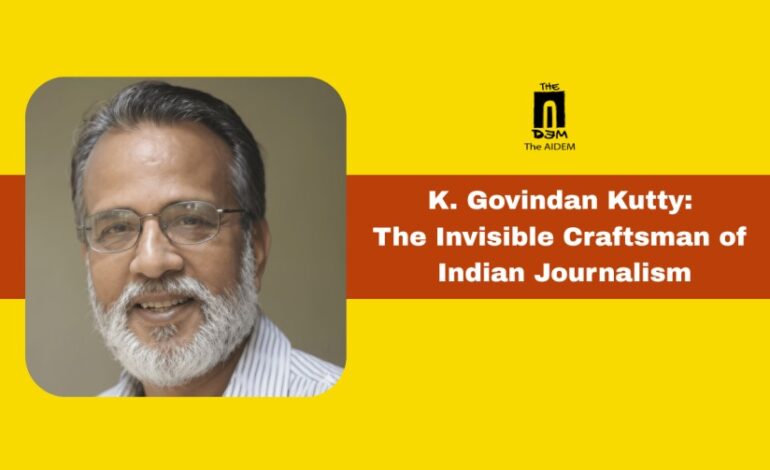
Some journalists chase the spotlight; others build the stage on which history performs — then step back into the dark. K. Govindan Kutty belonged to that vanishing fraternity: the newsroom’s quiet architect, shaping narratives, polishing arguments, and, at times, lending his voice to others without leaving a signature. His influence travelled through corridors of power and columns of print, rarely announcing itself, yet unmistakably present to those who knew where to look. In an era that increasingly rewards noise over nuance, remembering such a figure is also an act of mourning for a certain kind of journalism itself — a loss made more intimate by the candid, disarming Facebook post of his reproduced at the end.
For long, K. Govindan Kutty was more a byline than a person to me — a familiar name that appeared with reassuring regularity beneath incisive commentary. That equation changed in 1994 when I joined the Indian Express. The cabin adjacent to mine belonged to Kutty, then Senior Editor with the Financial Express.

One day, finding myself unassigned, I called him on the intercom and asked if I could meet him. His response revealed the man: “I believe in good neighbourliness and you can drop in any time.” That first meeting began an association marked by quiet admiration.
My eyesight was better then. From a distance, I could read the opening lines of an article he had just begun on his desktop. The next day, I saw the piece on the editorial page — but with another byline. It confirmed what many suspected: Kutty was a master ghostwriter, a distinction that speaks not of anonymity but of rare trust in one’s craft.
A year later, the editorial office of the Indian Express shifted to Bisleri House in the Qutab Institutional Area, away from Bahadur Shah Zafar Marg — India’s Fleet Street. Yet, distance did not diminish my engagement with his work. Whenever I saw his byline, I read the article. Often, I read another columnist too, convinced that the elegance of thought and turn of phrase bore Kutty’s invisible imprint.
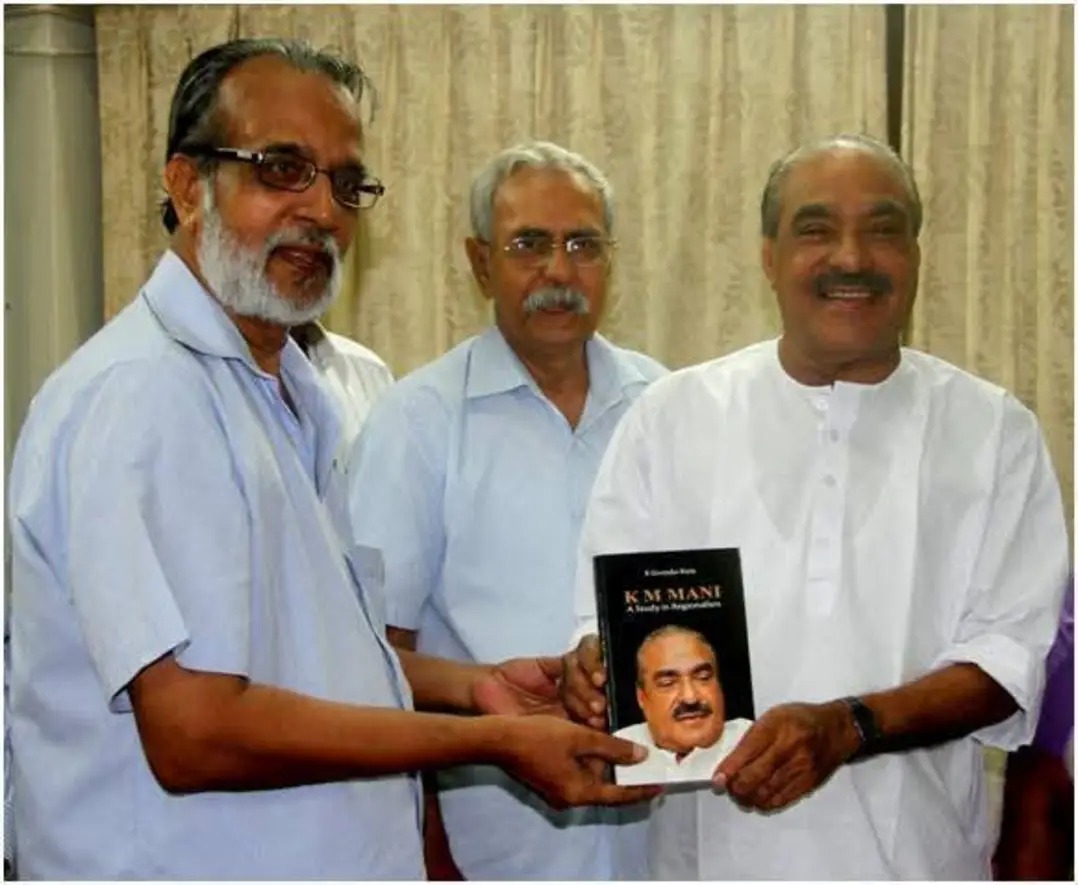
Over the years, he authored many books. It is a pity that I read only one —his work on TN Seshan, who had become popular as the best Election Commissioner. Later, when I became more of a Facebooker than a newsroom regular, we reconnected online. He had settled down in Kerala. He was prolific there, writing with enviable ease in both English and Malayalam.
One memorable piece of his described a modest hotel in Thiruvanthapuram frequented by artists, writers, and travellers — later converted into Padma Café under the Nair Service Society (NSS). Inspired, Betty and I visited a Padma Café on the National Highway, near Cherthala, and I wrote about it, acknowledging the cue I had taken from Kutty.
His scholarship was breathtaking. He could move seamlessly from music to sacred texts — the Narayaneeyam, the Bhagavad Gita, and the Bible — quoting William Shakespeare as effortlessly as a contemporary Malayalam poet. His review of journalist and friend PP Balachandran’s memoirs remains, to my mind, a classic of literary criticism. Yet he wore his erudition lightly; there were no airs about him.
We once exchanged views on a contentious contemporary issue. Our perspectives diverged, but he engaged with tireless patience, embodying the civility that journalism sorely needs.
For some time, his Facebook posts had disappeared from my feed. I assumed the algorithm was to blame. I did not know he had been unwell. Nor did I know much about his family until obituary references surfaced in WhatsApp groups this morning.
In his passing, journalism has lost a great practitioner — a writer who proved that influence need not seek the spotlight. A few years ago, responding to something I had written, he revealed how a major scoop — the report that stockbroker Harshad Mehta carried a suitcase containing Rs 1 crore to the residence of Prime Minister PV Narasimha Rao — had been fabricated.
That candid admission reflected his commitment to truth over myth, even when it meant puncturing journalistic legend. (Read his thoughts on this subject in one of his Facebook posts provided at the end.)
Govindan Kutty belonged to that vanishing tribe of editors whose words shaped public discourse without drawing attention to themselves. He was the quiet authority of a craftsman, the intellectual generosity of a teacher, and the humility of a seeker.
May his soul rest in eternal peace. May God grant his family the necessary fortitude to bear this irreparable loss.
First Rough Draft
By Govindan Kutty
The draft was perhaps too rough, first or nth. A J Philip, veteran journalist, provoked me to probe into it, history’s first rough draft, as they qualified journalism. Philip and I had cabins in the same row, ensconced in the decomposing ghats of history. There was yet certain pride in scripting history, its plural, “histories,” according to Herodotus.
History was, then, very contemporary, its centre and periphery not lengthening beyond or between the era of P V Narasimha Rao. As it unfolded, history conspired against him. In many matters national, he was verily a prophet of transition, a sankramapurusha, so to say. But our draftsmen of history nearly dislodged him. He let the calamity pass, leaving him unshaken.
His minister of state, M M Jacob, no high-profile man, was fond of repeating himself when Rao was under exclusive discussion. His Buddha-like dictum was to avoid doing tomorrow what could be put off to the day after. He saw a purpose in delay. In his little world, nothing expired. Addressing elders whose Rajya Sabha term was ending, he said nobody retired, no one went but only came, in our tradition, punaragamanaya.
When the whole world wanted to believe he had taken a bribe of a crore stacked in a suitcase, he stood as a doubting Rao. The scandal broke one night in our editorial office, but he remained sphinx-like, eternity twinkling in the silence of his kurta. He took a good two days, or was it three, to discover that he had neither “blessed” the suitcase as was averred nor taken out its contents.
“What prime minister is this whose value is one crore?” Muslim League leader P K Kunhalikkutty had reportedly thought aloud, amid peals of an infectious chuckle. It is said that nothing would taint some people, like the protagonist in Rao’s novel, The Insider. Conversely, everything could stick to some. Rao let it remain. That was his style. After deliberating on a cabinet reshuffle for a few months, he went to Burkina Faso to announce it, involving no more than two people. He left more hope smouldering, with a cryptic statement that it was yet only “half a glass of water.”
The suitcase story came from Mumbai. It came like manna to the harried chief sub-editor who had no story so far meriting a three-column headline. The dull holiday was being wound up when editor Prabhu Chawla rang me up from Mumbai, excitement in every breath. “Don’t go, Govindan, we have a story to break, a big story,” he said, giving me the impression that the government was going down the precipice in a couple of hours, or take half a day.
He stormed into the office before Boeing halted. He told me the story in two staccato sentences. How the suitcase travelled from a hotel room to the PM’s house, how the private secretary kept it ready for appropriate dispatch to safe custody, how the PM blessed it, and so on–we composed the suitcase story in hair-raising detail.
What broke my rhythm was when we reached the stage of Rao emerging from his living quarters and “blessing” the suitcase. It made sense to bless a man or an ass, but why was this suitcase, an inanimate container, blessed, with or without anything inside it?
That was not the hour for such questions with levity or in high seriousness. The story of the suitcase had to go to all editions without a moment’s delay. Editors waited there, unassailed by doubt, probably electrified by a new epiphany. While I composed the script, polishing it then and there, doubts crawled and hissed in my mind, which formed as vicious questions: Who was witness to this great act of fraud? Who said what, where? What was the evidence for the story, if not for the historic act itself?
There was no need for doubt or worry, Chawla said, reassuring me and those like Devsagar Singh, chief of bureau, who shared my question when they saw it in cold, cocky print. We lived on the assurance that there was an abundance of evidence, even videographic evidence! It was acerbic fun to assume that the Prime Minister had sanctioned live coverage of an act of fraud on his official premises.
When the story was out, there was an inevitable follow-up with competitive enthusiasm. Some intelligent sleuths measured the size of an identical suitcase in an effort to calculate how many currency notes were needed to fill the space. The rest was history, its first and final rough draft. Bit by bit, its base was broken. The legal prodigy who had provided the story had no evidence of any kind to back it up.
Were you not taken for a rough ride, we asked the editor. Not only I, but everyone was taken for a ride, he conceded. But the objective had been achieved, the objective being damning the Prime Minister. And then history moved on to its next rough draft.





This moving portrait restores visibility to a quiet architect of Indian journalism. K. Govindan Kutty’s integrity, editorial craft, and commitment to the public interest shaped newsrooms from behind the scenes—proof that the most influential figures are often the least celebrated.