
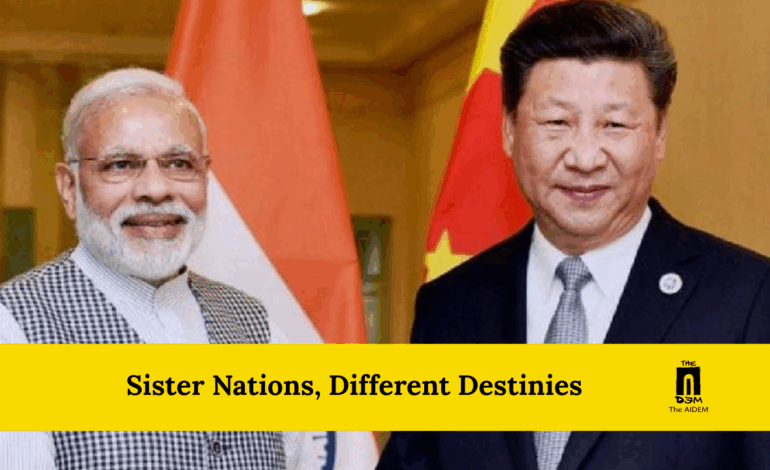
Sister Nations, Different Destinies

The world is going through a seismic shift in the geopolitical order. As Lenin’s famous quote says: “There are decades where nothing happens; and there are weeks where decades happen.” With the USA–Israel attack on Iran, and Iran putting up a valiant fight against the global order itself—by targeting and exposing the fragility of financial hubs such as Dubai, bringing the invincibility of the oil and natural gas economy into serious question, and forcing the easing of the west’s crippling sanctions on Russia in the process—the last few weeks have become a testament to that quote. We are witnessing a permanent shift away from a unipolar, Western-centric world towards a firmly multipolar one.
Even while constantly demonising China, US President Donald Trump is scheduled for a state visit to Beijing on March 31, showcasing the importance of China in the new world order. It is just one example of China negotiating from a position of strength. Although not militarily involved, China has shown where its sympathies lie in major flashpoints of Western aggression—whether in the case of Venezuelan President Nicolás Maduro’s alleged kidnapping by the USA, the Palestinian genocide by the Israeli regime, or the massacre of Iranian schoolchildren by US missile strikes on day one of the ongoing conflict.
India, on the other hand, has often been used as a tool by both the USA and Israel in this geopolitical chess game—whether in barring us from buying Russian oil and then “allowing” a one-month reprieve, or in inviting an obliging and genuflecting Modi for a state visit to Israel just hours before brutally attacking and killing the Iranian Supreme Leader, Ayatollah Khamenei. Clearly, both India and China are historically part of the Global South, but these current events depict vastly different worldviews. In such times, it is imperative for any observer to examine the trajectories of the world’s two largest countries—India and China.
There was a time in history, not too long ago, when India and China were plodding along as “developing” sister economies. Even until the early 1990s, China had poverty levels comparable to India. But what we are witnessing today is a fascinating success story—one that has rarely, if ever, been seen in human history.
China today is arguably one of the most advanced countries in the world by several measures. While there are “developed” countries that rank higher on indicators such as the Human Development Index (HDI), most either carry a colonial legacy that enabled their rise or are relatively small in scale, making wealth distribution easier. China, in contrast, has no history of usurping land or resources from other nations and has long been one of the most populous countries in the world.
Its ascent is thus a mesmerising tale—one that fills the Global South with pride, as it offers a counter-model to centuries of colonial hegemony. The world is now witnessing a Chinese model that has emerged as a new benchmark for lifting masses out of poverty while remaining self-reliant and fundamentally opposed to Western neoliberalism.
The Scale of the Chinese Miracle
China is now one of the world’s leading economies and, in the process, has lifted around 800 million people out of poverty, virtually eliminating extreme poverty by 2021—an achievement with no parallel. What makes this remarkable is its emphasis on the larger public good through massive investments in sectors that serve the population at large.
In mass transportation, for instance, China is the undisputed leader in high-speed rail (HSR), connecting the length and breadth of the world’s third-largest country by area. It also dominates urban metro transit, with 9 of the 10 largest subway systems globally located in China. The scale is staggering. During the Chinese New Year “Chunyun” (Spring Festival) season, the HSR network is expected to handle 540 million trips in just 40 days—historic in itself—while in an average year, it carries around 1.2 billion passengers.
In healthcare, China’s infant mortality rate stands at 4.0 (2024), lower than that of the USA (5.5), while maternal mortality is 14.3 compared to 19 in the USA. More than 95% of Chinese citizens are covered by basic health insurance, providing access to robust, high-quality care comparable to that in developed nations.
China’s investment in education has been the bedrock of its economic rise. Literacy is now nearly universal, with no discernible gender gap. The focus has shifted toward improving specialized literacy—digital, health, and scientific—across the population.
Shedding the Civilisational Burden
Chinese civilisation is one of the oldest in the world, yet China has managed to shed the burdens often associated with ancient histories. Following the 1949 revolution and the devastating civil war, the newly formed People’s Republic of China placed its people at the center of national reconstruction.
The Cultural Revolution (1966–76), spearheaded by Mao Zedong—though controversial—played a role in promoting scientific temper and a results-oriented mindset over blind tradition and superstition. It helped the nascent nation reset its trajectory.
At the same time, China preserved its historical legacy. From the Terracotta Army in Xi’an—linked to Emperor Qin Shi Huang—to the Tiananmen complex in Beijing, including the Forbidden City, the country has maintained its architectural and historical heritage. This demonstrates a pragmatic and scientific engagement with history—free from excessive pride or prejudice.
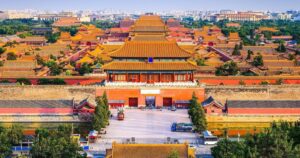
This balance laid the foundation for China’s industrial transformation in the 1980s and beyond. Another lesser-known aspect is its diversity: China officially recognizes 56 ethnic groups and several autonomous regions, yet has managed to sustain unity in diversity in both letter and spirit.
Indian Context
India, now the world’s most populous country, shares certain similarities with China—it was never a colonizer and has a long civilisational history. Around the time Emperor Qin Shi Huang built his Terracotta Army, India had Emperor Ashoka, who promoted rational and ethical governance, public welfare, and Buddhist philosophy through inscriptions across his vast empire.
These ideas traveled to China, inspiring scholars like Xuanzang (Hiuen Tsang) and Faxian (Fa Hien), who journeyed to India in search of knowledge. Even today, Xuanzang is commemorated in Xi’an with statues and memorials.
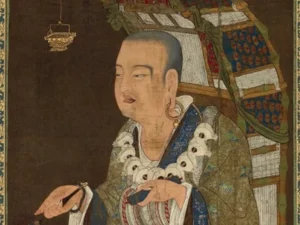
Despite such shared histories, India’s modern trajectory since independence in 1947 has been markedly different. Official figures suggest that around 75 million Indians live in extreme poverty, with approximately 343 million experiencing multidimensional poverty. Some independent estimates place the poverty rate as high as 21%.
India’s infant mortality rate stands at 25 per 1,000 births, maternal mortality at 80 per 100,000, and literacy at around 80%, with a significant gender gap (74% for women, 87% for men). India ranks 130 out of 193 on the HDI (medium category), compared to China’s rank of 75 (high category). These figures clearly indicate the distance yet to be covered.
Is the Chinese Model Elusive to India?
Where did India go wrong after both nations began their modern journeys at roughly the same time?
The answer is complex, but two major structural issues stand out.
First, caste remains a deeply entrenched social evil with no parallel in China. A caste-driven society is inherently constrained, fostering exclusion and limiting social mobility. Incidents of caste violence and discrimination remain widespread, reflecting a deeply regressive undercurrent.
Second, India has historically lacked consistent, decisive leadership with a sustained commitment to mass welfare. Critical investments in education, healthcare, and land reforms were insufficient from the outset. Even these limited efforts weakened further after economic liberalisation in the 1990s,




“A sharp and insightful take on how similar nations can take very different paths over time—thought-provoking and well written.”