


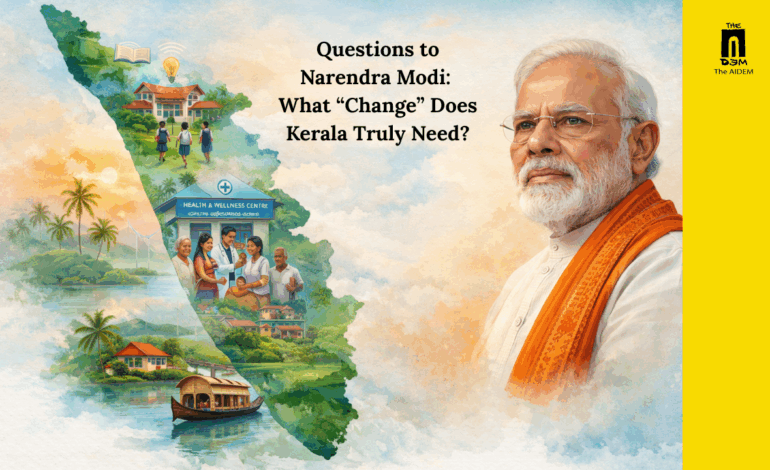
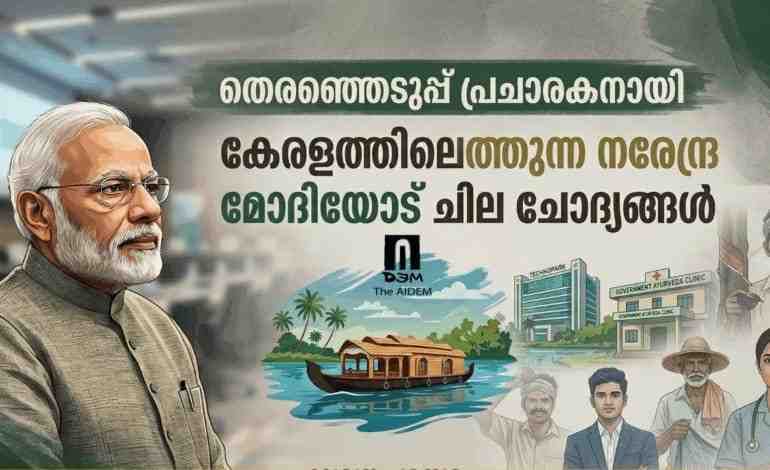
As Prime Minister Narendra Modi prepares to campaign for Bharatiya Janata Party (BJP)–National Democratic Alliance (NDA) candidates in Kerala, it is only appropriate that some vital questions are addressed to him. Of course, one must remember that he has not been willing to answer questions from the media throughout his tenure as Prime Minister since 2014.
Yet, I would like to pose these questions directly to him. When you were the Chief Minister of Gujarat in 2007, your face—visibly uneasy before the questions of journalist Karan Thapar—asking for a glass of water before abruptly ending the interview, remains fresh in public memory even today.
Even so, as a Malayali, and as someone concerned about the election slogan put forward by you and your party, I believe certain questions must not go unanswered.
“Let’s start the change… and then Kerala will grow” is the slogan your party and alliance are presenting to the people of Kerala. The question is: where exactly should Kerala change?
The BJP, led by you, has ruled Gujarat for nearly three decades, and you yourself served as Chief Minister for ten of those years. Therefore, it is only fair to compare the social development achievements of Gujarat and Kerala during this period.
According to the latest figures, the multidimensional poverty index of the state you call “Garvi Gujarat” is 11.66 percent, while Kerala’s stands at just 0.55 percent (NITI Aayog). Mr. BJP’s star campaigner, where exactly are you trying to take Kerala?
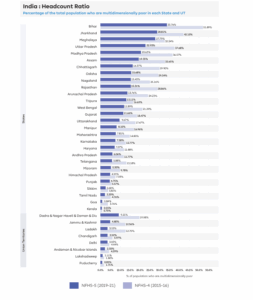
Now let us compare infant mortality rates. According to the Economic Survey 2025–26, Gujarat records 20 deaths per 1,000 live births, while Kerala records just 5 per 1,000. Is the Prime Minister, who calls himself “Vikas Purush,” promising to bring Kerala’s infant mortality rate in line with Gujarat’s?
Let us also examine the education sector, Mr. Prime Minister.
Official figures show Gujarat’s literacy rate at 84.6 percent, compared to Kerala’s 95.3 percent. In the past decade, 525 government schools have been closed in Gujarat. In Kerala, not a single government school has been shut during the same period. Is this the change you wish to bring—closing public schools and paving the way for private educational businesses?
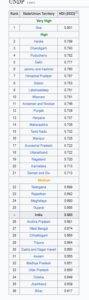
You must also be aware that Gujarat ranks 25th among Indian states in the Human Development Index (HDI), while Kerala ranks 2nd.
Instead of transforming Gujarat, where social indicators lag behind, are you now seeking to “transform” Kerala, Mr. Prime Minister?
On communal harmony, your own Home Ministry reports that 150–200 communal riots have occurred in Gujarat over the past decade. In contrast, data from the Union Home Ministry and the National Crime Records Bureau indicate no such communal riots in Kerala during the same period.
Are you suggesting that Kerala—long known for religious coexistence—should be transformed into a state marked by communal conflict?
So far, these questions have focused on Gujarat. Let us briefly turn to Uttar Pradesh and Madhya Pradesh, where your party has been in power for the past decade and two decades respectively.
Uttar Pradesh ranks 33rd and Madhya Pradesh 32nd in the Human Development Index among Indian states. In education and literacy as well, both states fall below the national average.
In Madhya Pradesh alone, 29,410 government schools have been closed over the past decade. In Uttar Pradesh, 25,126 schools were shut during the same period. These closures took place during your tenure as Prime Minister, in states governed by your party.
In every sphere related to social welfare—health, sanitation, infant mortality, and public health infrastructure—Kerala remains ahead of BJP-ruled states.
It is equally important to note that Kerala’s achievements are not the result of any single party, leader, or government. They are rooted in a long history of social reform and renaissance movements—histories unfamiliar to you and your party. The contributions of leaders such as Narayana Guru, Ayyankali, Poykayil Appachan, Vakkom Moulavi, Pandit Karuppan, Kochukali, Halima Biwi, Arya Pallam, and Kaumudi Teacher have shaped this progress. From the land struggles led by communist leaders like Comrade Krishna Pillai and A.K. Gopalan to more recent movements led by Laha Gopalan and C.K. Janu, people’s struggles have been central.
This small state has a long tradition of democratic resistance—of debates, movements, and public accountability that prevent governments from straying from the path of social development. A democratic culture unfamiliar to you and your party.
You have already given indications of the direction in which you wish to take Kerala.
Despite a Supreme Court verdict allowing women’s entry into Sabarimala, your party mobilised protests that clearly reflected an anti-women stance. We also see your party leaders repeatedly spreading communal hatred against Muslim and Christian communities. How can we forget Gujarat, Kandhamal, and Muzaffarnagar?
Anti-farmer and anti-labour laws were enacted during your tenure as Prime Minister.
The steady decline in the value of the Indian rupee since you assumed office is no longer even considered news.
The closure of hotels and workplaces across the country stands as evidence of administrative failure. While carefully curated images by PR machinery may attempt to project statesmanship, the reality—millions of struggling households, shuttered businesses, and rising unemployment—tells a different story. I refrain from listing all the statistics here, lest it be seen as exaggeration.

Let me conclude with this:
Mr. Prime Minister, as a Malayali, I say with pride that Kerala stands far ahead of BJP-ruled states on most indicators. When you and your party speak of “change,” it raises a genuine concern in my mind. Let the progress we have achieved through struggle, debate, and coexistence continue undisturbed.





Brilliant questions Sahadevan ji – but do not expect answers from Modi or his ilk in BJP and NDA
The strength of Kerala’s social fabric lies in its long-standing tradition of coexistence, and there is a valid concern that any external push for “change” could disrupt the very harmony and progress that define the state’s identity