

Bare Foot College – Degrees don’t matter

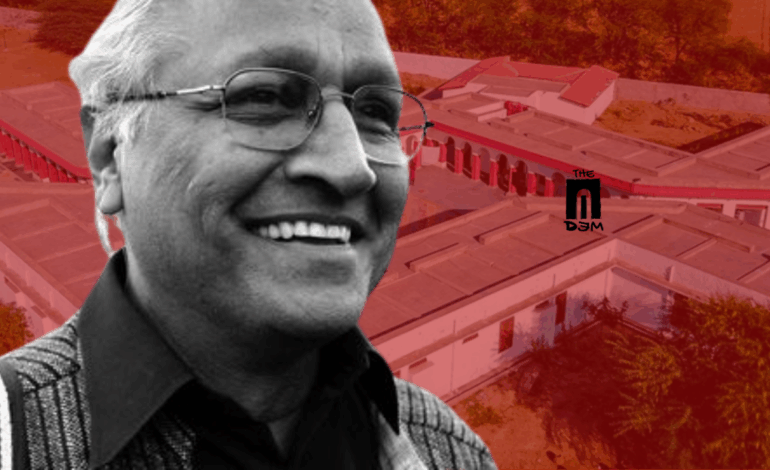
Part of The AIDEM,s Gandhian Economics series—this piece reimagines development through the lens of self-reliance, dignity of labour, and community knowledge.
Balasubramaniam Muthusamy explores how the Barefoot College challenges conventional ideas of education and expertise—proving that empowerment does not come from degrees, but from skills rooted in lived experience.
Bunker Roy was a squash champion, a product of India’s finest schools, and heir to every advantage his country offered. He gave it all up to dig wells in the Rajasthan desert. What he built there—a college without degrees, staffed by people without qualifications, in a village most maps do not bother to include—now sends solar engineers to eighty-one countries. The students are grandmothers. The teacher is a temple priest who never finished school.
Ancient Nalanda, in what is now the Indian state of Bihar, was for centuries one of the great universities of the world. At its peak, around the fifth century of the common era, it drew scholars and students from across Central Asia and Southeast Asia to study theology, philosophy, linguistics, and medicine in a campus of nine monasteries and a library said to hold millions of manuscripts. The institution was, by every account, extraordinary: a place where knowledge was treated as a thing that transcended origin, that could be carried across deserts and mountain ranges and deposited in unlikely minds.
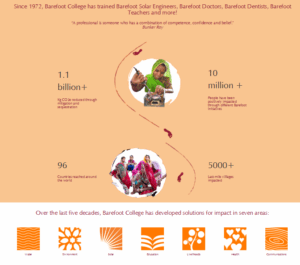
In the village of Tilonia, in the Ajmer district of Rajasthan, there is a college that has been drawing students from eighty-one countries since 1972. Women arrive from Afghanistan and Sierra Leone, from Jordan and the Solomon Islands, from countries many of their neighbours have never heard of. They stay for six months. They do not receive degrees. They do not receive certificates. When they leave, most of them can build, install, and maintain solar lighting systems—a skill they will take back to villages where the electric grid has never arrived and, in many cases, never will.
The institution is called the Barefoot College. Its founder is Sanjit Roy, known to everyone as Bunker, who gave up what might generously be called a glittering future in order to dig wells in the Rajasthan desert. He has spent decades since constructing, in the unlikeliest of places, a working argument about what education is actually for.
“Train a young man and he’ll leave for the city. Train an old woman and the knowledge stays in the village forever.” —Bunker Roy
The Swerve
Bunker Roy was born on the second of August, 1945, into the kind of family that Indian society reserves its highest ambitions for. His schooling was at the Doon School in Dehradun, the institution that has produced Indian prime ministers and business leaders, kind of a secular seminary for the ruling class. He proceeded to St. Stephen’s College in Delhi, where he was academically accomplished, and more visibly, a squash player of serious distinction: three-time national champion, representative of India at international competitions. The trajectory from there was obvious—the Indian Administrative Service, the Foreign Service, postgraduate study abroad, a career in one of the institutions that run the country. Each door stood open.
Then, in 1967, the year he finished college, Bihar was hit by a famine. Jayaprakash Narayan—the independence-era leader who had become, by that point, the conscience of Indian public life—put out a call to educated young people to come to Bihar and help with relief efforts. Roy went. He spent several weeks in the villages, where he encountered starvation and death at a scale he had not previously imagined possible in independent India. When he came home, he told his mother that he would not be continuing his education.
She asked what he planned to do instead. He said he was going to go live in a village. She asked what work he intended to do there. He said he was going to dig wells for daily wages. She did not speak to him for several years afterward.
For roughly five years, Roy worked as a manual labourer in the Ajmer region of Rajasthan, digging wells alongside the men who did this work professionally, earning what they earned, living where they lived. The experience, he has said, was the most important education of his life—more consequential than anything that happened at the Doon School or St. Stephen’s.
In 1972, he came to Tilonia, a village in the same region. The village elders who encountered him did not know what to make of him. Their working hypothesis was that he was either a criminal evading the police, an academic failure hiding his shame, or a man who had quarrelled irreparably with his family. When he told them he wanted to do something for the village, this was a new category entirely. When he told them he wanted to start a college, one of the elders gave him advice that would shape everything that followed: “Do it. But don’t bring educated people from the city.”
The Building That Won a Prize It Refused
The Social Work and Research Centre—which would eventually become the Barefoot College—grew slowly from that conversation. Its founding premise, which Roy articulated early and has never abandoned, was a redefinition of expertise. A professional, as he defines, is someone who has mastered a skill and can apply it. By this definition, the man who can locate underground water by reading the landscape is a professional. So is the village midwife, the herbalist, the potter, the weaver, the farmer who knows which crop to plant in which soil in which season. The college was not built to import expertise from outside; it was built to recognize and organize the expertise that was already there.
The physical building of the college was constructed by local craftsmen, using local techniques. The roof was waterproofed using a method known only to the women of the region, a knowledge that had been passed down for generations without ever being written down or formally recognized as knowledge at all. Thirty-five years after the building was completed, Roy notes with some satisfaction, the roof has not leaked.
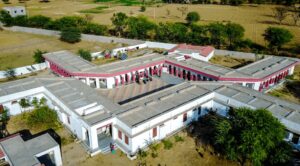
The building won the Aga Khan Award for Architecture, one of the most prestigious design prizes in the world, along with a cash award of fifty thousand dollars. The Aga Khan Foundation, reviewing the submission, found it difficult to believe that the structure had actually been built by the people Roy said had built it. Bunker Roy returned the prize and the money without accepting them. The foundation’s skepticism was, in his view, precisely the problem the Barefoot College existed to correct – an assumption that quality and local knowledge are incompatible, that a building made by villagers without formal training cannot be as good as a building made by architects with degrees.
Barefoot College and Water Issues
In the Rajasthan desert, water is not a resource. It is an obsession, a theology, a source of conflict, and the organizing principle of daily life. The Barefoot College has addressed it on three fronts simultaneously: rainwater harvesting, small-dam construction, and the drilling and maintenance of hand pumps.
Rainwater harvesting structures have been built across eighteen Indian states, with a total storage capacity of five hundred million litres—enough, Roy estimates, to serve roughly two million people. Four check dams have been constructed to benefit twenty villages, holding sixty-five million litres between them. More than seventeen hundred hand pumps have been installed in schools and in Dalit settlements, and the college has trained seventeen hundred Dalit women to maintain them—creating, in the process, a cadre of female engineers whose expertise is formally unrecognized but practically indispensable.
The Sambhar Salt Lake, one of the largest inland salt lakes in India, sits in the Ajmer district at the heart of Barefoot College territory. Its water is saline; the surrounding villages have long struggled to find potable water. Eleven solar-powered water purification plants, operating on reverse osmosis technology, now supply drinking water to the communities around the lake. Each plant is maintained by a woman from the local village, trained by the college—which means that once the infrastructure is installed, the community owns it entirely, without dependence on outside technicians.
The college practises what it teaches. Its own campus in Tilonia collects every drop of rain—and Rajasthan receives among the least rain of any Indian state—through a system of rooftop and surface channels that feed into an underground cistern with a capacity of four hundred thousand litres. Roy’s calculation is straightforward: Rajasthan has never experienced four consecutive years of complete drought in recorded history, so four years of stored water means the campus will never face a shortage. The logic is the same logic that the desert dwellers of the region have always applied; the Barefoot College has simply formalized it.
The Night School
Children in poor rural families do not attend school during the day for the same reason that adults do not attend training programmes during the day because the daytime is meant for work. Girls herd goats and help their mothers. Boys work the fields. The family’s survival depends on every pair of hands, and the school’s schedule—designed, like most institutional schedules, for the convenience of the institution rather than the people it serves—simply excludes them.
The Barefoot College’s answer was the night school – solar-lit classrooms, running after dark, in roughly seven hundred villages, serving children between the ages of six and fourteen. The curriculum is practical – basic science, health, democratic process, animal husbandry – and designed around the lives the children are actually living rather than the lives that school curricula typically assume. “These schools,” Roy has said, “work on the students’ schedule, not the teacher’s.”
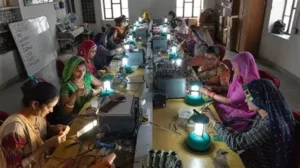
Approximately seventy-five thousand children have passed through the night schools since they were established. More than four thousand of them, including twelve hundred and fifty girls, all from poor families, most from Dalit communities, subsequently enrolled in conventional schools and continued through to college. This is, by Roy’s own assessment, one of the college’s most important outcomes: not that the night schools produced graduates, but that they produced students.
The schools are governed by the students themselves. Elections are held; one student serves as prime minister, others as ministers with specific portfolios. The administrative decisions of the school—scheduling, supplies, maintenance, conflict resolution—are made by children who have, in many cases, never seen a functioning democratic institution in any other context. Democracy, in this model, is not a subject on the curriculum. It is the operating system of the building.
The college also runs sixty crèches, serving approximately two thousand families per year. The logic is the same as that behind the night schools: a woman who cannot leave her infant at home cannot work, which means her income falls, which means her family becomes poorer, which means her daughters are less likely to be educated and more likely to repeat the cycle. The crèche is not, in this analysis, a welfare provision. It is an economic intervention.
The Solar Grandmothers
Women in rural Rajasthan spend a significant portion of their lives on two activities: collecting water and collecting firewood. The firewood, once collected, is burned in indoor stoves in houses with no adequate ventilation, producing smoke that damages lungs and eyes over decades of daily exposure. After dark, the absence of reliable lighting means that children cannot study, women cannot work, and the village becomes dangerous in ways that fall disproportionately on the women within it.
The Barefoot College’s solar program addresses this directly. Its method is unusual enough to be worth describing in some detail, because the principle it embodies—that the most effective solution to a technical problem in a remote community is a technical solution that the community itself can maintain—runs against most of the assumptions that govern international development practice.
The program begins by identifying villages that have no grid electricity and no realistic prospect of obtaining it. In such a village, one woman is selected—not a young woman, and not an educated one. Specifically, an older woman, often a grandmother, who has not previously left her village. This woman is brought to Tilonia for six months for hands-on training in solar panel assembly, installation, and maintenance. The language barrier is not treated as a problem: the training is deliberately designed to function without linguistic instruction, using color-coded components, demonstration, and repetition. Women who have arrived unable to identify a circuit board have left able to wire a solar panel array and diagnose a fault in a twelve-volt system.
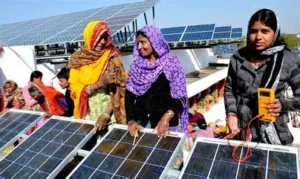
When they return to their villages, they install solar panels on rooftops, run lighting cables into homes, and connect charging points for mobile phones. They become the technical infrastructure of their community—the person you call when the light goes out, the person who orders replacement parts, the person whose knowledge keeps the system running. Because they are old, and because they are women, they do not leave.
Roy’s reasoning about the age and gender of his trainees is one of the most frequently quoted things he has said, and it is worth examining carefully. “Training men is very difficult. They are impatient, ambitious, they want certificates, and as soon as they have them, they go to the nearest city to start a business. Old women are rooted in their communities. The knowledge stays where it is needed.” This is not sentimentality. It is, after decades of observing what happens to development programmes that train young men, an empirical finding.
The training at Tilonia is conducted by a local temple priest who completed his formal education at the eighth standard—equivalent to roughly eighth grade. He has trained more solar engineers than any formally qualified electrical engineer in India. The people he has trained have electrified homes in conditions that utility companies have assessed as commercially unviable for the foreseeable future.
The man who trains solar engineers for eighty-one countries completed his education at the eighth standard. His students have never finished school. The villages they electrify have been assessed as commercially unviable by every utility company that has looked at them.
From Tilonia to the World
The solar programme expanded first within India, then, in 2008, with support from the Indian government’s Ministry of External Affairs, into the developing world. The logic of the international expansion followed the same model as the domestic one: identify a village with no electricity and no prospect of it, find an older woman who has never left, bring her to Tilonia, train her for six months, send her home with equipment. The Indian government covers the cost of travel and training. What arrives in the village is not aid, in the conventional sense—a donation that creates dependency—but a person with a skill, who will maintain that skill indefinitely, and who will train others.
The geography of the programme now covers eighty-one countries: thirty-nine in Africa, nineteen in Latin America, thirteen in Asia, and ten in the Pacific Islands. More than six hundred Solar Mamas, the name the programme gave to its graduates, have completed the Tilonia training and returned to their communities. Eighteen thousand families in the world’s poorest villages now have solar lighting because of them.
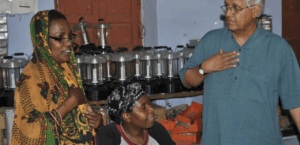
In Afghanistan, the programme encountered a specific obstacle: the husbands of the women selected for training refused to allow their wives to travel to India alone. Roy’s solution was to bring the husbands too. Seven hundred villages in Afghanistan now run on solar power. The total cost of electrifying them, training, equipment, and travel included, was one hundred and fifty thousand dollars. Roy notes, without apparent bitterness, that this is approximately what the United Nations pays a single Afghan-based consultant for one year. There are, he adds, hundreds of such consultants currently deployed in Afghanistan.
Sierra Leone and Tanzania, having observed the programme’s results in their own countries, have established their own Barefoot College training centres—institutions that now train women from neighbouring countries. The model has, thus begun to replicate itself without requiring the original institution to manage the replication.
In Belize, kerosene costs the equivalent of approximately a hundred and eighty rupees per litre in remote villages—several times the urban price, because the supply chain is long and the market is small. Families who cannot afford it live in darkness after sundown. The economics of solar power, in this context, are not complicated: a one-time installation cost, followed by free light, indefinitely. The Solar Mama programme does not require the village to understand photovoltaics. It requires the village to have one person who does.
The Prize Roy Accepted
Rajiv Gandhi, who became aware of Roy’s work, appointed him to the Planning Commission—India’s central planning body—in the nineteen-eighties. Roy used the position to argue for something that the Commission’s bureaucratic culture found profoundly uncomfortable: the formal incorporation of civil society organizations into government programmes. The argument was that the government had money and scale but lacked the trust of the communities it was trying to reach, while organizations like the Barefoot College had trust in local knowledge but lacked resources. The combination, Roy contended, was more effective than either alone.
Rajiv Gandhi overruled the objections and ordered the policy implemented. Today, a significant number of government programmes—including the subsidies that allow organizations like the Aravind Eye Care System to provide free surgeries to patients who cannot pay—function through partnerships with civil-society institutions. The policy has not transformed Indian governance, but it has opened channels that did not previously exist.
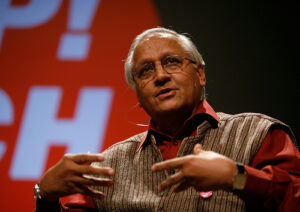
Roy did accept one prize. In 2010, he delivered the TED Talk that brought the Barefoot College to the attention of a global audience. The talk has been watched more than four million times. In it, he describes, with a directness that the TED format usually smooths away, the condescension embedded in most development practice: the assumption that solutions must come from the educated, the credentialed, the urban, the male. He proposes, as an alternative, that the people best equipped to solve the problems of poor villages are the people who live in them.
This is not, in itself, a new idea. It has been articulated, in various forms, by development economists, anthropologists, and community organizers for decades. What the Barefoot College contributes is not the theory but the practice: a replicable model, tested in eighty-one countries, that demonstrates the theory’s validity in conditions that the theory’s advocates rarely have to inhabit.
The Salary
The monthly salary of a Barefoot College employee is very nominal. This may not be a living wage by the standards of any Indian city. It is a living wage in Tilonia, where the cost of housing is low and the community provides much of what money would otherwise buy. It is also, Roy has pointed out, a meaningful signal about what the institution values: not the credentials of its staff but the work they do.
Megan Falloon, a New Zealand-born administrator who joined the college as its chief executive in 2011 and stayed till 2020, had brought to the institution a more systematic approach to its global programmes and to the marketing of goods produced by the rural women it serves. Under her direction, the Solar Mamas programme has tripled in scale. The college’s work is now organized under a single governing purpose: education, enterprise, and empowerment for and by rural women.
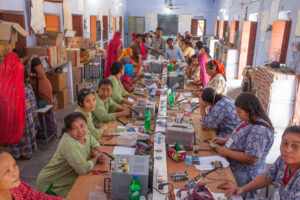
A McKinsey study on gender equality in the global economy estimated that closing the gap between men’s and women’s economic participation could add twelve trillion dollars to world GDP, roughly four times the size of India’s entire economy. “Poor rural women,” Falloon has said, “are the best return on investment in the world.” It is the kind of argument that Roy may not make—his vocabulary might run to Gandhi rather than to McKinsey—but it arrives at the same conclusion by a different route: the people who have been systematically excluded from the global economy are, by that same logic, the people whose inclusion would transform it.









“A powerful and inspiring piece that challenges the conventional idea of education by emphasizing that real learning goes beyond formal degrees. It highlights how skills, practical knowledge, and community empowerment can create meaningful change and self-reliance, especially at the grassroots level. Truly thought-provoking.”