


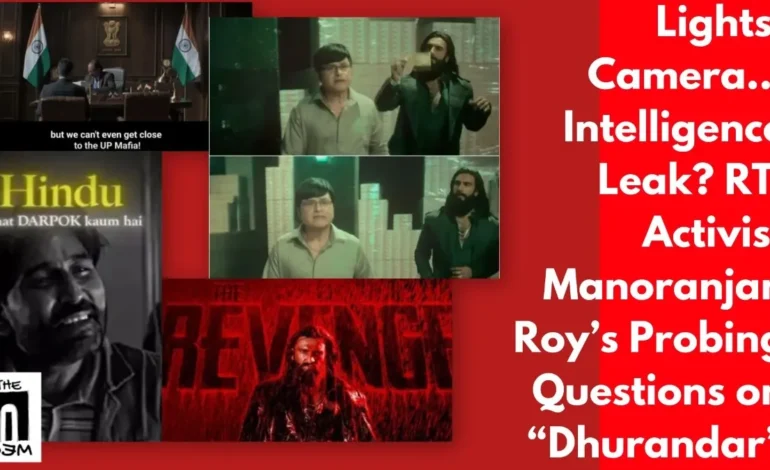
In a sharply worded petition, RTI activist Manoranjan S. Roy has raised a barrage of troubling questions about the shadowy overlap between blockbuster cinema and statecraft . Roy’s RTI questions are based on the recent , phenomenally successful commercial movie Dhurandar Part 2. His contention is not merely about cinematic exaggeration—it is about whether fiction has trespassed into the territory of classified reality.
Roy, no stranger to using the Right to Information Act ( RTI ) as a tool of accountability, has built a reputation around persistently probing opaque corners of governance—especially where public institutions, financial systems, and national security intersect. His latest intervention continues that pattern: methodical, data-backed, and unafraid to challenge powerful stakeholders.
When Fiction Looks Like Classified Briefing
At the heart of Roy’s petition lies a provocative concern: how does a commercial film appear to possess such granular “insider” knowledge about counterfeit currency operations, election funding pipelines, and cross-border intelligence activity?
The film reportedly claims that ₹11,500 crore in fake currency had already entered India, with an additional ₹60,000 crore allegedly routed through Nepal for electoral purposes. It then links this narrative directly to the 2016 demonetisation announcement by Prime Minister Narendra Modi—suggesting the policy move was aimed at neutralising this very cache.
Roy’s questions are direct and difficult to dismiss:
- What is the source of these figures—₹11,500 crore and ₹60,000 crore?
- Do these claims correspond to any official intelligence reports?
- Were agencies like the Intelligence Bureau, RAW, or the Ministry of Home Affairs involved in sharing such information?
- If yes, under what authority was it disclosed for cinematic use?
The implication is stark: either the film is indulging in reckless speculation, or it is drawing from sensitive inputs that were never meant for public consumption.
National Security as Plot Device
The petition escalates further when addressing scenes of covert operations. The film depicts an Indian operative entering Pakistan, meeting fugitive don Dawood Ibrahim, and carrying out targeted eliminations of underworld figures.
Roy asks:
- Has any such cross-border operation ever taken place since 1947?
- Were filmmakers granted permission to depict such missions?
- Does such portrayal risk escalating public misunderstanding or geopolitical tension?
Here, the concern is not artistic liberty alone—it is about the normalisation of highly sensitive military and intelligence narratives without accountability.
Currency, Data, and Contradictions
Roy strengthens his case with data obtained through RTI. He references:
- The 1995 disposal of printing machinery by the Currency Note Press, Nashik—without accompanying printing dyes.
- RBI statistics showing massive volumes of counterfeit ₹500 and ₹1000 notes detected before demonetisation.
- The puzzling scale at which notes returned to the banking system post-demonetisation, raising deeper concerns about counterfeit penetration.
Against this backdrop, he questions how Dhurandar convincingly portrays currency printing processes—including the use of printing dyes—when official records suggest such materials were not publicly accessible.
Real Events, Reel Consequences
The film’s use of real-world imagery—such as the televised demonetisation announcement and public hardship during cash shortages—adds another layer of complexity.
Roy argues that:
- These are not fictional constructs, but lived national experiences.
- Their portrayal, especially when tied to unverified claims about counterfeit networks, risks distorting public understanding.
- It may even appear insensitive to the hardships faced by ordinary citizens during demonetisation.
The Bigger Question: Who Regulates the Narrative?
Ultimately, Roy’s petition is less about one film and more about a systemic vacuum: The central questions he poses are the following:
- Who regulates the depiction of national security themes in cinema?
- Are filmmakers required to verify claims involving intelligence or defence?
- Can fictional disclaimers absolve responsibility when real events and real figures are invoked?
The Demands
Roy’s “prayer” is sweeping:
- A full investigation into the filmmakers’ sources and possible links to illegal networks.
- Scrutiny of mobile records and financial connections.
- Clarification from authorities on whether any classified data was shared or misused.
- Examination of whether such portrayals could undermine trust in India’s financial and security institutions.
- Even a controversial suggestion: that profits from the film be redirected towards public welfare if wrongdoing is established.
An Activist’s Pattern
This petition fits squarely within Manoranjan Roy’s broader RTI activism. His approach is consistent . He anchors his arguments in documented data , uses RTI responses to challenge official silenceand frames questions in terms of citizens’ constitutional rights
In doing so, Roy is not merely critiquing a film—he is testing the boundaries of transparency in an era where storytelling, propaganda, and intelligence can sometimes look uncomfortably similar.
Whether Dhurandar Part 2 is guilty of overreach or simply guilty of cinematic ambition, Roy’s intervention forces a necessary pause. In a media landscape hungry for spectacle, his petition asks a fundamental question:
When does fiction stop being harmless—and start demanding accountability?
Read the full text of Roy’s petition here.









:
“Raises serious questions about the intersection of media, power, and narrative control. Is this an ‘intelligent leak’ or a carefully crafted strategy to shape public perception? Manoranjan Roy’s probing lens makes this issue impossible to ignore.”
“The piece examines how elements like lights, camera, editing, and narration shape the story around Dhurandar. It questions whether this is an ‘intelligent leak’ or a carefully crafted narrative to influence perception. Manoranjan Roy raises important doubts about how much of what we see is real and how much is constructed
Respected Venkitesh Ramakrishnan Sir,
Thank you for this sharp and insightful piece. As always, your analysis brings much-needed clarity to complex political developments.
I am an avid reader who greatly values your perspective, especially given your four decades of experience covering Indian politics. While I understand your responsibilities as Managing Editor keep you extremely busy, it is unfortunate that your own articles appear so rarely on The AIDEM. I, like many others, would deeply appreciate reading your direct comments and opinions on the major events unfolding across India right now — be it the latest political manoeuvres, governance issues, or constitutional matters.
Looking forward to more regular contributions from you on the big national questions of our time.
With warm regards,
Karthikannan Andisamy