


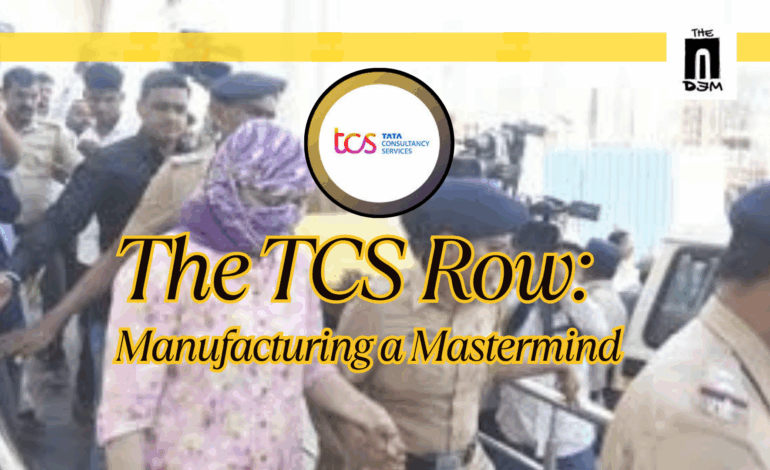
The controversy surrounding Tata Consultancy Services in Nashik did not erupt in a vacuum. It began with allegations of serious workplace misconduct at the company’s local unit, claims that pointed to the suppression of complaints and possible violations of internal safeguards, including those mandated under India’s POSH Act framework. As the story broke, reports indicated that senior functionaries, including HR personnel, were under scrutiny, with Ashwini Chainani -Head of HR and Operations Manager – reportedly arrested for allegedly silencing victims.
What should have followed was a rigorous examination of institutional accountability—how the basic and stipulated systems failed, who wielded authority, and why safeguards did not work. Instead, the public discourse took a sharp and troubling detour.
Into this scenario stepped a narrative—loud, repetitive, and increasingly detached from verifiable fact. At its centre was Nida Khan, projected across sections of the media as a key conspirator, even a “mastermind.” The problem is that this claim collapses under the weight of the company’s own official clarification.

In its April 17 statement, issued under CEO K. Krithivasan, TCS laid out the steps it had initiated: an internal probe led by Aarthi Subramanian, external oversight involving Deloitte and Trilegal, and a supervisory committee chaired by Keki Mistry. But crucially, it also stated that Nida Khan was neither an HR manager nor involved in recruitment, and held no leadership position.
That single clarification should have forced a reset. It did not.
Instead, the narrative hardened. What has been constructed around Nida Khan is not a routine case of sloppy reporting. It is something far more deliberate—a distortion so persistent that it begins to resemble design. By elevating a process associate into a central figure of culpability, while simultaneously muting the role of those actually in positions of power, the discourse does not merely stray from the truth; it inverts it.
This inversion serves a purpose. It deflects scrutiny away from institutional responsibility and relocates it onto an individual who lacks the structural capacity to exercise the power attributed to her. In doing so, it produces a convenient scapegoat—one that can be amplified, personalised, and, crucially, communalised.
That last dimension is where the story becomes deeply unsettling.
The attempt to link Khan to unrelated incidents, including insinuations around events like the Delhi blast, marks a dangerous escalation. A case that began as an inquiry into corporate misconduct is being recast in the language of national security, where fear substitutes for evidence and suspicion masquerades as fact. This is not merely irresponsible; it is corrosive.
At this point, journalism crosses a line. It ceases to be about investigation and becomes an exercise in narrative engineering.
Because what is being engineered here is outrage and perception. A perception in which identity begins to outweigh evidence. In which a Muslim professional can be transformed, through repetition and insinuation, into a figure of suspicion irrespective of documented fact. The implications extend far beyond one individual or one company. They shape who is seen as trustworthy, employable, or even as belonging within critical sectors like IT.
The consequences are not abstract. They accumulate—quietly, steadily—across hiring decisions, workplace interactions, and public attitudes. They redraw the boundaries of economic participation through stigma and suspicion.
Equally telling is what has been pushed to the margins. When the arrest of individuals in leadership roles is downplayed while speculative allegations against a junior employee dominate headlines, it reveals a hierarchy of attention that is anything but accidental. Facts that complicate the preferred narrative are buried; those that inflame it are amplified.
The TCS statement, cautious and corporate in tone, does not directly confront this distortion. But it does something equally significant: it establishes a factual baseline that stands in stark contrast to the media spectacle. In that contrast lies the real story.
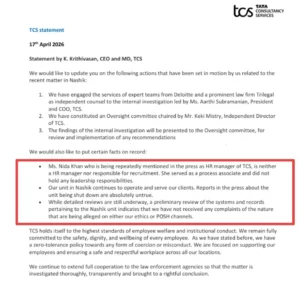 Statement from K. Krithivasan , CEO and MD , TCS
What is unfolding is the systematic construction of a narrative that serves multiple ends—deflection, sensationalism, and, most troublingly, social conditioning. It conditions the public to conflate identity with culpability, to accept insinuation as proof, and to overlook the structures where accountability truly resides.
In such a climate, the Nashik controversy is no longer just about corporate governance or workplace safety. It is about the integrity of the information ecosystem itself. When sections of the media choose scripted hysteria over verifiable fact, they do not merely fail in their duty—they actively participate in shaping a reality that privileges power over truth.
And that is not an error. It is a devious manipulation.








A compelling and sharply argued piece that unpacks how a complex issue was deliberately reframed into a narrative of suspicion and scapegoating, raising critical questions about media ethics, accountability, and the power of constructed narratives.”