

The Power of a Born Storyteller

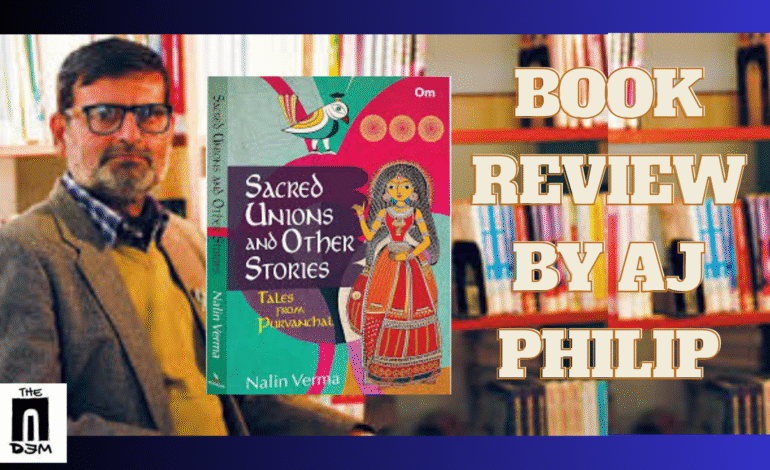
Sacred Unions and Other Stories by Nalin Verma is much more than an anthology of fiction, it is an immersion into the social landscape, emotional contradictions, and cultural textures of Purvanchal. With remarkable ease, Verma transforms ordinary lives into compelling narratives and mundane incidents into unforgettable literary moments, the kind that linger in the mind long after the final page is turned.
Storytelling is not a skill acquired solely through grammar or craft manuals; it is instinctive. Some possess it naturally. I was reminded of this one late evening while driving back from work on the Outer Ring Road near IIT Gate in Delhi. In a dimly lit stretch, I noticed a cyclist collapse on the road, froth coming from his mouth. His tiffin box had rolled into the traffic. It was obvious he had suffered an epileptic attack.
Had I swerved and sped away like some others, the man might have been crushed under the wheels of the vehicles behind me. I stepped out and tried to move him to safety but could not do it alone. I pleaded for help, yet not a single motorist stopped. Finally, after several anxious minutes, a Sikh gentleman with an Army tag on his windscreen halted his vehicle. Together we lifted the man and placed him safely on the road divider, along with his bicycle.
When I narrated the incident at home, it sounded like a plain account of a roadside emergency. But a few days later, I overheard my grandson Nehemiah retelling the same episode to a visitor. By then the story had acquired colour, tension, atmosphere, and drama. Listening to him, I wondered whether it was indeed the same event I had experienced. Small wonder, last week he won the first prize in the Marthoma Church’s Delhi Diocesan-level storytelling competition.
That ability to breathe life into a narrative is what distinguishes a genuine storyteller from a mere narrator. For four decades, I have known Nalin Verma to possess this rare gift in abundance. Even in casual conversation, he can transform a prosaic incident into an engrossing anecdote. He has spent years gathering stories from villages, railway compartments, political corridors, and forgotten lanes, storing them like a master craftsman preserving tools for future use.
Today, Verma is no longer just a former journalist exchanging memories on social media. He has evolved into a serious academic and accomplished author with a literary agent negotiating publication deals, a distinction few Indian journalists can claim. Talent may open the first door for a writer, but survival depends entirely on sustained excellence. Sacred Unions and Other Stories, a collection of five long stories, is the fifth of his books I have read or reviewed, and it confirms his growing literary stature.
Though the book reached me weeks ago, I was too preoccupied to begin reading it immediately. Once I did, however, I regretted the delay. Better late than never. I read every page with care and discovered stories that were enchanting, suspenseful, and deeply humane. If readability is the greatest virtue of fiction, this volume possesses it in abundance.
One reason the stories appealed to me is that parts of Verma’s fictional world are not unfamiliar. Though I have never visited his ancestral village, I once travelled with him through Siwan on the way to the village of Lalu Prasad Yadav. I know the terrain, the poverty, the aspirations, and the peculiar rhythms of life in that region.
When I arrived in Patna in 1980 to join The Searchlight, I became friendly with a young man on the train who happened to be the son of the chief engineer supervising the construction of the iconic Mahatma Gandhi Setu across the Ganga. Fascinated by the project, I visited the site myself. Unlike several recently constructed bridges in Bihar that collapsed embarrassingly within months, Gandhi Setu continues to serve as the vital artery connecting Patna to North Bihar.
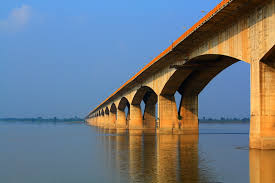
The Gandhi Setu Bridge (located over river Ganga in Bihar, connecting Patna in the south to Hajipur in the north)
In Verma’s hands, however, the bridge becomes much more than concrete and steel. It becomes the emotional centrepiece of a love story blooming amid orchards and gardens, only to be bulldozed in the name of development and replaced by a motel. Quietly but powerfully, the author questions the meaning of “progress.” Is development merely the multiplication of buildings and highways, or does it also involve preserving human relationships, memories, and landscapes?
Characterisation remains Verma’s greatest strength. Every figure in these stories carries a distinct identity and emotional weight. The corrupt daroga in the opening story is so despicable that readers almost cheer when he is finally struck down at the command of his own daughter, an IPS officer. The episode may stretch the limits of plausibility, but fiction is not a police diary. Its obligation is not always realism; sometimes it is emotional truth. Verma understands how to sustain suspense, tighten tension, and keep the reader invested until the final revelation.
Equally memorable is his portrayal of love. In one story, an illiterate village girl falls in love with a brilliant young man who secures first rank in the competitive examination for admission to the All India Institute of Medical Sciences. The relationship is tender, restrained, and sublime. Verma understands that great love stories are not always measured by physical union. The world still remembers Romeo and Juliet, as well as Salim and Anarkali, not because they lived happily ever after, but because their love transcended circumstance.
Importantly, Verma does not burden his fiction with excessive explanations. He leaves certain questions unanswered. Will the lovers eventually marry? The author trusts the reader’s imagination enough not to spoon-feed conclusions.
Growing up in a culturally eclectic environment, Verma displays equal familiarity with Hindu and Muslim traditions. Muslim characters and Islamic references emerge naturally in his stories, never artificially inserted for effect. One particularly moving story revolves around a saintly Muslim figure whose death plunges an entire village into grief. The narrative gradually becomes a moral lesson for his self-centred son, who must rediscover humility before regaining the community’s trust.
Another story, which could easily have descended into sensationalism, is handled with extraordinary sensitivity. The mother of an illegitimate child emerges not as a figure of shame but as one of dignity and near-saintly character. In one poignant moment, the child asks about his father:
“Who is my father?” he had once asked his mother. “The Sun,” she had answered. The child’s mind was satisfied by the conclusion of this mystery, and he had gone on to repeat her answer to anyone who asked him about his father”.
That single passage captures Verma’s literary gift: tenderness without sentimentality, pathos without melodrama.
At just 180 pages, Sacred Unions and Other Stories is deceptively slim. Yet within its modest length lies an entire universe of flawed humans, wounded hearts, fading villages, moral dilemmas, and fragile hopes. The stories move effortlessly between love and violence, faith and betrayal, memory and modernity.
Most importantly, the book possesses that increasingly rare quality in contemporary literature: it is unputdownable. Once a reader enters Nalin Verma’s world, leaving it midway becomes almost impossible. One turns the pages not out of obligation but out of irresistible curiosity to know what happens next. That, ultimately, is the hallmark of a born storyteller.







“The Power Of A Born Storyteller” by A. J. Philip is a beautiful tribute to the timeless art of storytelling and the rare ability to transform ordinary experiences into unforgettable narratives. The piece reflects depth, sensitivity, and the emotional power of words that only a true storyteller can command. Insightful, elegant, and deeply engaging from beginning to end.
Deeply touched and humbled by this extraordinarily generous review by A.J. Philip Sir.
For me, this review carries a very special meaning because Sir has not merely been a senior journalist whose work I admired from a distance. He was my mentor — the editor who initiated me into Hindustan Times and guided me in the craft and discipline of writing during my formative years in journalism. Much of what I learnt about storytelling, observation, readability, and respect for language came through that association.
Coming from someone who has shaped generations of journalists and writers, these words mean far more to me than I can adequately express.
What moved me most was the seriousness and empathy with which he entered the emotional and cultural world of the stories — the villages, the landscapes, the loves, losses, memories, and moral dilemmas of Purvanchal. His reflections made me feel that the stories had reached a reader who truly understood their soil and silences.
I am especially grateful for his faith in my storytelling instinct. For a writer, there can hardly be greater encouragement.
Thank you, Sir, for your affection, generosity, mentorship, and for reading Sacred Unions and Other Stories with such warmth and care. I shall cherish this review for a very long time.