

Good Times, Bad Times
And New Delhi Times

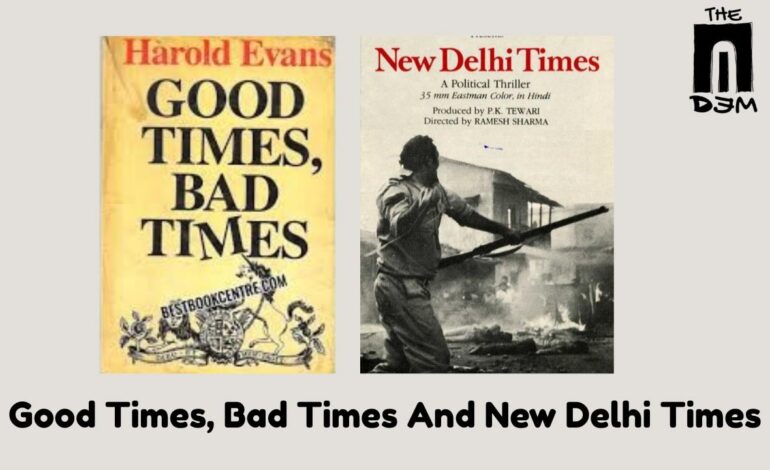
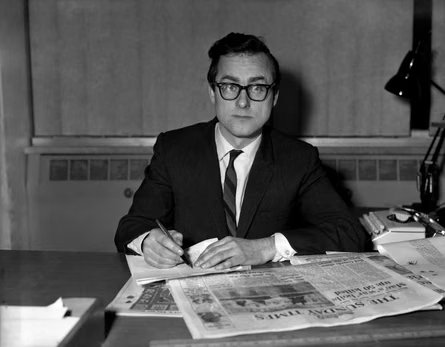
Harold Evans goes for the jugular with the very first sentence in the foreword to his book, Good Times, Bad Times: “Early in 1982, ten months after he had taken over The Times and The Sunday Times. Rupert Murdoch went to see the Prime Minister, Mrs Thatcher. They shared a problem: it was me.”
Evans published Good Times, Bad Times in 1983 — the year I decided to become a journalist. I was 15 then.
It should not be misunderstood that I was inspired by Evans to pursue journalism or that his books are in any way to blame for what I turned out to be or that I am foolhardy enough to draw any comparison between the great editor and me. I was trained to be a backroom boy, not an editor. (One of the greatest compliments I received was from a veteran editor who told me after I lost my job that I was built to be a chief-sub, not an editor. Anyone who has read Evans will know why it is a great compliment. Becoming a chief-sub — and surviving as one — was one of the most arduous tasks in journalism when I first entered a newsroom in 1990. If this article is run through a chief-sub, not a sentence will survive the lethal blue pencil wielded with ruthless finesse. I would rate myself as a reasonably competent senior-sub, a rank just a notch below chief-sub.)
I came across the book, Good Times, Bad Times, only several years later. In fact, I heard the author’s name — first as Harold Evans and then as “Harry” which was always followed by “Tina” (Brown, the celebrated journalist and his wife) only around 1990.
In 1986, three years after Good Times, Bad Times was published unbeknownst to me, I saw the movie, New Delhi Times, in Thiruvananthapuram. I was lucky I could see the movie because it ran into hurdle after hurdle at the halls, possibly because it portrayed riots. A Calcutta lawyer also played a part in undermining the box office run of the movie, and Doordarshan found the film “too hot” (a phase freighted with significance for the film) to telecast. Yet, the movie won several awards, including Shashi Kapoor’s solo best actor national honour for his lead role as executive editor Vikas Pande. Many believed this character was modelled on MJ Akbar and Arun Shourie, part of the typewriter guerrillas of the time.
Director Ramesh Sharma made the rakish Kapoor sport a moustache, apparently so that he would radiate less disarming charm and more no-nonsense gravitas. Needless to say, Gulzar’s script was taut and Subrata Mitra’s cinematography had the sting of a whiplash.

The movie stood out for its largely authentic representation of a newsroom. Sharma depended on the infrastructure of three newspapers — The Times of India, The Indian Express and Hindustan Times — to finish filming fast. The movie stands out for its unconventional ending even though it did not give much importance to the newsroom craft itself. Executive editor Pande is taken for a ride by a chief minister who plants a murder story to make his rival sue for peace. The movie ends with Pande’s terrifying realisation that he had been deceived. Director Sharma promised a sequel a few years ago. I don’t know about the current status of that project.
An HD version of the movie is available for free on YouTube. Last week, I saw the movie again, this time in Calcutta and as a former journalist. I was struck by two scenes, the significance of which had escaped me when I watched the movie first as a greenhorn 40 years ago.
One was where the proprietor’s son tries to gently kick Pande upstairs. The other was where Pande tells the son the difference between the editor and the owner. I was impressed by director Sharma’s ability to figure out in 1989 itself how some media houses perfected the art of “handling” insolent editors.
Indian journalism has had some nasty departures. In recent memory, the best-documented one was the exit of Avirook Sen. In a “blow-by-blow” account in Open magazine, Sen has described how he was forced out of NewsX, the television channel, when he was executive editor there. Matters went out of hand rapidly. According to Sen, his driver Chhuttan Yadav “received a couple across the face for his brief resistance”. Sen eventually won a Rs 2 crore settlement and has had the satisfaction of ensuring that the key to an SUV was handed over to Chhuttan Yadav himself by one of the “micro-bhais”.
Sounds like the enforcers at the then NewsX had not watched the New Delhi Times. In truth, it is hard to say whether art imitated real media houses or media houses imitated the film.
Director Sharma has said in an interview that he was guided, among other narratives, by Harold Evans’s account in Good Times, Bad Times. Evans and Murdoch did wage an epic and nasty battle, marked by newsroom betrayal and displays of loyalty, that went down the wire, unlike the elegant and subtle club-and-beer scene in New Delhi Times.
When I re-read parts of Good Times, Bad Times (a free copy is available on Internet Archive, the non-profit digital library) after watching afresh New Delhi Times last week, I was astonished by parallels between the beer scene and an excerpt from Evans’s afterword: “A proprietor of commercial and political instinct who interferes in the running of a quality newspaper will inevitably erode its standards. This need not be obviously dramatic. It can happen in ways as apparently innocuous as insisting that sport has extra columns at the expense of news, or closing a foreign bureau on grounds of cost, or offering guidance on the state of the economy. It is like a drip effect, however; in time the authority and quality of the paper will be undermined and sometimes dramatically so.”
When I was editor, some of my former colleagues had wondered why I did not show any interest in sports news. I hope the preceding paragraph answers their question, if they are still interested.
Again, my scepticism about excessive sports coverage was not inspired by Evans — for the simple reason that I do not recall having paid earlier the same attention to Evans’s afterword as I did last week, thanks to New Delhi Times.
Gulzar’s lines in the two scenes stun with their clarity. Below, I have added the AI-enabled translation in English for the readers who may not understand Hindi. I have added a video clip of 4 minutes and 12 seconds showing the two scenes. Do watch the two scenes although the audio is feeble, another reason for reproducing the conversation below. In the full movie on YouTube, the relevant timestamps are 1:19:24 to 1:21:17 and 1:31:06 to 1:33:25.
Context: Much to the discomfiture of the newspaper management, New Delhi Times executive editor Vikas Pande is going after a politician suspected of plotting a murder. The propreitor suffers a heart attack and his son takes over the management. The son meets the executive editor at the club over beer.
Vikas Pande (executive editor, New Delhi Times): How is your stud farm? What is the news about the horses?
Jugal Kishore (newspaper baron’s son): I don’t get any time at all. Ever since father had a heart attack, the entire responsibility of the press has fallen on me.
Vikas: When will Sethji (the father) be able to come to the office?
Jugal Kishore: It will take a long time before he can come to the office. It’s been two weeks, and he hasn’t even been given permission to come home yet.
Vikas: Do you want to say something to me?
Jugal Kishore: Hmm… I need to take some advice from you. I want to start a new magazine. And it has been my father’s wish for a long time that a serious news magazine like Sunday or India Today should be published. What do you think?
Vikas: The idea is good.
Jugal Kishore: And we couldn’t find a better editor for this magazine than you. Father will also agree, I’m sure.
Vikas: Are you making me an offer?
Jugal Kishore: Of course. If you want, you can start working from tomorrow itself. You will have a free hand to build up the magazine as you like. You have full freedom, whatever shape you want to give it.
Vikas: And what will happen to New Delhi Times?
Jugal Kishore: Shah (the editor) is there, isn’t it?
Vikas: Is it that I have become too hot for New Delhi Times?
Jugal Kishore: What do you mean?
Vikas: Have I become too hot for New Delhi Times?
Jugal Kishore: Come on! That is your paper too.
Vikas: I need some time to think.
The second (non-contiguous) scene.
Context: Vikas has written his story but the editor and the management have misgivings. The executive meets the baron’s son (now the vice-chairman) in the latter’s room.
Jugal Kishore (newspaper baron’s son): No calls please, I don’t want to be disturbed.
Jugal Kishore: Vikas, I saw your story on the Bhaleram murder. Very well written.
Vikas (executive editor): Thank you.
Jugal Kishore: I’m sorry, but like Shah (the editor), I too have my reservations.
Vikas: I am surprised how this matter reached you. Whether to publish a story or not is in the hands of the editor. He could have refused. There was no need to consult you in this matter.
Jugal Kishore: Don’t get worked up. Shah’s opinion is that we should investigate its legal aspects. If Ajay Singh and his party file a case, it could result in losses worth millions. This article is so provocative. We cannot publish it without changes.
Vikas: If this is published, it will be published as it is. I am not ready to change a single comma or full stop in it.
Jugal Kishore: Look, Vikas. You at least admit that in this article you have clearly named Ajay Singh as responsible for Bhaleram’s murder.
Vikas: And not only that, he is also behind the liquor tragedy in Ghaziabad. I am not ready to discuss my article with you before it is published.
Jugal Kishore: New Delhi Times is not ready to publish it.
Jugal Kishore: You know there was a strike in the press four days ago. Work was stopped for six hours. And you know very well that this strike was orchestrated.
Vikas: No newspaper can run by succumbing to threats.
Jugal Kishore: And no newspaper can run with such irresponsibility either.
Jugal Kishore: I have called an emergency meeting of the Board of Directors this afternoon. Whatever they decide…
Vikas: The management has no right to interfere in editorial matters. I am only ready to hear the editor’s decision.
Jugal Kishore: What if he refuses to publish it?
(I have kept only the parts I felt were relevant to the specific topic of equations between the editor and the owner. Vikas’s immediate response is a bit too dramatic for my taste or perhaps, journalists had unshakeable faith in other newspapers then. Vikas’s faith sounds somewhat unrealistic now.
The saddest part is that the two scenes from New Delhi Times, a movie made 40 years ago, were more prophetic and less make-believe.)






a deeply insightful and thought-provoking presentation. It goes beyond the story of changing media landscapes and explores the complex relationship between journalism, power, and democracy in India. The way Rajagopal reflects on political shifts and the evolution of news culture with honesty and depth makes this an important watch for anyone trying to understand contemporary media and public discourse.
Raja,
Movies like Spotlight and Shattered Glass are among the many iconic movies about Journalism. Last Sunday, I watched The Devil Wears Prada 2. The challenges of being a journalist at any time or age do not change. Individuals with integrity, without integrity, are part of this profession like any other. My take is that the reader has changed. That is the challenge for those who must maintain the integrity of Journalism as it has evolved within the system. The paradox is: should we continue to tell the reader what they want, or what it is? More than the advertisers or management, catering to the fast-changing demands of readers is the real challenge for a Journalist. The rot of management and advertisers remains constant. That’s my two bits. I blamed my parents for inculcating the value of integrity, even though I struggled to maintain it. But survived for a price. Is it worth it? I don’t know. Because sometimes, it hurts. But will the next generation be able to do it? I doubt.