

Can the VD Satheesan Government Architect a Global Keralam?

Understanding the Anxieties of an Era
Keralam already possesses a powerful historic precedent for transformative governance shaped through institutional understanding and sensitivity to the realities faced by ordinary people. In 1957, Justice V. R. Krishna Iyer, then a brilliant young lawyer from the Tellicherry Bar, assumed office as Keralam’s Law Minister. His rise demonstrated how close engagement with society’s lived realities could translate into structural legislative reform.
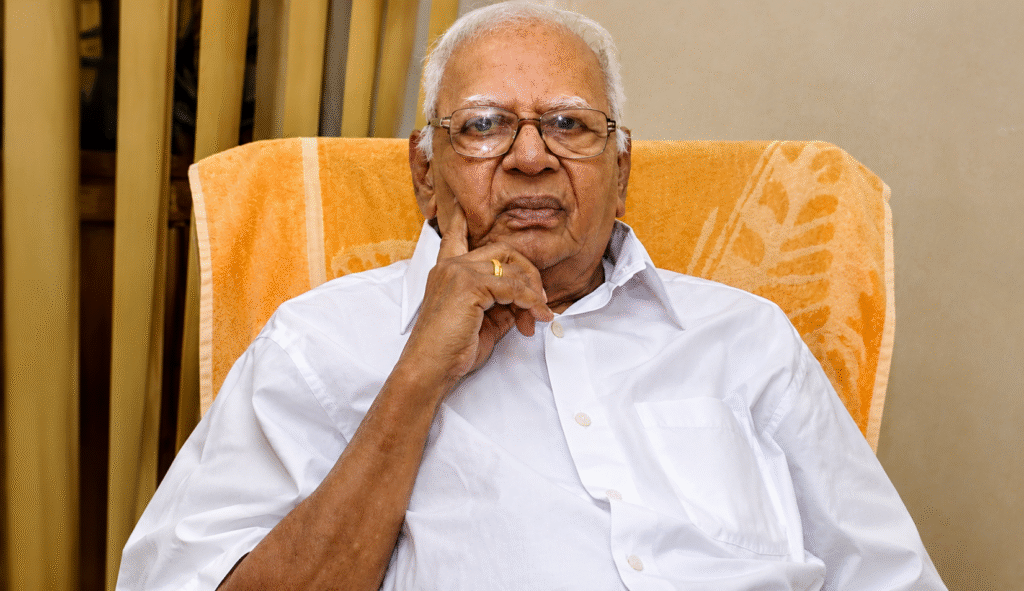
As a practising advocate, Krishna Iyer had spent years navigating complex property disputes and representing major landed interests across Malabar and Cochin. Yet it was precisely this intimate understanding of land relations and social inequalities that enabled him to recognise one of the defining crises of that era. The result was the landmark Keralam Land Reforms framework — among the most consequential socio-economic transformations in modern Indian history.
Justice Krishna Iyer understood a principle that remains deeply relevant even today: governance becomes meaningful when institutions understand the changing anxieties of society and respond with vision, sensitivity, and structural reform.
A Different Structural Challenge for a Different Era
Every generation confronts its own defining structural challenge.
For the leadership of the late 1950s, the crisis lay in inequitable land relations and entrenched feudal structures.
Fast forward 70 years, and Keralam’s realities are vastly different.
Today, the state exists far beyond its geographical borders. Modern Keralam simultaneously lives in Dubai, Doha, London, Toronto, Melbourne, Muscat, and New York through millions of Non-Resident Keralites whose economic, familial, and emotional ties remain deeply connected to their homeland.
Yet our institutional systems continue to function largely through outdated territorial assumptions.
The realities confronting modern Malayali families today are increasingly complex — involving cross-border succession, international wills, overseas matrimonial disputes, transnational inheritance structures, foreign investments, documentation issues, and multi-jurisdictional administrative processes.
Many families often find themselves caught between multiple legal systems, bureaucratic procedures, and jurisdictions without meaningful institutional guidance or support.
A Constitutionally Aware Institutional Moment
With the formation of the new administration in Keralam, the state therefore enters an important institutional phase. During the 1990s, I had the privilege of practising before the High Court of Keralam during the same period as our present Chief Minister, V. D. Satheesan. While our professional journeys eventually moved in different directions, they remained rooted within the same constitutional ecosystem.
Several ministers and legislators across Keralam’s political spectrum possess legal and constitutional exposure at a time when Keralam itself has become deeply transnational in character. The significance of this moment lies not merely in legal qualifications, but in the possibility that governance itself may increasingly engage with institutional accountability, administrative responsiveness, and the evolving realities faced by globally dispersed Malayali families.
The comparison here is not between personalities or political eras, but between the nature of the structural challenges confronting society at different moments in Keralam’s evolution.
Governance Beyond Administrative Templates
Keralam’s future governance challenges cannot be approached solely through conventional administrative or managerial templates. A people’s government must first understand the lived realities of its citizens — including the millions of Keralites dispersed across the Gulf, Europe, North America, and other parts of the world whose lives remain deeply connected to their homeland.
If governance begins from that human understanding and institutional sensitivity, Keralam possesses the potential to evolve into something unprecedented: a truly global civil society rooted in local identity, yet institutionally connected to the world.
Across the world, governments are increasingly adapting themselves to globally mobile populations, transnational families, international investments, and cross-border realities. Keralam cannot afford to remain institutionally static while its people themselves have become globally dispersed.
Beyond Remittances and Symbolic Engagement
Historically, Keralam’s engagement with the Non-Resident Keralite community has often evolved along two parallel tracks. Welfare-oriented approaches largely focused on addressing the immediate vulnerabilities of blue-collar and lower-income expatriate workers, while engagement with affluent NRKs frequently centred around expectations of investment inflows and philanthropic participation.
While both approaches had relevance within their respective contexts, neither fully evolved into a long-term institutional framework capable of meaningfully integrating the broader global Malayali experience into Keralam’s governance and developmental future. Emotional attachment alone does not automatically translate into sustained institutional investment. Despite the immense economic contribution of the diaspora over decades, only a limited segment of overseas Malayali capital has transformed into long-term institutional investment within Keralam itself.
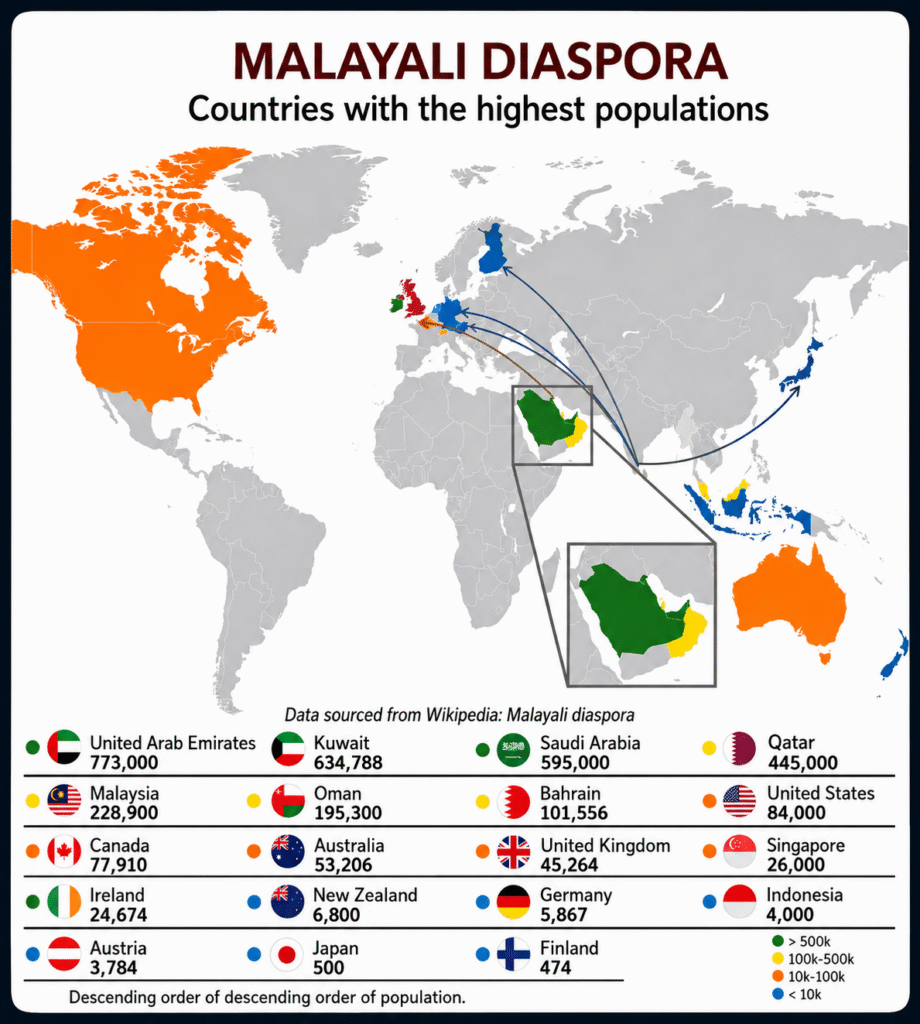
The concerns of the diaspora today extend far beyond remittances or investment discussions. For millions of globally dispersed Malayali families, the real anxieties often involve institutional responsiveness, documentation complexities, succession-related concerns, overseas family disputes, investment security, administrative coordination, and the emotional challenge of remaining connected to one’s homeland while living across multiple jurisdictions.
Importantly, the expatriate question cannot be viewed solely through the lens of Keralites living abroad. Every migration story simultaneously creates another reality within Keralam itself — parents growing old away from their children, spouses managing households alone, children growing up across fragmented jurisdictions, and families navigating complex institutional systems from afar.
In that sense, the expatriate community is not confined to those who left Keralam. It also includes the countless dependants and families who continue to live within Keralam while remaining emotionally, economically, and administratively tied to lives unfolding abroad.
Towards a Global Keralam Policy
The next phase of Keralam’s evolution may therefore require moving beyond fragmented diaspora engagement toward the creation of a comprehensive and forward-looking “Global Keralam Policy” – one capable of recognising Keralam as a truly transnational society whose people, capital, relationships, and economic futures increasingly extend beyond geographical borders.
Such a vision cannot remain confined within traditional political binaries or patronage structures alone. The scale and complexity of the challenges confronting modern Keralam demand the identification and engagement of the right minds – including legislators, Members of Parliament, local self-government representatives, bureaucrats, administrators, technocrats, diaspora professionals, and globally experienced individuals – capable of contributing beyond political allegiances and institutional silos.
The Next Institutional Transition
If the Land Reforms era defined twentieth-century Keralam, the coming decades may well depend upon whether Keralam can successfully evolve governance systems capable of responding to the realities faced by a globally dispersed Malayali society.
The future of Keralam may increasingly depend upon how meaningfully it understands and responds to the concerns of millions of Keralites whose lives today transcend borders while their roots remain firmly connected to their homeland.
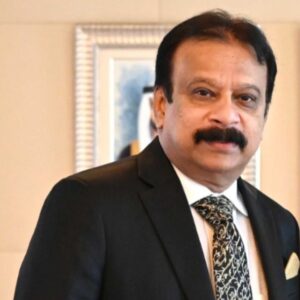







“Can The V.D. Satheesan Government Architect A Global Keralam?” by Musthafa Zafar O.V raises a thought-provoking question about Kerala’s political future, development model, and global aspirations. A timely and insightful piece that encourages serious discussion on governance, diaspora engagement, and the evolving vision of Keralam in a rapidly changing world.
It is indeed an eye opening write up concerning the Keralam spread around the world. Mr Musthafa’s idea of a Global Keralam Policy is very much in need considering the cross-boundary Malayalee population. I hope the Political Keralam take note of this and formulate policies and strategies to bring the Keralam spread over the world to a single entity without borders. Kudos to Mr Musthafa.
Very insightful and thought provoking write up by adv Mustafa Zafeer . The new Keralam sworn In government under the leadership of VD Satheeshan and his team should look into this highly complex issues of the diaspora which has been spreaded all across globe. While looking into the fact that most of them are highly educated and very successful as well as enormously influential in those countries where they are living .
However , using these powerful resources and ensuring a Parellel contribution from them both intellectually and financially in terms of creating a Futuristic Keralam Model is the need of the time , as Adv Mustafa Zafeer rightly pointed out with a probable comparison of such an initiative with the most landmark law which has ever changed the entire prespective of present Keralam called “the land reforms act “.
By allowing such participation, our democracy and the constitutional responsibilities will emerge as one of the most matured amongst the entire world and may be a very significant, unique and rare approach by any government in the history of India.
Kudos to Adv Mustafa Zafeer for igniting such a timely topic on the table .