


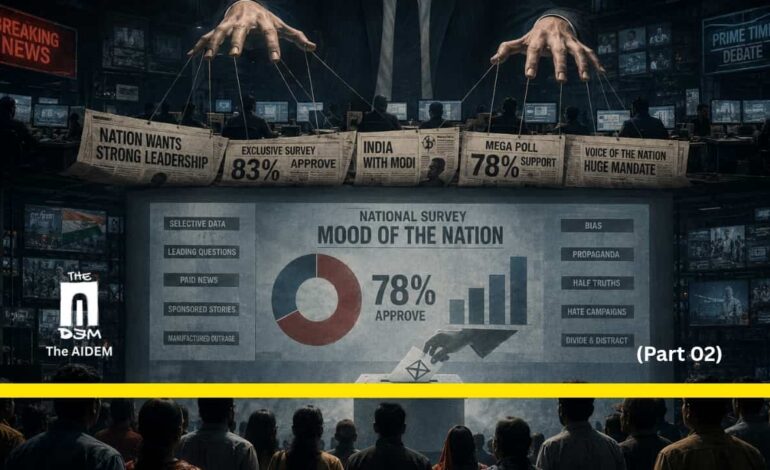
In this two part article Advocate Syed Mohammad Haider Rizvi stresses on the urgent necessity of banning fabricated survey reports and holding the press accountable to the constitutional republic it claims to serve. Read Part One here.
Manufacturing Consent and the Political Economy of Phantom Polls
The phenomenon of the phantom poll cannot be fully understood in purely legal terms. Its deeper pathology is political and epistemological. In their seminal 1988 work, ‘Manufacturing Consent: The Political Economy of the Mass Media’, Noam Chomsky and Edward S. Herman offered a rigorous structural diagnosis of how mass media in liberal democracies does not merely report the world, but actively constructs a version of it that serves the interests of those who own and finance the press.
Their “Propaganda Model” identifies five hierarchical filters through which all news must pass before it reaches the public: ownership, advertising revenue, official sourcing, the disciplining power of flak, and the mobilisation of ideological consensus.
A fabricated survey, released by a large media conglomerate with commercial and political interests, passes through every one of these filters with dangerous ease. It is precisely the kind of output the Propaganda Model predicts: laundered through institutional authority, dressed in the vocabulary of social science, and designed not to inform but to shape.
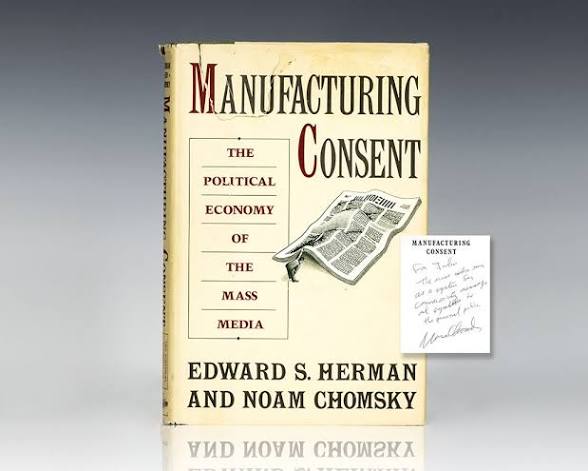
‘Manufacturing Consent: The Political Economy of the Mass Media’ (1988) says:
“The mass media serve as a system for communicating messages and symbols to the general populace. It is their function to amuse, entertain, and inform, and to inculcate individuals with the values, beliefs, and codes of behaviour that will integrate them into the institutional structures of the larger society.”
The authors further observe that the media do not resort to crude falsification alone; far more insidiously, they manufacture consent—the appearance of popular agreement—by presenting as the voice of the public what is, in reality, the voice of power. A phantom poll is precisely this manufacture rendered visible: it substitutes the simulacrum of public opinion for public opinion itself.
Chomsky’s critique acquires particular force in the context of universal adult franchise, which is the cornerstone of the Indian democratic republic. In a democracy, the vote of the most learned jurist and the vote of the most unlettered labourer are, by constitutional design, of precisely equal weight, as Allama Iqbal also laments:
जम्हूरियत इक तर्ज़-ए-हुकूमत है कि जिस में,
बंदों को गिना करते हैं तौला नहीं करते..
This radical equality is not a defect of democracy; it is its highest aspiration. It rests upon a foundational premise: that each citizen, however varied in education or station, is capable of forming a judgment upon the public good when furnished with honest information. The phantom poll strikes at this premise with surgical malice. It does not persuade through argument; it does not inform through evidence. Instead, it manufactures an artificial social reality—a false consensus—which the ordinary voter, lacking the methodological tools to detect the fraud, absorbs as truth.
The intellectual may see through the deception. The average citizen, trusting that a prominent national newspaper would not fabricate the voice of the people, cannot. And it is precisely this asymmetry of epistemic armour that makes the phantom poll so profoundly anti-democratic: it exploits the good faith of the voter whose equality the Constitution most jealously protects.
Chomsky and Herman further draw attention to what they call “the manufacture of marginalisation” – the media’s capacity to render certain politicians or public figures invisible or discredited in the public eye, not by honest criticism but by relentless manufactured negative framing. A fabricated survey declaring a sitting legislator to be unpopular is a textbook instrument of this marginalisation. It does not engage with his legislative record, his policy positions, or his conduct in office. It simply asserts, falsely and without evidence, that “the people” have already judged and condemned him. This is not democratic accountability; it is its precise inversion. It is the capture of democratic language, the language of popular will, of surveys, of voter sentiment, and its deployment in the service of interests that are anything but democratic.
Permitting such practices to continue unchecked is to allow the machinery of democracy to be operated from the outside, by those who have never submitted themselves to an election, in service of agendas that the ballot box would never endorse.
The freedom of the press is among the most luminous achievements of the modern constitutional order. It is the oxygen of democracy, the light by which citizens see their governors clearly. But oxygen, misused, feeds the fires of injustice as readily as it sustains the fires of truth. A press that fabricates surveys, targets individuals, and manufactures political narratives without evidence is not the fourth estate , it is the fifth column.
The remedy lies not in hostility toward journalism, but in the insistence, rooted in the Constitution, fortified by the Supreme Court, and demanded by every citizen who values the democratic process, that journalism mean what it says: the truthful, verified, and responsible reporting of facts. Nothing more. And nothing less.

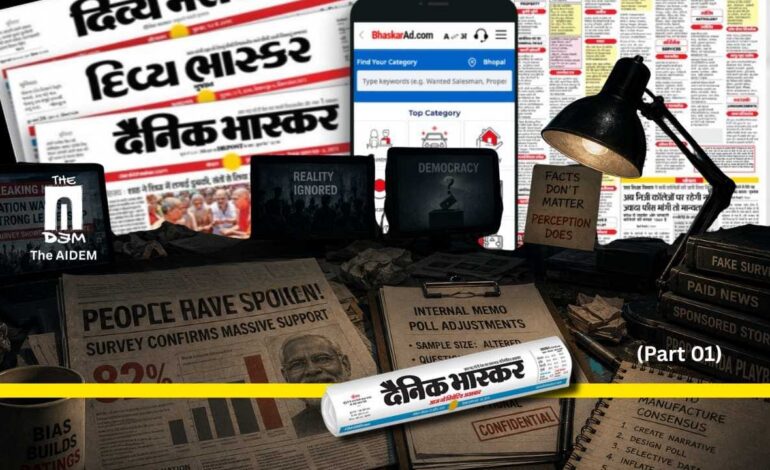






A compelling continuation of Part 1 by Syed Mohammad Haider Ali Rizvi, this second part deepens the critique of “phantom polls” and their role in shaping political narratives through selective journalism. The article thoughtfully exposes how media manipulation, perception management, and biased reporting can weaken democratic values and informed public opinion. Insightful, bold, and highly relevant in the present political environment.