


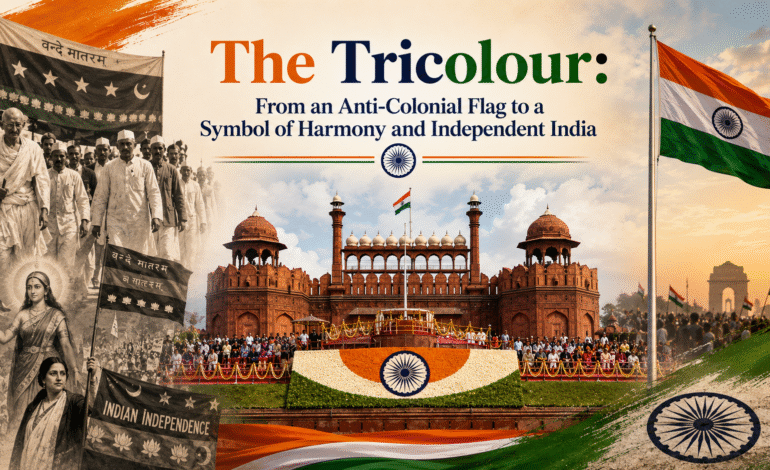
The Indian flag was born not in the quiet of a design studio, but in the heat of the anti-colonial struggle. It began as a visual expression of a people who were still subjects of an empire but were learning to imagine themselves as citizens of a free nation. The early flags of the movement were evolving symbols, carrying the aspirations of a country searching for a common identity amid extraordinary religious, cultural and social diversity.
The flag was argued over, redesigned, contested and finally transformed from a symbol of an anti-colonial movement into an emblem of a democratic Republic. The questions embedded in the Tricolour remain alive: What kind of nation did its makers imagine? What values were they asking future generations to uphold? And what does the flag ask of those who stand beneath it today?
On the occasion of the 80th Independence Day author and researcher Anu Jain recounts the fascinating tale of the Indian flag and underscores the importance of remembering it , repeatedly.
To look at the tricolour today is to see more than just three bands of colour; it is to see the layered “imagination” of a people who had to invent a symbol of unity before they could even claim a country. Every year, as the monsoon clouds part over Delhi on the 15th of August, a singular ritual unfolds. The Prime Minister of India stands before the sandstone bulwarks of the Red Fort, a site once the seat of Mughal power and later the stage for British colonial trials, and hoists the tricolour. On the 26th of January, the President unfurls it at Kartavya Path, marking the moment the country transformed from a dominion into a Republic.
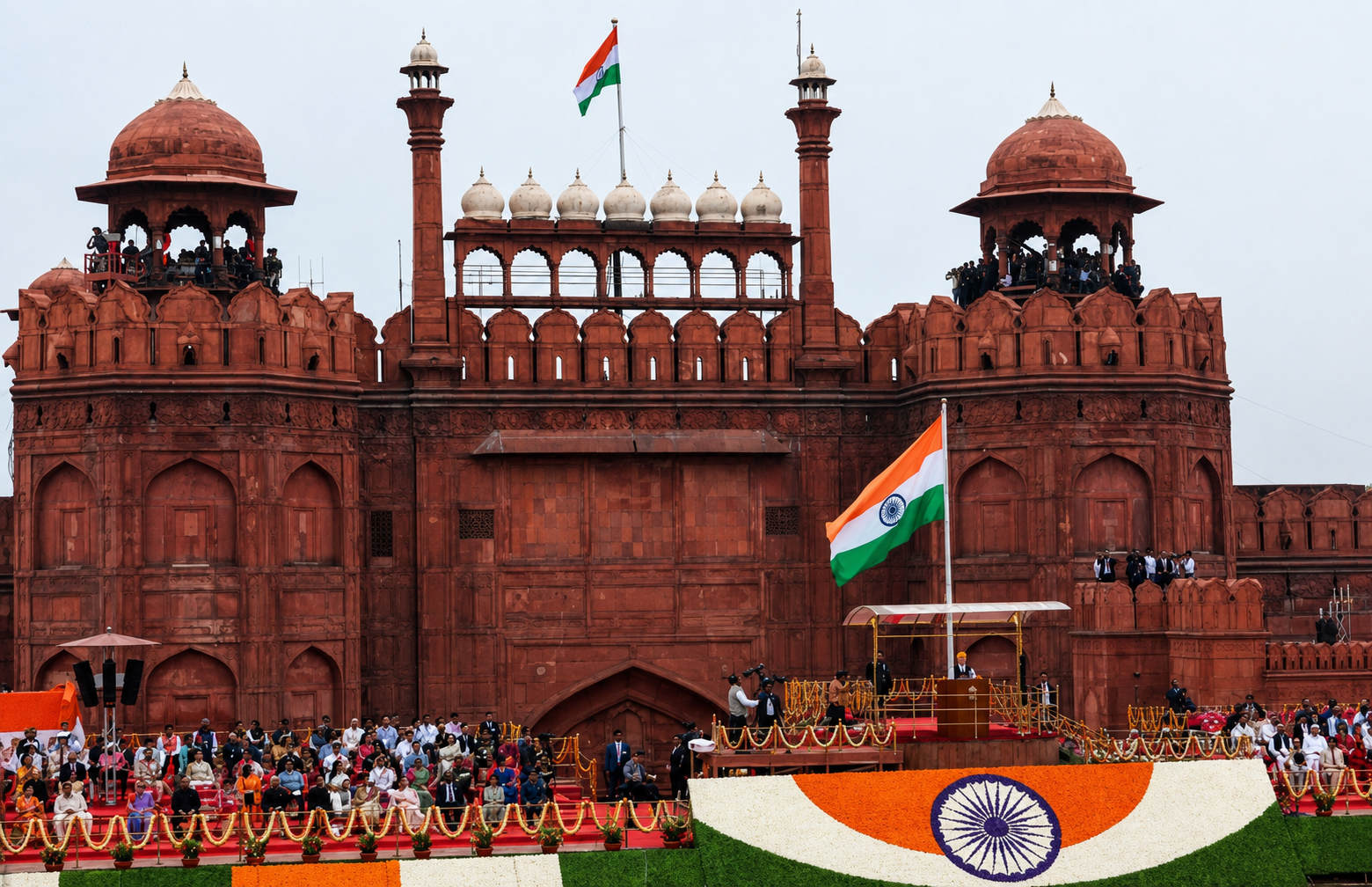
These ceremonies fill the air with ceremony and a quiet, heavy sense of pride. Yet, for most of us, the flag is a “given.” It is a static fact of our geography, as permanent as the Himalayas.
We rarely pause to ask, how did this specific arrangement of saffron, white, and green come to be? What banner did Indians gather under before this one? Why a wheel and not a spinning wheel?
The truth is that flags are rarely born in the sterile silence of design studios. They are forged in the heat of political urgency. They emerge when a people decide they are no longer merely “subjects” of an empire, but “citizens” of a dream. Like the revolutionary tricolour of France or the stars and stripes of the American republic, India’s flag was not inherited from a monarchy; it was argued, debated, and imagined into existence.
Under the British Raj, India was a cartographic reality but not yet a symbolic one. The Union Jack flew over government buildings, symbolizing an imperial authority that stretched from London to Rangoon. For the colonized, there was no sovereign emblem to mirror their own identity.
As anti-colonial consciousness began to stir in the late 19th century, the need for a “visual shout” became undeniable. A nation, as the scholar Benedict Anderson famously argued, is an “imagined community.” To imagine a community of millions who will never meet, you need symbols that act as a psychological glue.
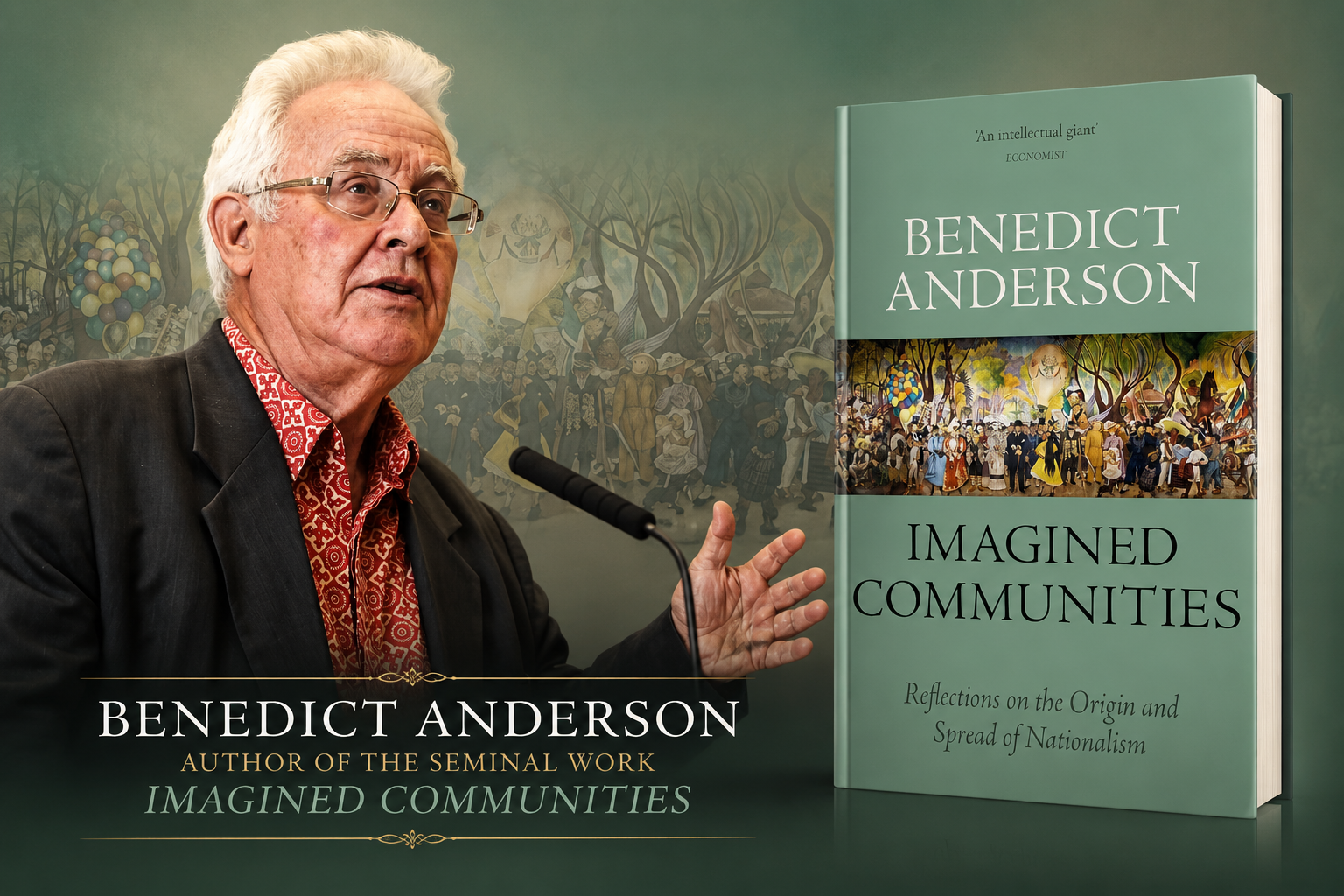
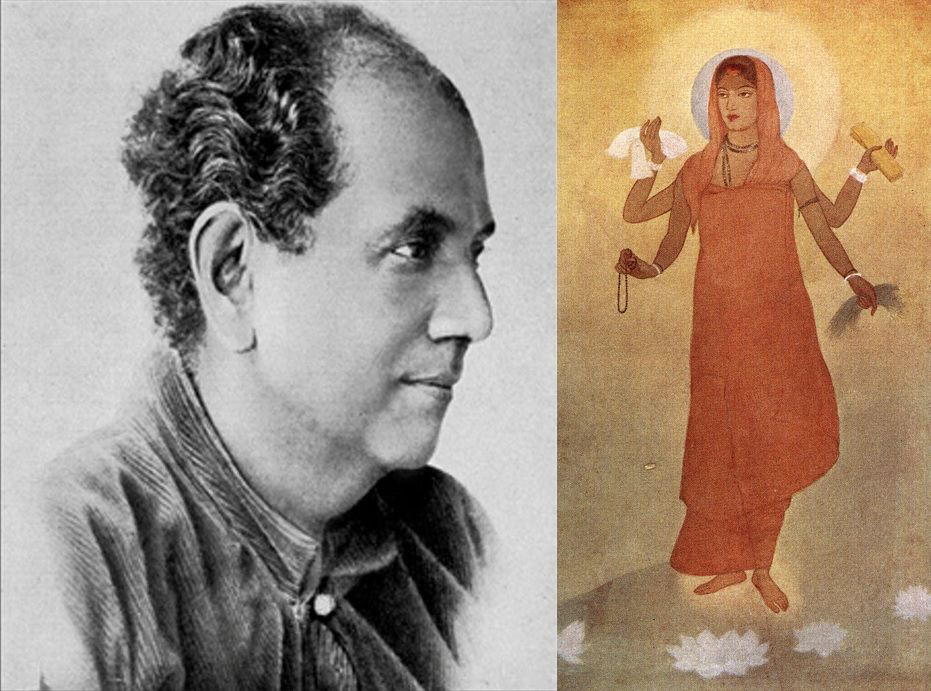
Before the flag, there was the Mother. In 1905, amidst the roar of the Swadeshi movement against the partition of Bengal, Abanindranath Tagore painted Bharat Mata. She was depicted not as a warrior goddess, but as a serene, saffron-clad woman holding four objects – beads, Vedas, a piece of cloth, and a sheaf of paddy. She represented the land, the culture and the sustenance of the people.
Soon, this imagery evolved. In popular street art and nationalist posters, Bharat Mata began to be depicted holding a flag. This was a masterstroke of emotional mobilization. It fused the physical territory of the subcontinent with the concept of motherhood, making the quest for independence not just a political struggle, but a filial duty. The flag became her standard, and to defend it was to defend the mother.
The road to the current Tricolour was littered with prototypes. In 1906, a “Calcutta Flag” was hoisted, featuring three horizontal stripes of green, yellow and red, adorned with eight half-bloomed lotuses. A year later, the indomitable Bhikaji Cama unfurled a similar version at the International Socialist Congress in Stuttgart, Germany. “This is the flag of Indian Independence,” she declared to a stunned international audience. “Behold, it is born!”
But these early flags were fluid. They often leaned heavily on religious symbolism, suns, crescents and lotuses, reflecting a nation still trying to find a visual language that could encompass its staggering diversity.
The true turning point came in 1921. At the All India Congress Committee session in Bezwada, now Vijayawada, a young educator and activist named Pingali Venkayya presented a design to Mahatma Gandhi. Venkayya’s initial proposal was stark, two stripes, red for Hindus and green for Muslims.
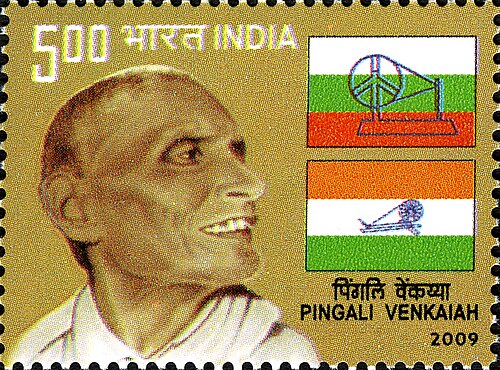
Gandhi, ever the philosopher-politician, saw both the utility and the limitation of this design. He realized that a flag representing only the two largest communities would inherently exclude the “others,” the Sikhs, Christians, Parsis, Jews and the marginalized. In the pages of Young India in 1921, Gandhi proposed adding a white stripe to represent the remaining communities and to symbolize peace and truth. However, his most radical suggestion was the addition of the Charkha or spinning wheel, at the very centre.
For Gandhi, the Charkha was never merely decorative. It was a revolutionary tool of economic defiance. By placing it on the flag, he transformed a political banner into an ethical manifesto. The Charkha represented Swaraj (self-rule) in its most literal sense. It stood for the dignity of labour and the rejection of British-made textiles that had decimated the Indian handloom industry.
Gandhi called the spinning wheel “the sun of the village solar system,” the central force around which rural Indian life revolved. “It will be necessary for us Indians, Hindus, Muslims, Christians, Jews, Parsis and all others to whom India is their home, to recognize a common flag to live and to die for,” Gandhi wrote.
By 1931, the Indian National Congress formally adopted a tricolour of saffron, white and green with the Charkha in the centre. Saffron stood for courage, white for truth and green for faith. But as the 1940s dawned and the prospect of a sovereign Republic became a reality, a final, structural evolution was required.
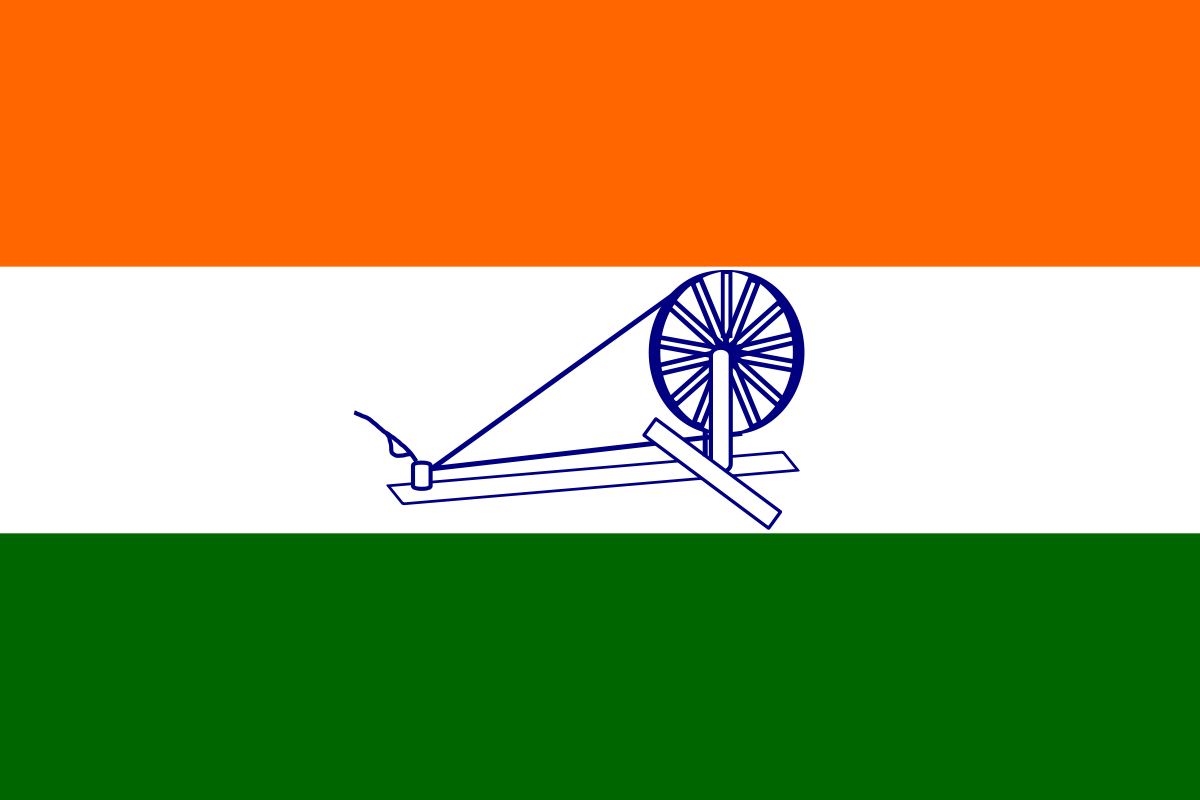
As Independence approached, a committee headed by Dr. Rajendra Prasad was tasked with finalizing the flag. There was a subtle but significant problem, the Charkha, while emotionally potent, was a party symbol of the Congress. For a Republic that belonged to all, including those who did not subscribe to Congress’s politics, the flag needed to transcend partisan identity.
Furthermore, there were practical, aesthetic concerns. The Charkha, with its delicate spindle and thread, was asymmetrical. When printed on fabric, the design would appear inverted on the reverse side. For a national flag that would fly at the UN and on high-seas vessels, visual consistency was paramount.
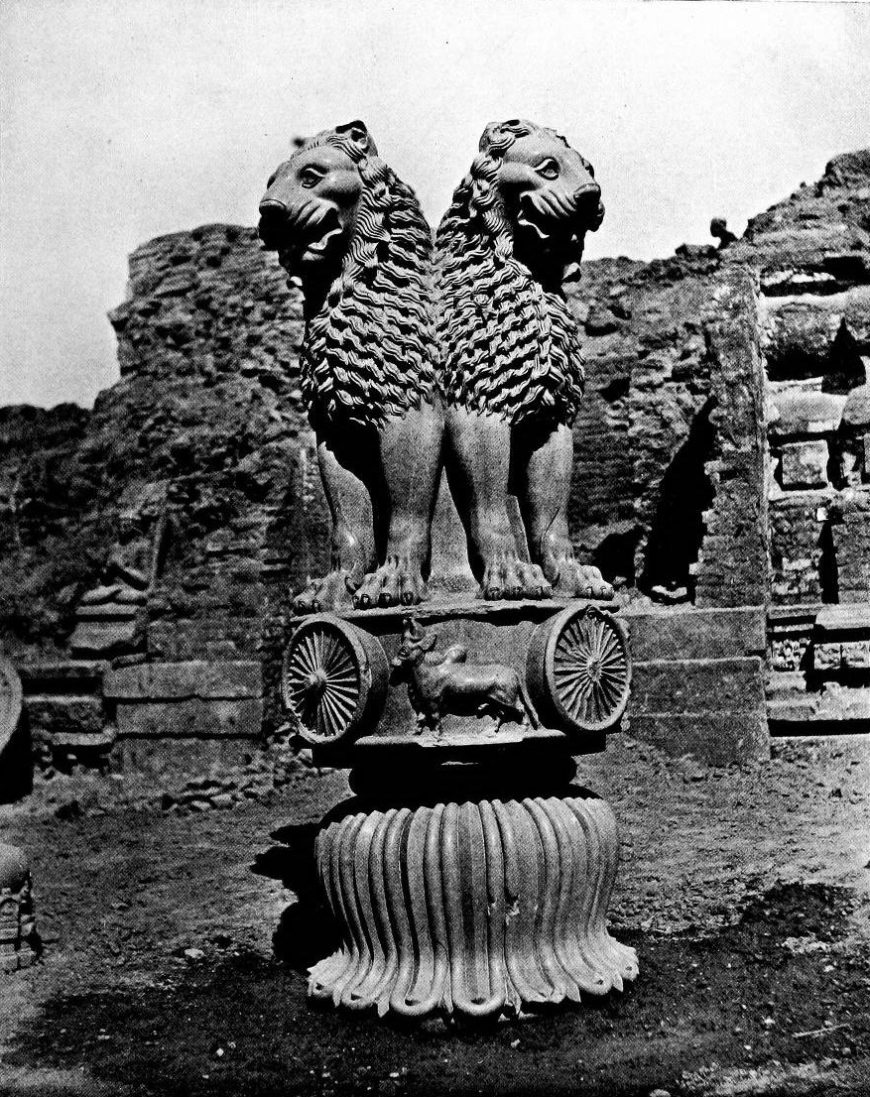
On July 22, 1947, Jawaharlal Nehru rose in the Constituent Assembly to move the resolution for the National Flag. He proposed replacing the spinning wheel with the Ashoka Chakra—the “Wheel of the Law” from the Sarnath Lion Capital of Emperor Ashoka.
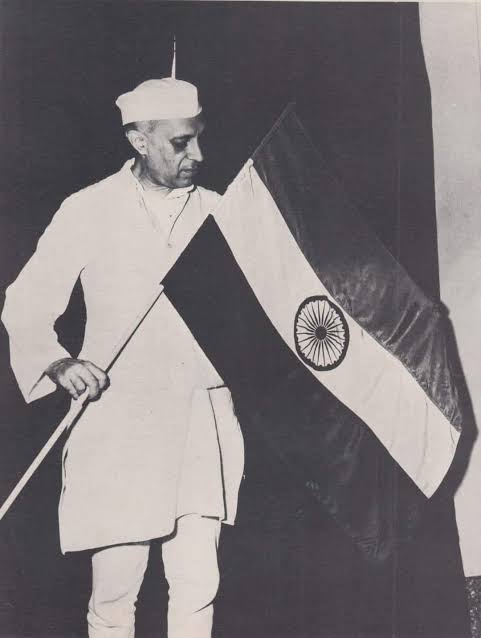
The choice was a stroke of genius. Ashoka represented an era of Indian history characterized by ethical governance, religious pluralism and international outreach. By adopting the Chakra, the modern Republic was anchoring its identity in a civilizational past that predated colonial strife.
The Ashoka Chakra carried a philosophical depth that extended beyond aesthetic balance. Derived from the Dharmachakra at Sarnath, it symbolized the eternal motion of law, justice, and moral order (dharma). Its 24 spokes have been interpreted as representing virtues such as courage, patience, righteousness, and peaceful conduct, as well as the continuity of time through the 24 hours of the day. Unlike the Charkha, which was rooted in a specific political movement, the Chakra conveyed universality—standing for peace, equality, and the constant progression of a society governed by ethical principles rather than force. In this sense, it linked the modern Republic not only to Ashoka’s legacy of non-violence but also to a broader civilizational commitment to reason and moral governance (Archaeological Survey of India; Nehru, 1947).
This transition, however, was not without resistance. Gandhi was initially strongly opposed to the removal of the charkha from the national flag when it was replaced by the Ashoka Chakra in July 1947. His reaction was marked by deep disappointment, and he publicly declared that he would not salute the new flag if the charkha was removed. In a statement made in Lahore on August 6, 1947, he said, “I must say that, if the Flag of the Indian Union will not embody the emblem of the Charkha, I will refuse to salute that flag.”
For Gandhi, the charkha represented economic self-reliance, the dignity of the common man, and the essence of non-violent resistance against British rule. He believed that abandoning it was akin to “remembering God in sorrow and forgetting Him when He showers happiness.” When the Constituent Assembly adopted the tricolour with the Ashoka Chakra on July 22, 1947, Gandhi remained deeply unhappy. Yet, over time, he is believed to have reconciled with the change, recognising that the Ashoka Chakra symbolised universal law and unity rather than a party-specific ideology.
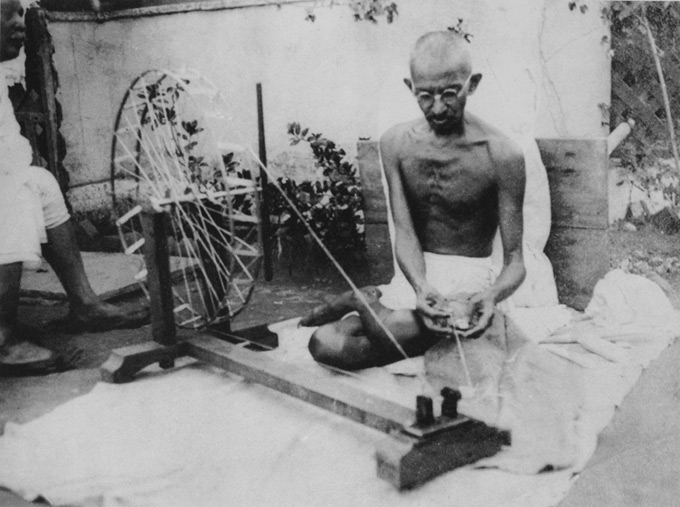
Ultimately, the flag adopted for independent India retained its tricolour form, with the Ashoka Chakra at its centre, while the spirit of khadi—so dear to Gandhi—continued to define its fabric.
Nehru argued that while the “spirit” of the Charkha remained, the idea of movement and progress, the Chakra provided a “symmetry” that the spinning wheel lacked. The 24 spokes of the wheel represented the 24 hours of the day, a reminder that “there is life in movement and death in stagnation.”
The flag we see today is governed by the Flag Code of India, a document that treats the tricolour not just as cloth, but as a sacred object. The colours were re-interpreted by the philosopher-statesman Dr. S. Radhakrishnan during the Constituent Assembly debates to move away from communal associations entirely. “Saffron denotes renunciation and disinterestedness. Our leaders must be indifferent to material gains and dedicate themselves to their work. White is the path of light to guide our conduct, the symbol of truth. Green is our relation to the soil, the plant life on which all other life depends.”
The proportions of the Indian national flag have remained remarkably consistent since independence. The ratio of width to length was fixed at 2:3, ensuring visual balance and uniformity across all official uses (Government of India, 2002). The Ashoka Chakra, placed centrally within the white band, was specified to have a diameter approximately equal to the width of the white stripe, maintaining symmetry across the tricolour.
This standardization was essential not only for aesthetic clarity but also for international recognition, ensuring that the flag appeared identical whether flown on government buildings, naval vessels, or global platforms. While the material of the flag has evolved—from mandatory hand-spun khadi to the inclusion of machine-made fabrics in recent amendments—the proportions and structural design have remained unchanged, preserving continuity with the moment of independence.
The Ashoka Chakra is the wheel of the Law of Dharma. Truth or Dharma ought to be the controlling principle of those who work under this flag, he added. For decades, the flag was essentially a “State” symbol, restricted for use by government buildings and officials. However, a landmark legal battle resulted in a 2004 Supreme Court ruling that flying the national flag with dignity is a fundamental right of every citizen.
More recently, the 2022 amendments to the Flag Code allowed for machine-made and polyester flags, and permitted the flag to be flown day and night in private homes. While some purists mourned the shift away from the mandatory hand-spun Khadi, the move reflected a new era, a desire to move the flag from the pedestal of the State into the hands of the people.
If one looks closely at the tricolour, it reveals far more than dyed fabric. It carries the layered history of a subcontinent’s awakening—the early revolutionaries in Stuttgart who dared to imagine a nation before it existed, the Gandhian vision of a self-reliant village economy, and the Nehruvian aspiration for a modern Republic anchored in law and ethical governance.
The saffron evokes not only sacrifice and courage, but also the spirit of renunciation that demands leaders place the nation above personal gain. The white reflects truth and moral clarity, acting as a constant reminder that political freedom must remain guided by ethical restraint. The green signifies the land’s fertility and enduring vitality, grounding the abstract idea of nationhood in the material realities of agrarian life and ecological dependence.
At its centre, the Ashoka Chakra introduces motion into this field of colour—a visual insistence that the nation is not static, but continuously in the making. It represents the primacy of dharma, or righteous conduct, suggesting that the legitimacy of the state rests not merely on sovereignty, but on justice. In this sense, the flag becomes a bridge between past and present: it draws upon an ancient civilizational vocabulary while articulating the aspirations of a modern democratic order.
What emerges, then, is not merely a national emblem, but a condensed narrative of struggle, imagination, and political transformation—a fabric in which competing visions of India were not erased, but carefully woven together into a single, enduring symbol.
Nations require symbols to stir collective emotion because patriotism is rarely born in abstraction. It is stirred by shared rituals, the silence during the anthem, the snap of the cloth as it catches the wind. The Indian tricolour is the ultimate “imagined community” made tangible. It reminds us that we were not born a nation; we became one through argument, sacrifice, and a shared visual language.
The next time you watch it rise against the blue sky of August, remember that you aren’t just looking at a flag. You are looking at the long, fluttering story of a people who first imagined themselves into a nation, and then gave that imagination a home. In that fluttering cloth lies the long, restless story of a people who refused to be subjects and chose, instead, to be a nation. It is history, hope, and hard-won dignity, all stitched together in a 2:3 ratio.




A powerful reminder that the Tricolour is not merely a piece of cloth—it carries the history of India’s freedom struggle, diversity, sacrifice and democratic aspirations. Anu Jain beautifully reminds us that the Ashoka Chakra represents movement, justice and ethical governance. Respecting the Tricolour truly means upholding the constitutional values, unity and pluralism that it represents. 🇮🇳