


The Chinese legacy in Kolkata extends far beyond the famous Kolkata-Chinese cuisine. It is stitched into the city’s daily rhythm found in mishti doi, hand-pulled rickshaws, and green chili sauce, which have become inseparable from Bengali cultural identity. This proves that culture is never a closed loop. Despite systemic efforts to draw borders and define ‘us’ versus ‘them,’ no identity truly flourishes in isolation. Yet the cultural legacy does not guarantee security. Despite their profound influence on the city’s identity, the community remains caught in a precarious struggle against urban encroachment and displacement. For them, the Lunar New Year is not just a celebration, but a vital act of resilience in an uncertain landscape. We owe our palate to them; shouldn’t we know their faces?
Tale of Migration, Craft, and the Struggle for Belonging
Chinese settlers established themselves in Achipur, a town about 33 kilometers from Calcutta, around 1778. The town’s name comes from a Chinese immigrant, Yang Daijiang, better known as Tong Atchew, who came from Guangdong province seeking fortune. Impressed by Atchew’s gift containing a shipload of Chinese tea, Governor General Warren Hastings granted him 650 bighas of land in the south of Calcutta, with a yearly rent of ₹45, to start a sugar mill and a plantation. Atchew called 110 Chinese workers to Calcutta to work for him. Calcutta also became an early “Land of Opportunity” for Chinese migrants, whose arrival in the city occurred mainly in three main waves between the nineteenth and the twentieth centuries. Chinese migration from Shanghai, Canton, and Hubei province of China resulted in early Chinese settlement in central Calcutta, around the Bowbazar area, where a ‘Chinatown’ emerged as early as the nineteenth century—the oldest being Tiretta Bazaar.
Calcutta’s Chinese community was associated with a trade-based diaspora where a particular occupation was associated with specific immigrants’ identity. For example, the Cantonese Chinese group were mainly employed in carpentry, the population from Hubei province became skilled in dentistry, and the tannery business and shoe making were taken up by the Hakka Chinese community. The rigid hierarchies of the Indian caste system, which stigmatized leatherwork as ‘impure,’ inadvertently carved out a unique economic niche. Unfettered by local religious taboos, the enterprising Hakka Chinese moved into the shoemaking trade, transforming a marginalized craft into a thriving communal industry. Hakka shoemakers opened their retail shops near the Bentinck Street area, which expanded with such rapidity that the number of Hakka-owned shoe stores on Bentinck Street soon crossed the hundredth threshold and initiated competition among the other shoemakers of the region. As the business flourished, the Hakkas started relocating to a new area with their families, and a community of Hakkas had emerged in Dhapa (Tangra), which became known as the city’s second “Chinatown.”
Post-independence, Bowbazar’s Chinatown faced a series of structural and political upheavals that fundamentally altered its landscape. In the 1950s, the Kolkata Metropolitan Development Authority (formerly the Kolkata Improvement Trust) introduced a modernization project that carved a massive thoroughfare through the heart of Tiretta Bazaar. This infrastructure project physically severed the community, fragmenting historic corridors like Chattawala Gully, Phears Lane, and Blackburn Lane. Vibrant communal spaces were ultimately supplanted by commercial hubs like Poddar Court and the Telephone Exchange, leaving traditional landmarks like the Siyi and Toong-On Churches dwarfed by modern high-rises
Following India’s independence, new dental regulations required clinics to obtain certification from recognized dental hospitals or health authorities posed a significant challenge for Chinese dentists, since most lacked formal training or qualified facilities and thus did not meet the required standards. The community’s stability was further shaken by the 1962 Sino-Indian War. During this period, ethnic Chinese residents—many of whom had called Kolkata home for generations—faced mass arrests and internment at a camp in Deoli, Rajasthan. Detentions were often based solely on physical appearance, surnames, or marital ties. Later, the neighborhood’s economic backbone suffered a final blow in 1996, when a Supreme Court mandate forced the closure of Tangra’s Hakka tanneries, requiring their relocation to Bantala for environmental reasons. Today, with continuing erosion of the Chinese population, only a few Chinese carpentries survive in Calcutta.
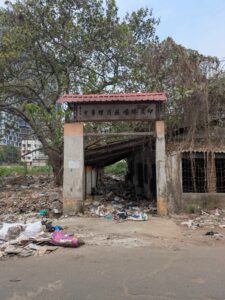
The Overseas Chinese Commerce of India, or the Seong Pow, was a four-page Mandarin newspaper that published its last newspaper in March 2020 and was shut down after the paper’s editor, Kuo Tsai Chang, died in July 2020. It cannot be revived again due to the shortage of Mandarin speakers in Calcutta, and, presently, its building lies as a garbage dumping ground and in ruins in Tangra. Presently, Pei Mei School and both branches of Ling Liang School, one in Tangra and the other in Tiretta Bazaar, are the only functional Chinese schools in Calcutta. Sadly, these schools no longer teach Mandarin; rather, these schools have adapted to the present-day secondary and senior secondary curriculum and are the last remains of Chinese educational institutions in Calcutta.
The Celebration: Lunar New Year 2026
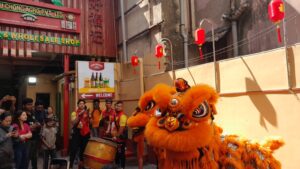
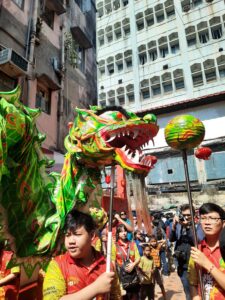
The Lunar New Year transforms the historic neighborhoods of Tiretta Bazaar and Tangra. As the only city in India with a dedicated Chinatown, Kolkata celebrates with the traditional rhythmic drumbeats of the lion and dragon dances that echo through narrow, red-lantern-lined lanes. The festivities typically begin with midnight prayers at Chinese temples and the famous Chinese Kali Temple, where noodles are offered as prasad. The streets come alive with firecrackers believed to ward off ancient spirits.
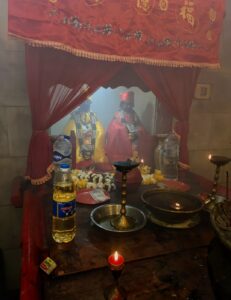
The celebration extends beyond the domestic sphere, as the community gathers for large-scale carnivals at venues like the Pei Mei School, featuring martial arts displays and food stalls piled high with handmade siu mai and dumplings. There is also a tradition of annual pilgrimage to Achipur, where the community pays homage to the grave of Tong Atchew and worship Bogong and Bopo, the Earth God and Goddess. In 2026, as the city ushers in the Year of the Fire Horse, the celebrations continue to serve as a vital pulse for a dwindling but resilient community. As the lunar calendar turns and the air fills with the scent of incense and the crackle of firecrackers, the Shining Star Lion Dance group emerges as the heartbeat of the Chinese New Year celebrations. The connection between the dancers and the spectators is sealed through the tradition of the Hongbao—a traditional gift of money tucked into a red paper envelope, symbolizing good luck, prosperity, and protection from evil spirits. During the celebratory parades, business owners and families hang red envelopes alongside heads of lettuce high above their doorways, a ritual known as Cai Qing, or “Plucking the Green.” The lion maneuvers with acrobatic grace to “consume” the lettuce and the red envelope, and by “feeding” the lion, the community offers gratitude and support to the next generation, while the lion, in turn, scatters the shredded greens back onto the crowd, symbolically showering the neighborhood with wealth, health, and vitality for the year ahead.
Conclusion: A Call to Witness
The story of the Chinese community in Kolkata is less of a “window” and more of a layered record, a canvas where layers of history, trauma, and adaptation are visible all at once. Shifting the identity from “Chinese in India” to “Chinese-Indian” is to move from being a guest to being part of a contributor to the already vast and rich history of India. The first step to ensure the continuity of the said traditions and their preservation is awareness. While recent cultural and historical walks have been instrumental in preserving the heritage and traditions, they are only a temporary shield. Without formal government recognition and heritage status, we are left merely hoping that these traditions can withstand the relentless ravages of time.








This story brings out the forgotten history and everyday struggles of Kolkata’s Chinese community with empathy and depth. Their cultural roots along the Hooghly are part of the city’s living heritage, yet neglect and politics have pushed them to the margins. Remembering these voices is essential to preserving Kolkata’s plural identity.