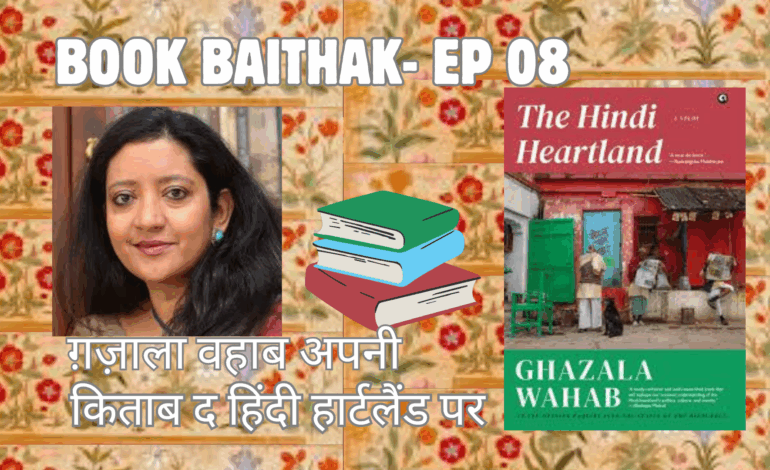
Book Baithak with Ghazala Wahab

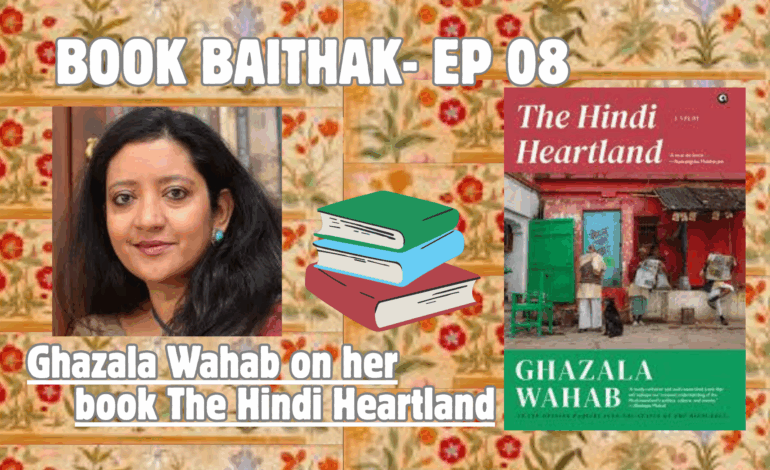
Gaurav Tiwari: Welcome to the eighth episode of the Book Baithak series. Today, in this episode, we will discuss a new book The Hindi Heartland. The author of this book is Ghazala Wahab, and we will be talking to her about it.
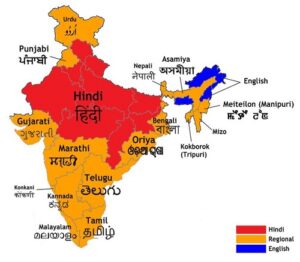
To begin with, we would like to know—what exactly is the ‘Hindi Heartland’? How have you mapped it within India’s geographical structure? Which places are considered part of the Hindi Heartland, and why are some excluded? And conversely, why are certain regions included?
Ghazala Wahab: In popular perception, the ‘Hindi Heartland’ is often referred to as the ‘Cow Belt’—usually in a negative or mocking sense. But in reality, it is a geographical region, shaped by a specific geographical feature, namely the Indo-Gangetic Valley.
Geographically, this region stretches from Rajasthan in the west to the Rajmahal Hills in Jharkhand in the east. Although Haryana and Himachal Pradesh are also Hindi-speaking states, they are not included in this definition because they are considered part of the Indus Valley region. That is why I excluded them from the Hindi Heartland.
As I worked on this, I gradually realized that this region exists as a unit precisely because of geography. Several factors contributed to its formation, with geography playing a central role. To the north lie the Himalayas, to the south the Deccan Plateau, to the west the Thar Desert of Rajasthan, and to the east the Rajmahal Hills and dense forests. These natural boundaries defined the region. Within them, there were no major impediments, which made human movement historically easy.
The land here is flat, the climate relatively moderate—yes, it gets hot, but there are no extreme natural disasters like earthquakes or cyclones. This allowed large tracts of land to be cultivated, and prosperity developed organically. When external invaders arrived, their expansion began here first. From Punjab to Bihar and Jharkhand, they found an open plain where they could expand their empires and create a unified economy.
As a result, linguistic similarities also began to emerge. Although there were distinct dialects like Bhojpuri, Awadhi, Braj, and Magahi, continuous movement and the presence of central authority—whether the Sultanate or later the Mughal Empire—brought vocabulary closer together. Grammar differed, but words overlapped. This helped bind the region culturally and linguistically.
That is why, despite such diversity, the Hindi Belt remained a connected region. Even after independence, it continued to be treated as a single unit, though in reality it is not entirely homogeneous. Later, when the term ‘BIMARU states’ was coined, this same region was included under it.
Gaurav Tiwari: What is this book about? Is it a book of history, sociology, economics, or an anthropological study? If so, which period does it cover? What is its time span?
Ghazala Wahab: In fact, this book does not fit neatly into any single genre. From my perspective, it is a tribute to this region, because I myself belong to it.
Look at how many streams of thought and traditions have emerged from here—whether connected to Hinduism, such as the Ramayana or the Gita, which were composed here, especially in Banaras. Several currents within Islam also originated here—Dar-ul-Uloom Deoband gave rise to the Deobandi school of thought, while the Barelvi tradition, the Tablighi Jamaat, and Jamaat-e-Islami also emerged from this region. Jamaat-e-Islami even became an international organization, introducing the idea of political Islam.
Buddhism too arose from this region; its philosophy and ideas were developed here. All this is evidence that the region enjoyed long periods of peace. People conversed, learned from one another, and engaged in dialogue. As a result, there was immense prosperity and economic well-being. The grand palaces, forts, and monuments like the Taj Mahal were possible because of this wealth. The infrastructure and roads also show that this region was part of international trade routes—whether the Silk Road or maritime trade.
At one time, India contributed significantly to global trade, and the Hindi region was its center. Trade from here flowed to the port of Surat. This demonstrates that the region was never ‘BIMARU’ (backward), but rather prosperous and peaceful. Despite diversity, people lived together in harmony.
So, to answer your question: this book does not belong to any single category. It is an attempt to understand how, despite such a rich history, we have arrived at our present situation—where we are lagging behind, entangled in conflicts, and intolerance has grown so much.
That is why the book includes history—beginning with the establishment of the Delhi Sultanate, which was the most disruptive moment for this region. Before that, there were no large kingdoms here, only small political units. I have covered history from around 1100 CE through the British period up to 1947.
But it is not just a history book. It also contains commentary on society, discussions of social debates, and two chapters on the economy—how it developed and what its pillars were. In this way, the book cannot be confined to any single category.
Gaurav Tiwari: As you mentioned, the historical coverage of the book is very extensive. It begins around 1100 CE, when people from Afghanistan came here for invasions or wars. After that, the book covers the historical journey up to 2020—nearly a thousand years in scope.
There is a very interesting perspective in it. Usually, it is believed that the governance model in India was introduced entirely by the British, and that nothing of the sort existed before them. But the book challenges this notion. It shows that the processes of governance, the development of industries, and systems of tax collection had already begun much earlier.
So my question is: over these thousand years, what kinds of industries developed in the Hindi region? Which industries emerged in different periods, and how did they evolve alongside governance structures?
Ghazala Wahab: See, industries did not spread uniformly across the Hindi belt—there were not industries everywhere. And this is important to understand in today’s context. For example, in different cities of Uttar Pradesh, craft-based industries developed, and entire ecosystems grew around them. Banaras became a center of weaving—not just weaving, but also textile dyeing, embellishment, and then its market. All of this together created a complete system in the city. In Firozabad, glasswork developed, and its ecosystem grew there.
Leather is an interesting case: shoes were manufactured in Agra, with large factories there, but leather tanning took place in Kanpur, because the water of the Ganga was considered better for tanning than that of the Yamuna. So across UP, flexible and small-scale manufacturing spread widely—and this was not a modern phenomenon, it had already begun before the arrival of the Mughals.
In Rajasthan—especially Jaipur—semi-precious and utilitarian stone mining had been going on for many years. The economy there was based on mining: marble, granite, limestone, and so on. In Bihar, agriculture was the main economic base. In Madhya Pradesh, handicrafts and weaving centers—like Maheshwar and Indore—existed alongside activities based on natural and forest resources. Altogether, the foundations of economic growth in this belt developed organically in different regions.
As for governance, the organized influence of central authority—the Delhi Sultanate—became clear during Balban’s era. Balban’s political self-identity was as an ‘Indian ruler,’ because his prestige and authority arose from here. During his time, industries became more systematically developed, since he had to establish the legitimacy of his power through local resources and revenue. Large tracts of forest land were converted into cultivable land, which expanded production and the local economy.
Illustration of Balban of the Delhi Sultanate
Once central authority stabilized, law and order improved, and trade routes became secure, since a major portion of revenue came from trade. Connections to the Silk Road were safeguarded; caravans could reach ports like Surat without being plundered. At that time, Portuguese dominated maritime trade, the French were active in the south, and foreign traders conducted business as equal partners with Mughal permission.
Through this process, industry-based economies and revenue models were strengthened—taxes were paid to the government, currency circulation was organized, and multi-tiered currencies (such as daam and paisa) were in use. Therefore, it is incorrect to say that modern governance or administrative systems were learned only from the British. These systems already existed—indeed, that is why the British first came here to trade, and only later moved toward empire-building. To deny this is, in fact, to turn away from our own history.
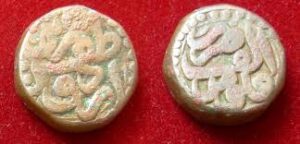
Illustration of Daam currency
Gaurav Tiwari: In the book, you also mentioned that during the Mughal period, a service-class industry developed across this region.
Ghazala Wahab: When large empires are established, they naturally require administrative systems to run them. And this need is not limited to the capital—it extends to districts, provinces, and every level of governance. Record keepers, revenue collectors—such positions became increasingly necessary. This was the time when the concept of government employment began to take shape.
With government jobs came the rise of a new middle class. Society was no longer confined to kings, landlords, or high-ranking military officers. Generals often received land grants and became minor rulers themselves, but alongside them, a working-class population also emerged.
This class was not limited to those directly employed by the state; it also included those dependent on it. For example, artisans who not only wove cloth but also embroidered it, carved designs, and crafted jewelry. Such ancillary industries gradually developed, supported by royal patronage.
Similarly, musicians, artists, painters, writers, and scribes emerged in distinct categories. All of these became part of a new form of employment.
As a result of this process, the economy came to be clearly divided into three tiers—the primary sector, the secondary sector, and the ancillary sector. In other words, by the Mughal period, all three sectors already existed and had become part of an organized economic framework.
Gaurav Tiwari: During the period of the Delhi Sultanate—around 1100–1200 CE—the Sufi tradition was also developing in India. The book contains a very interesting section which explains that there was a kind of competition between the Sultanate and the Sufi saints. They were contesting for a shared social and cultural space. So my question is: what was this shared space, and in this competition, who eventually prevailed?
Ghazala Wahab: In the end, it is always the one with power who prevails—that is natural. But it is also true that the Sufis had immense appeal among the common people. For this reason, even the ruling class had to give importance to the Sufis, so that their orders could reach the masses more effectively. This created a kind of rivalry between the Sultanate and the Sufis.
This rivalry was particularly visible in the Chishtiya order. For example, Khwaja Moinuddin Chishti of Ajmer or Hazrat Nizamuddin Chishti of Delhi—these Sufis did not give importance to political power. Their presence itself became an alternative center of authority, whether they intended it or not.
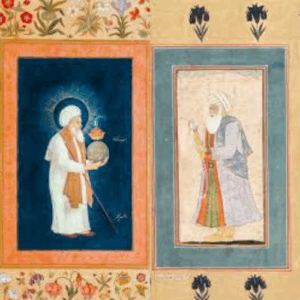
I have written in the book about an interesting incident involving Alauddin Khilji. When he was the governor of Allahabad, a Sufi predicted that he would one day become the ruler of Hindustan. Later, when his uncle died—amid accusations that Alauddin had him killed—this was never proven. At that time, a Sufi gave him a ‘clean chit,’ declaring that he was not guilty. People accepted the Sufi’s word, and Alauddin’s reputation was saved. This shows that the Sufis too drew their power from political centers.
They also believed that if they remained in the ‘good books’ of the Sultan or the Emperor, their own authority would increase. However, the Chishtiya order was unique in this regard. They very strictly maintained that they would not even meet with rulers. Hazrat Nizamuddin is believed to have said that if a Sultan entered through one door, he would leave through another.
Gaurav Tiwari: Gradually, after the arrival of the British—especially in the 19th and 20th centuries—religious identity became the primary identity of people, at least in Uttar Pradesh and Bihar.
Earlier, people were categorized on the basis of their work, trade, or livelihood. But during this period, everything began to be seen only in terms of ‘Hindu’ or ‘Muslim.’ Conversations too became centered on this—either about Hindus or about Muslims.
Farmers were now referred to as ‘Hindu farmers’ or ‘Muslim farmers,’ not simply as farmers. Similarly, the identity of the service class and other groups also began to be defined on religious grounds.
So my question is: how did this change occur in history? Was it present from the beginning, or was there a particular period after which religious identity became so strong that it turned into the primary identity, bringing us to where we are today?”
Ghazala Wahab: See, for this I would hold the British responsible. And it is not correct to say that this was limited only to Uttar Pradesh and Bihar—religious consciousness was equally strong in Rajasthan and Madhya Pradesh as well. The difference was only in how it manifested.
First, let me address the initial part of your question. After the revolt of 1857, the British decided that their main target would be Muslims, because the rebellion was fought in the name of Bahadur Shah Zafar. He was dragged into a trial for treason—which was absurd in itself, because how can a king be accused of treason? With this decision, Muslims were marked as the primary enemy, and from here the process of division began.
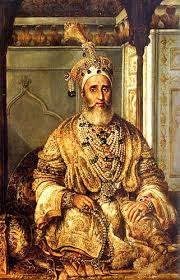
Bahadur Shah Zafar
However, it is important to note that the majority of rebels in 1857 were Hindus—about 60 to 70 percent. Among the sepoys of the Awadh region, a large number were Brahmins. Yet the British deliberately created this division. The big moneylenders of Delhi, who lent to both the Mughals and the British, also chose to side with the stronger power, hoping to regain their lost prestige.
Even before this, division had begun on the basis of language. At Fort William College, when the British prepared primers to teach their officers the local language and culture, Muslim scholars wrote using Persian and Arabic sources, while Hindu pandits drew material from religious texts like the Ramayana and Mahabharata. As a result, two different forms of the same ‘Hindustani’ language emerged—one with more Persian-Arabic vocabulary, the other with more Sanskrit words. The British interpreted this as a religiously based linguistic division and institutionalized it.
With the advent of the printing press, the need for standardization further strengthened this division. Diversity was no longer acceptable; uniformity was required. As a result, religious identities began to harden. Earlier, people could go to a Sufi shrine and also celebrate Holi, but now they were forced to choose only one identity.
After 1857, Darul-Uloom Deoband was established, with the agenda of clarifying Muslim identity. Special focus was placed on women—guidelines were issued about clothing, appearance, and conduct so that they would not resemble Hindus. For example, women were forbidden to wear bindis, and religious fear was invoked. None of this was in the Qur’an; it was an attempt to harden identity.
Similarly, Hindu identity also began to consolidate with the arrival of the Arya Samaj. They emphasized the idea of ‘one holy book’ and ‘one system’—in other words, an effort to organize Hinduism in a manner similar to Catholicism.
Thus, through British efforts and encouragement, religious identities kept hardening. By the time of the freedom struggle, this division had become very strong. Hindus and Muslims were both fighting against the British, but at the same time they were also in conflict with each other—because both wanted that whatever new shape India took after British rule, their religious identity should remain secure. The problem began from there.
Gaurav Tiwari: People may agree with some parts of the book and disagree with others. Everyone will have their own personal perspective. But what do you expect from the readers? What broad lessons should they take away from this book? What message do you want to convey to them through it?
Ghazala Wahab: My purpose in writing this book was to help our present generation understand that the way we look at our region and our history today has not always been the case. Our past was immensely rich—culturally as well. And this richness existed because we lived together in harmony.
Despite divisions of religion, caste, or economic class, there was a deep sense of interdependence among us. In the book, I have given examples showing that wherever Hindu and Muslim communities in the Hindi belt were economically interdependent through industries, large-scale riots never occurred. In Banaras, small-scale riots happened for centuries, but never anything like the scale of Jamshhedpur, Bhagalpur, or Gujarat. In Agra, where I come from, the first riot happened only in 1991—before that, people didn’t even know what a riot was.
The reason was that factories and industries were interconnected. The owner was someone else, the workers were someone else. If a riot broke out, both sides would suffer economic loss. In Banaras, for example, the thread for saris came from one place, weaving was done by another, and selling by yet another. This kind of interdependence always existed.
This did not mean that people ate together or had marital ties between communities. But there was tolerance—‘you live as you wish, we will live as we wish.’ That tolerance held society together.
There are many examples: Muslim artisans making idols for Durga Puja, Muslims crafting the kanwar for the Kanwar Yatra in Uttarakhand, Hindu painters in the Mughal court who learned Islamic art from Persian artists. All of this was connected to livelihood and employment.
Today, some writers and so-called historians claim that the ‘Ganga-Jamuni tehzeeb’ (the culture of coexistence) was an artificial construct, created later by Nehru and others. I disagree. It was not artificial—it was shaped by our social structure itself. Before the British arrived, no major riots were recorded. All recorded riots happened after 1857, triggered by the same issues we see even today—Ram Navami processions, cow protection, cow slaughter.
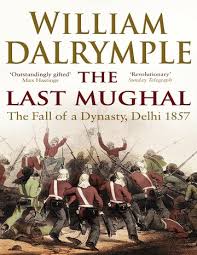
In William Dalrymple’s book The Last Mughal, he cites a decree by Bahadur Shah Zafar stating that cow slaughter would not be allowed on Bakr Eid. Many Muslims had requested permission, but he refused. The very fact that they asked for permission shows that cow slaughter was not common practice, and it was prohibited.
So my objective is this: if we understand our heritage properly, perhaps we can build a better future. The kind of hatred we are suffering from today—hopefully it will remain confined to our generation, and future generations will rediscover their true heritage.
Gaurav Tiwari: For me personally, this book is very hopeful. It shows that there was a long historical period in which the ruling class certainly had its religious preferences, but their influence did not spread widely at the cultural level, nor did it have any universal impact.
Even during the freedom movement, despite the presence of divisions, there were phases when examples of mutual respect and working together emerged.
That is why, for me, this book is inspiring. It demonstrates that today’s conflict and tension are not a permanent historical condition. If we look at the longer arc of history, this is an exceptional phase. And when circumstances return to normal, we will once again move toward the kind of society where mutual respect and peaceful coexistence have been our true identity.
Watch the full video of the conversation here-
Part 1: https://youtu.be/2ey8YirSKWg?si=9LucMDRg4oVkO66h
Part 2: https://youtu.be/vP_0l9pl_Qo?si=mdMJMSmFw4qdtmSy