

Kanal Chilambu: When Poetry Finds Movement in Mohiniyattam

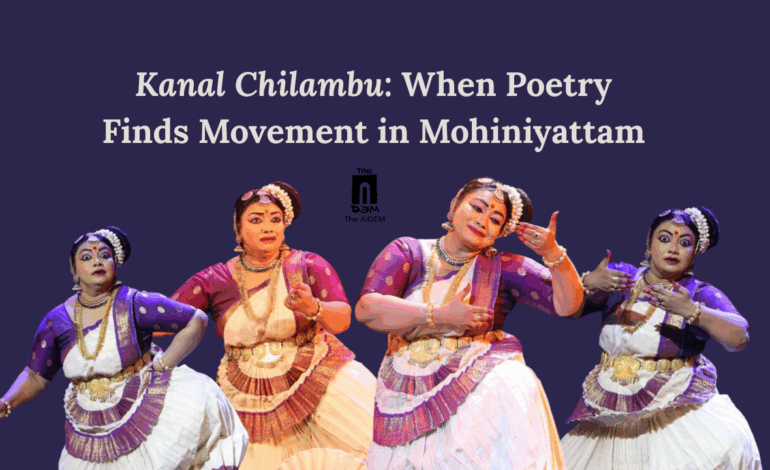
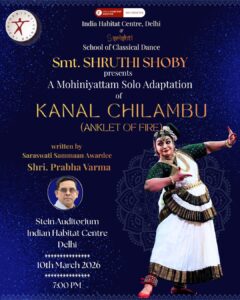
On the evening of 10 March, the Stein Auditorium at the India Habitat Centre witnessed a thoughtful and evocative encounter between literature and classical dance. Senior Mohiniyattam artiste Shruthi Shoby presented Kanal Chilambu (The Anklet of Fire), a solo dance production inspired by the celebrated Malayalam poetic novella of the same name by Prabha Varma, recipient of the Saraswati Samman. The performance sought to translate a monumental poetic work into the visual and emotional language of Mohiniyattam, offering the audience a meditative experience rather than a conventional dance narrative.
Prabha Varma’s Kanal Chilambu is an ambitious literary composition. Running to more than 5,000 verses, the poetic novella explores the interior landscape of a woman navigating love, loss, and the often invisible pressures of patriarchy. Instead of unfolding through dramatic incidents, the text moves through moments of reflection and symbolic revelation, gradually shaping the emotional and philosophical portrait of its unnamed protagonist. The work’s refusal to name its characters gives it a universal quality; the central figure becomes less an individual than a representation of lived experience across time and place.
Translating such a layered literary work into a forty-minute dance production is no small task. Shruthi Shoby approached the challenge with restraint and clarity, focusing not on the poem’s narrative expanse but on its emotional core. The choreography distilled the essence of the text into a sequence of psychological states, allowing the audience to follow the protagonist’s journey from innocence and attachment to grief, endurance, and ultimately a form of inner awakening.
One of the most intriguing motifs in both the poem and the performance is the question posed in the text: Why did the milkmaid laugh when her pot of milk broke? In ordinary terms, the moment suggests loss and disappointment. But in Varma’s poem, it becomes a metaphor for transformation—the instant when suffering yields insight. In Shruthi Shoby’s interpretation, this paradox was rendered through subtle shifts in expression rather than overt dramatics. A slight pause in movement, a controlled modulation of abhinaya, and the quiet stillness that followed conveyed a sense of inner realisation rather than outward despair.
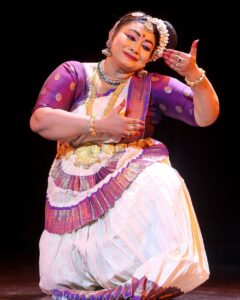
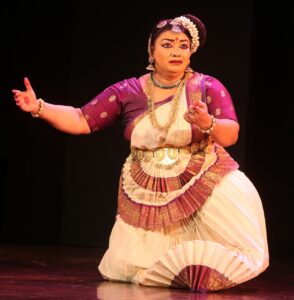
Mohiniyattam, with its graceful curves, soft footwork, and introspective temperament, proved particularly suited to this narrative. The form’s inherent lyricism allowed Shruthi Shoby to explore emotional nuance without resorting to theatrical excess. Her abhinaya was especially compelling in the passages depicting maternal anguish and introspection, where minimal gesture conveyed profound emotional weight.
The choreography, created by Shruthi Shoby in collaboration with Kalamandalam Kavitha Krishnakumar, maintained a careful balance between storytelling and abstraction. Rather than attempting to illustrate every moment from the poem, the production focused on the internal states that define the protagonist’s life. This approach preserved the contemplative spirit of the original text while making it accessible to audiences unfamiliar with the literary work.
The musical score played a crucial role in shaping the atmosphere of the evening. Composed by Vayala Rajendran and Thrissur Krishnakumar, the music supported the choreography with understated elegance. The melodic structure echoed the shifting emotional terrain of the narrative, guiding the audience through moments of tenderness, tension, and reflection without overwhelming the dancer’s presence.
For Shruthi Shoby, the production also reflects a long-standing engagement with women-centred narratives. Over more than twenty-five years in the field of Indian classical dance, she has developed a body of work that often places women’s emotional and spiritual journeys at its centre. Her career includes over 500 stage performances and more than ten choreographed dance-drama productions, many of which explore mythological or historical figures through a contemporary interpretive lens.
Her performances have been featured at major dance festivals across India, including the Konark Dance Festival, Chidambaram Dance Festival, and Nishagandhi Dance Festival, as well as cultural programmes organised by the Government of India. She has also taken her work to international audiences, including a recent appearance at the 12th Tamil Economic Conference Tamil Conference held in Washington, D.C. Beyond performance, she continues to nurture the next generation of dancers as the Founder-Director of the Srishti School of Classical Dance in Chennai.
Yet Kanal Chilambu occupies a distinctive place in her repertoire because of the scale and philosophical depth of the literary source it engages with. The challenge of translating a 5,000-verse poetic narrative into a concise dance form required a careful distillation of ideas. In this respect, Shruthi Shoby’s adaptation demonstrates a clear understanding that the essence of a literary work lies not in reproducing its narrative detail but in capturing its emotional and conceptual resonance.
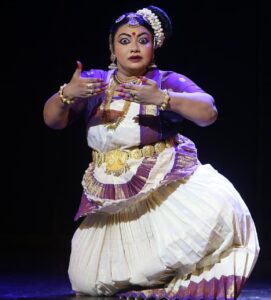
For audiences in Delhi, the evening also carried a sense of novelty. Although the production has been performed elsewhere and has drawn appreciative responses from both seasoned rasikas and newcomers to classical dance, this marked the first time Shruthi Shoby presented the dance-drama adaptation of Kanal Chilambu in the capital. The attentive silence in the auditorium suggested that the performance succeeded in drawing viewers into its contemplative rhythm.
What ultimately lingered after the performance was the central metaphor of the poem itself—the image of the milkmaid laughing when her pot breaks. In that quiet, paradoxical moment lies the philosophical heart of Kanal Chilambu: the idea that loss may also contain the seeds of liberation. Through the language of Mohiniyattam, Shruthi Shoby brought that insight to life on stage, creating an experience that was as reflective as it was aesthetically refined.
Highlights of Kanal Chilambu:









“A beautiful reflection on how poetry and Mohiniyattam come together to create a powerful artistic expression.”