


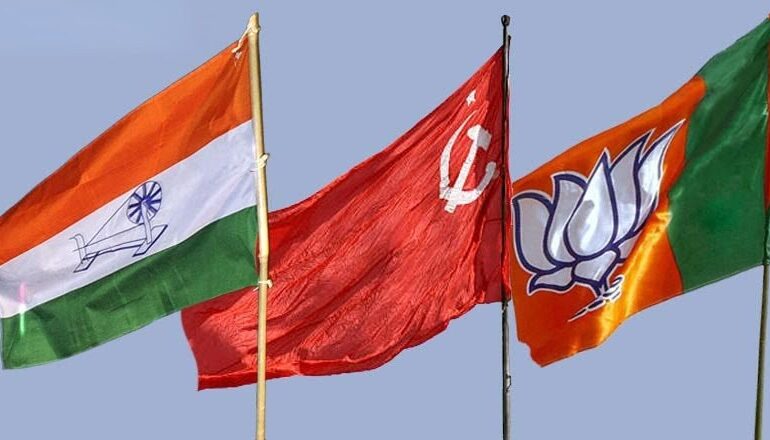
Kerala’s electoral politics, often described as a stable bipolar contest between the Left Democratic Front (LDF) and the United Democratic Front (UDF), is underpinned by distinct ideological formations that have historically structured voter alignments. The LDF draws its strength from a social-democratic and broadly Marxist orientation, rooted in class politics, welfare commitments, and a relatively cohesive organizational base among workers, peasants, and sections of the lower middle class. In contrast, the UDF represents a more heterogeneous coalition, combining centrist liberalism with the support of influential caste and religious groups, particularly through alliances that anchor its social base. While this dual structure has sustained a near-equilibrium in vote shares over decades, recent trends point to a significant shift with the rising presence of the BJP-led NDA. This emergence introduces not merely a third electoral force but a qualitatively different ideological project, grounded in majoritarian nationalism and Hindutva politics. The increasing vote share of the NDA has begun to erode the traditional bases of both fronts, more sharply affecting the UDF, but with visible inroads into sections of the LDF’s support as well. This development raises critical concerns about the fragmentation of Kerala’s historically progressive and plural political fabric, as even marginal shifts in vote share under the FPTP system can produce disproportionately large political consequences.
The Bipolar system and its internal instabilities
A longitudinal analysis of vote shares and seat distributions in the Kerala Legislative Assembly elections from 1980 to 2021 reveals an outwardly stable yet internally complex political structure. At one level, Kerala appears to exemplify a classic bipolar system, with the Left Democratic Front (LDF) and the United Democratic Front (UDF) alternating in power over decades. However, a closer look at vote share patterns, particularly in relation to the emergence of the NDA/BJP, suggests a more nuanced political economy marked by equilibrium, asymmetry, and structural vulnerability. In this context, several fundamental aspects of voting dynamics warrant further discussion.
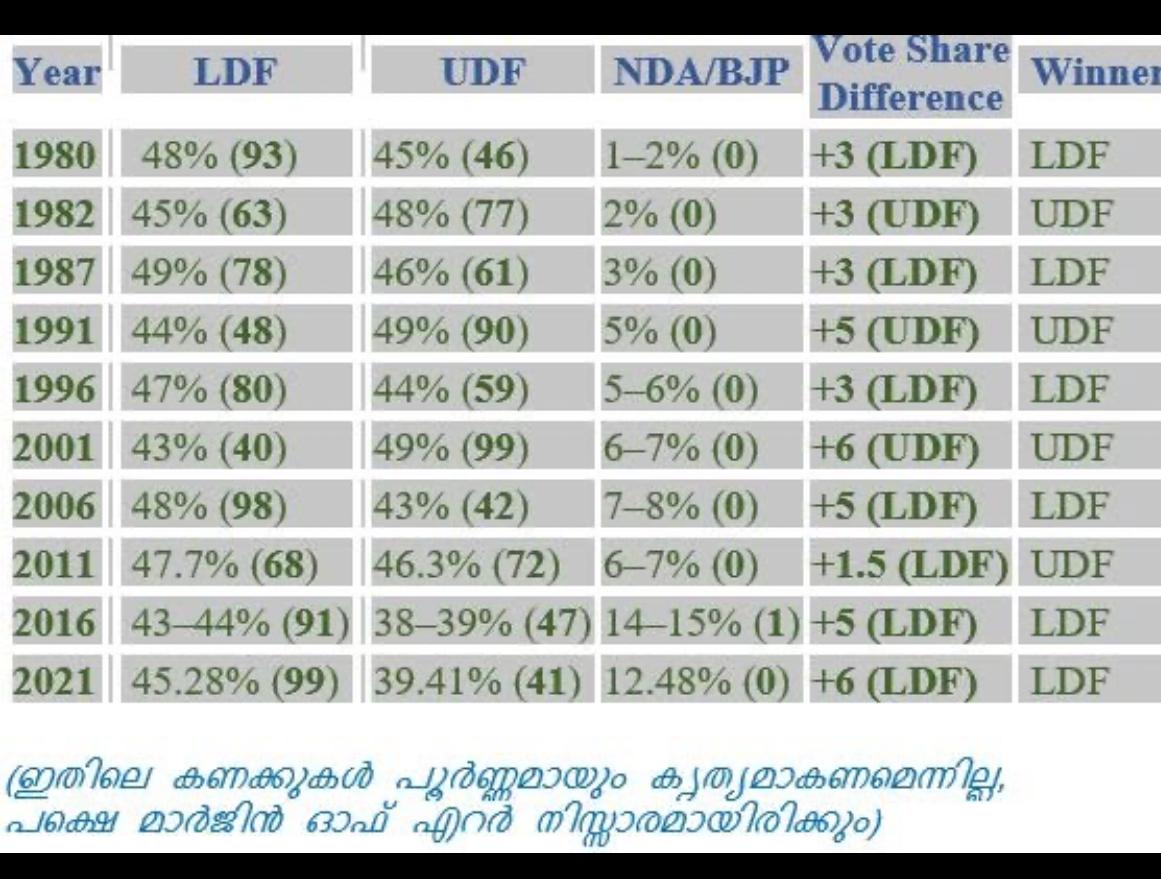
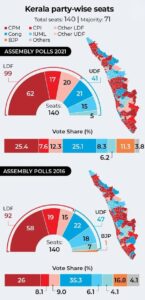
On one hand, Kerala seems to adhere to a classic bipolar system, characterized by the alternating governance of the LDF and the UDF. However, a closer examination of fluctuations in vote shares, specifically the emerging presence of the NDA/BJP, unveils a sophisticated political framework. This system is defined by an outward equilibrium, yet it simultaneously harbours structural vulnerabilities, particularly for the UDF. Perhaps the most striking feature of Kerala’s electoral politics is the remarkable parity in vote shares between the two dominant coalitions. Over the past ten assembly elections, the LDF has maintained an average vote share of 45–46%, while the UDF has followed closely with 44–45%. On the surface, this marginal difference of just 1 to 2 percent suggests a fiercely contested landscape where neither front can claim definitive dominance. However, beneath this equilibrium in vote share lies a significant disproportion in seat distribution. Historical data repeatedly demonstrates that a minor swing of 2–3% in the popular vote can translate into a massive shift of 40 to 60 seats in the legislature. This phenomenon serves as a textbook illustration of the inherent volatility in the ‘First-Past-The-Post’ (FPTP) system—an electoral mechanism where a candidate secures victory simply by polling more votes than any other individual contender, even without achieving an absolute majority ($50\% + 1$).
Despite the overall parity in vote shares, significant differences exist regarding the internal stability of the two fronts. The LDF maintains a relatively resilient electoral base; even during major setbacks, its vote share rarely dips below 43%. Its historical peak was recorded in 1987, reaching approximately 49%. This low variance indicates a disciplined and loyal vote bank rooted in a clear ideological foundation. The stability of the LDF can be attributed to its organizational prowess and historical roots in class-based politics, alongside a consistent commitment to welfare initiatives. Its core support is drawn from the working and lower-middle classes, where the influence of religion or caste remains relatively secondary, notwithstanding the specific communal equations often considered during candidate selection. The intersection of caste within this vote share is primarily a reflection of the socio-economic reality that backward and Dalit communities constitute the fundamental demographic of the labouring and lower-middle classes.
In contrast, the UDF exhibits significantly higher levels of instability. While they achieved a peak vote share of 49% in 1991 and 2001, matching the LDF’s historical highs, their support base is prone to dramatic fluctuations. The most notable instance occurred in the 2016 elections, when the UDF’s vote share plummeted to approximately 38–39%. These sharp variations indicate a diverse yet precarious electoral foundation that relies heavily on a complex coalition of various communal groups and regional allies. Consequently, even minor shifts in voter sentiment can disproportionately destabilize the UDF’s performance.
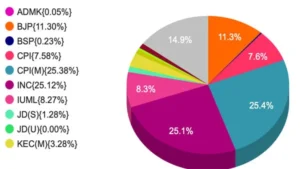
In understanding this electoral disproportion, the role played by the NDA/BJP is pivotal. During the initial phase (1980–2006), the BJP remained a marginal force, with its vote share typically fluctuating between 1% and 8%. However, even during this period, longitudinal data suggests that any marginal increase in their vote share was primarily drawn from the UDF’s social base, specifically from the upper-caste segments, sections of the Christian electorate, and the urban middle class. This trend became more pronounced during the second phase (2006–2021), as the NDA’s vote share rose significantly to the 12–15% range. The 2016 election serves as a critical milestone: when the NDA reached its peak vote share, the UDF’s share plummeted to its lowest point. While the LDF also experienced a marginal decline, their losses were negligible compared to the UDF, enabling them to secure a decisive victory. Even in 2021, when the NDA saw a slight dip in its vote share, the LDF staged a strong comeback while the UDF remained structurally weak.
The Two Historical Phases of the transformation of Bipolarity
To further clarify this evolution, a comparison between the two major phases, 1980–2001 and 2006–2021, is essential. The first phase was characterized by ‘Symmetrical Bipolarity,’ where both fronts operated as equal powers within the same vote-share threshold. During this period, electoral outcomes were primarily determined by anti-incumbency sentiments and the immediate performance of the respective coalitions. However, in the subsequent phase, the rise in the BJP’s vote share disrupted this equilibrium without entirely dismantling the bipolar contest. This shift has resulted in an ‘Asymmetrical Bipolarity.’ In this new framework, the LDF successfully maintains its structural integrity and organizational cohesion, while the UDF increasingly finds itself weakened by the systematic fragmentation of its traditional vote base.
The most critical insight from this analysis is that Kerala’s electoral system continues to operate within a finely balanced equilibrium. While both major fronts maintain a vote share of approximately 45%, even the slightest shifts triggered by the BJP’s intervention result in disproportionate swings in political power. Although the NDA has struggled to convert its popular support into legislative seats, it plays a decisive role in determining the margins of victory. Rather than acting as a front capable of capturing power or winning significant seats independently, they function as a ‘strategic disruptor’—altering the distribution of votes between the primary contenders and thus dictating the final outcome. Furthermore, analysing parliamentary election vote shares is arguably less essential, as those results are primarily influenced by national political climates and do not exert a direct impact on state assembly outcomes. However, a review of Kerala’s Local Self-Government (LSG) elections from 2010 to 2020 reveals a pattern that largely reflects the dynamics of the assembly elections, albeit with subtle regional variations.
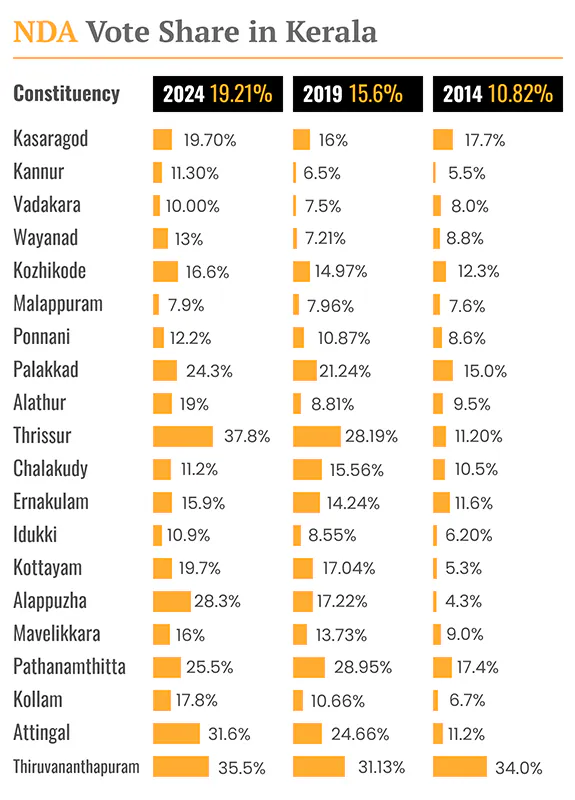
During the initial phase (2010–2015), local body elections in Kerala mirrored the familiar bipolar equilibrium of the state’s politics. During this period, both the LDF and the UDF maintained a vote share of approximately 43–46%, closely aligning with the patterns observed in the Legislative Assembly elections. However, from 2015 onwards—and becoming markedly evident in 2020—the NDA’s vote share surged to nearly 15%, beginning to redefine this traditional balance. While Assembly elections continue to be a neck-and-neck struggle with both fronts hovering around the 45% mark, the Local Self-Government (LSG) elections reveal a decline in these traditional shares (dropping to 38–40%), as a significant portion of the electorate shifts toward the NDA.
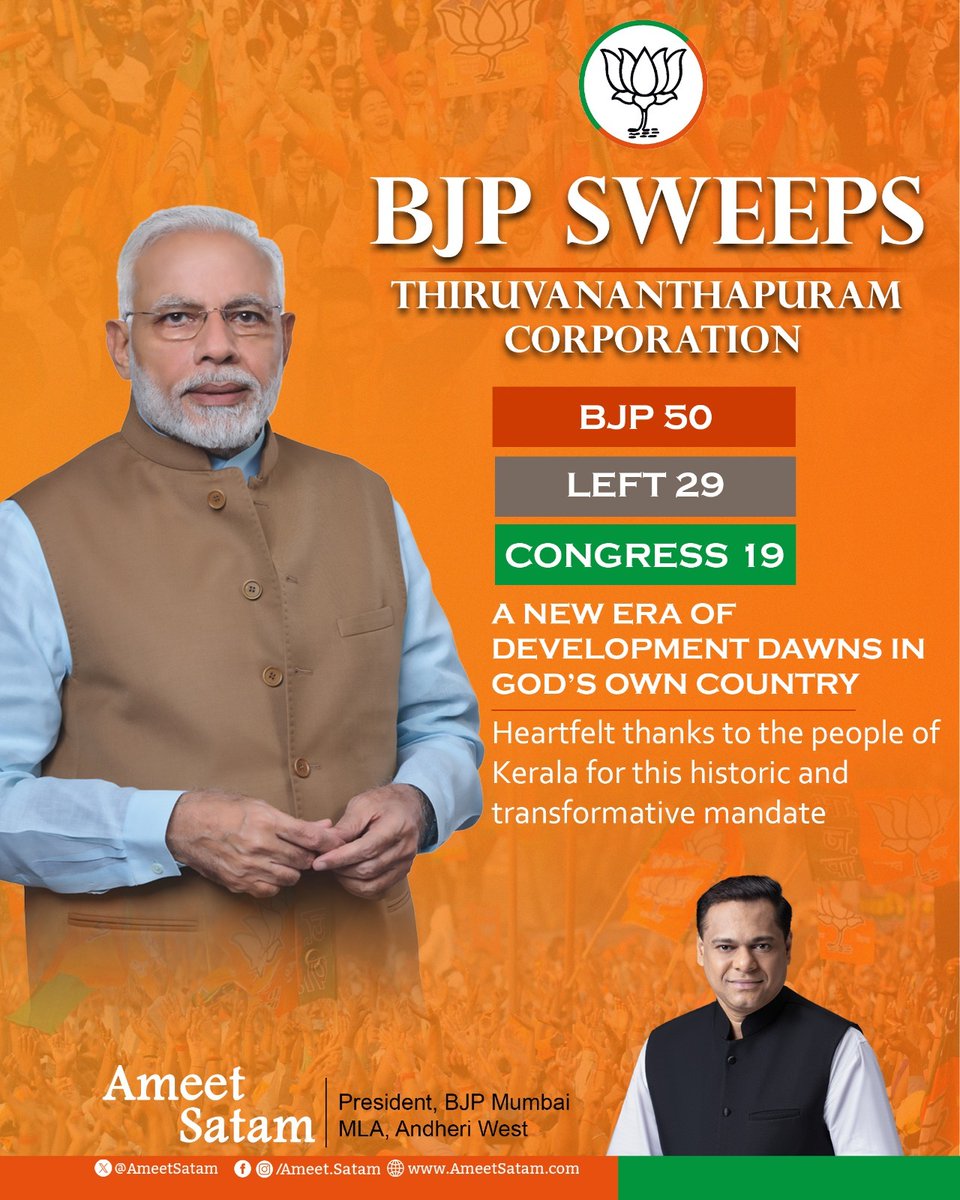
Nonetheless, this shift in voting patterns does not impact both fronts equally. Mirroring the trends observed in the Legislative Assembly elections, the growth of the NDA primarily erodes the UDF’s social base. Conversely, the LDF’s long-standing tradition in local governance and its robust grassroots organizational strength enable it to maintain a stable vote share. It is also noteworthy that local body elections serve as an accurate precursor, reflecting shifts in regional political dynamics well before the Assembly elections occur. This is largely because factors such as the individual charisma of candidates, intricate caste-communal equations, and the tangible performance of local administration exert a direct influence at this level.
The Saffronization of the electorate
Against this backdrop, the 2025 Local Self-Government elections mark a significant departure from previous trends: the LDF’s vote share declined to 33.45%, while the UDF’s share rose to approximately 38.81%. Whether this slump is merely a localized anti-incumbency sentiment or a deeper structural fissure in the LDF’s foundation remains to be seen; a definitive conclusion can only be drawn once the vote shares of the 2026 Legislative Assembly elections are analysed.
The political landscape of Kerala must be understood as a system defined by structural balance, differential stability, and the decisive impact of marginal shifts, rather than a mere cycle of alternating power. The historical parity in vote shares between the two major fronts, contrasted with the massive disproportion in seat distribution, underscores both the competitive nature and the inherent contradictions of Kerala’s electoral process. However, the rising influence of the BJP has begun to assault this equilibrium from both flanks. While the UDF faces the immediate structural crisis, any encroachment into the LDF’s vote share suggests a more profound phenomenon: the vulnerability of the working class and backward/marginalized communities to Saffronization (Hindutvaization) at the grassroots level. If this trend persists, the resulting communal realignment would fundamentally threaten the state’s left-progressive fabric.
While similarities exist, there are still profound differences in the structural influence each of the three fronts exerts on the populace. The UDF and NDA predominantly command influence among upper-caste voters. The presence of the Muslim League remains the vital anchor sustaining the UDF coalition, supplemented by a significant share of upper-caste Christian votes. Conversely, the NDA’s foundation is primarily built upon conservative upper-caste segments, while also attracting a section of conservative, Islamophobic Christian votes. The LDF continues to draw its strength from the working and middle classes, a base that includes a share of left-leaning upper-caste voters as well. The Left Front’s survival is rooted in the enduring relevance of its broad social-democratic project. Despite some electoral overlaps, the fundamental class character of these fronts has not undergone a radical shift. While some votes have leaked from the LDF to the BJP, a portion of the middle-class vote has migrated from the UDF to the LDF, which accounts for the LDF’s sustained edge in total vote share.
Global Left and the project of social democracy
Furthermore, if a UDF wave were to materialize in the current Assembly elections, what would be the actual implication? In reality, not much would fundamentally change. The only critical metric to observe is whether the UDF’s vote share increases while the NDA’s vote share remains stagnant. The primary focus should be on whether the LDF’s vote share experiences a significant decline. If their share remains within the 35–40% range, it signifies that the LDF’s core working-class support remains intact and that their broader social-democratic project has not been rejected by the masses. This logic applies whether the LDF secures a victory or the UDF achieves a mere numerical majority. In either scenario, Leftist politics, as the Kerala manifestation of the global Leftist project, will retain its historical and structural relevance. The liberal logic that equates electoral defeat with ideological failure is irrelevant here; if that were the case, even smaller revolutionary Left groups would have been deemed obsolete long ago. Kerala’s political landscape is best understood not simply as a case of alternating governments, but as a system defined by structural balance, differential stability, and the decisive impact of marginal shifts. The persistence of near-equal vote shares alongside sharply unequal seat outcomes underscores both the competitiveness and the inherent distortions of the electoral process.
The contemporary moment reveals a deep and widespread crisis confronting Left movements across the world. Once anchored in class-based mobilization and ideological clarity, many Left formations now face erosion of their traditional social bases under the pressures of neoliberal restructuring, precarity, and the fragmentation of labour. The rise of right-wing populism and majoritarian nationalism has further displaced class politics with identity-driven mobilizations, often drawing sections of the working classes into conservative ideological frameworks. In this context, even historically influential communist parties have struggled to retain relevance. The South African Communist Party, for instance, remains formally committed to socialist transformation but operates within a compromised alliance structure that limits its independent political agency. Similar patterns of accommodation, electoral marginalization, or ideological dilution are visible elsewhere. The challenge before the Left, therefore, is not merely electoral recovery but the rearticulation of a credible, contemporary project that can reconnect class, democracy, and social justice in rapidly changing socio-political conditions.








“This article offers a sharp insight into Kerala’s unique electoral dynamics and highlights how the social-democratic framework continues to shape its political stability.”